
Quick Answer
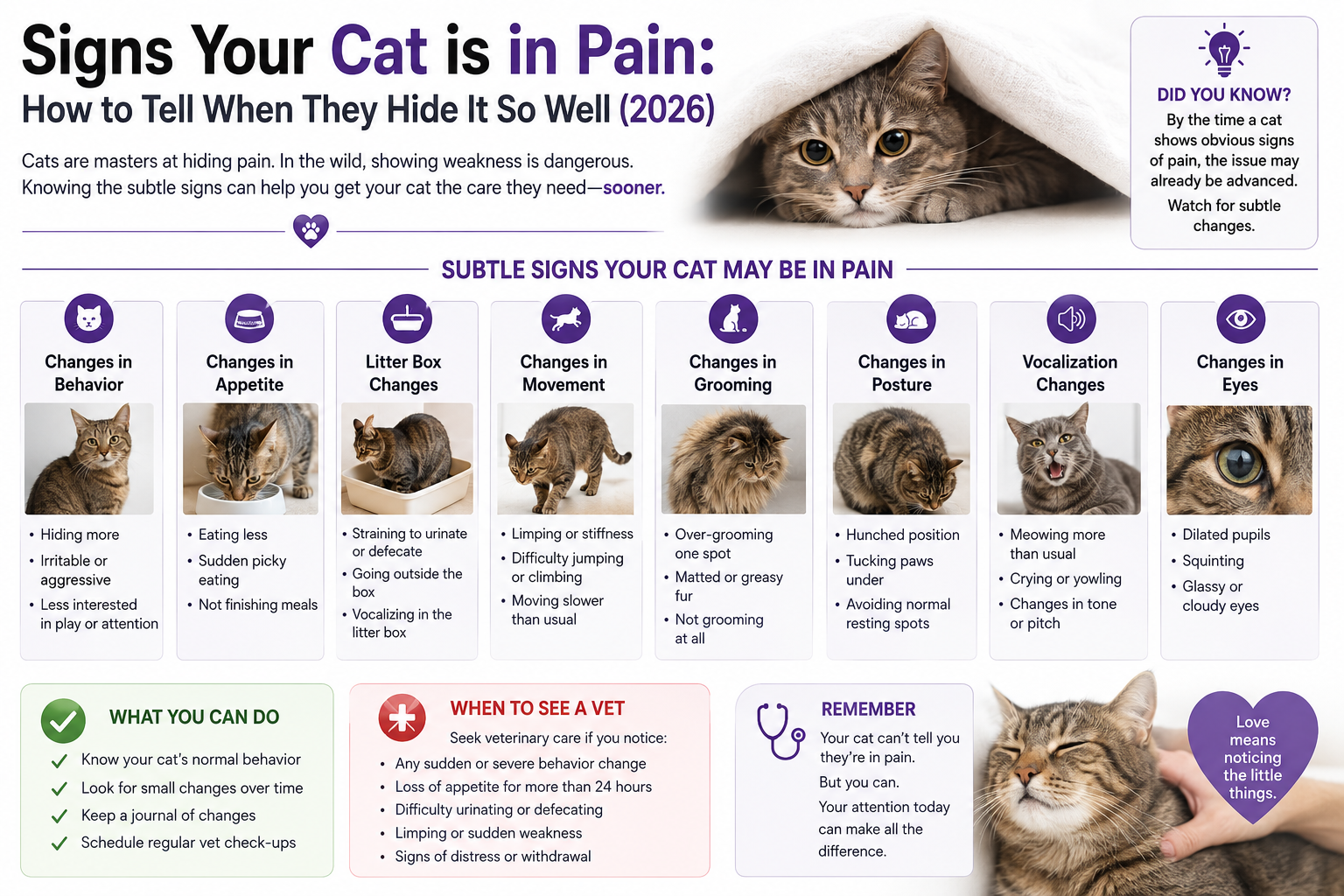
Cats conceal pain as a survival instinct, so the signs are behavioural rather than dramatic. Watch for a cat that hides, stops jumping, grooms less (or grooms one spot obsessively), sits hunched with paws tucked, or has simply become quieter. Purring does not mean a cat is comfortable cats also purr to self-soothe when distressed. And the single most important safety rule: never give a cat human painkillers. Paracetamol is fatal to cats even in small doses.
Key Takeaways
- Cats mask pain because showing weakness attracts predators silence is not comfort.
- Behaviour change is the main signal, not vocalising or limping.
- The Feline Grimace Scale gives you five facial features to check at home.
- Reduced jumping is the earliest and most reliable sign of feline arthritis.
- Purring can indicate pain, not just contentment.
- Paracetamol, ibuprofen, and aspirin are all dangerous or fatal for cats.
Why Cats Hide Pain
Cats occupy an unusual ecological position: they are both predator and prey. In the wild, an animal that visibly limps or cries advertises vulnerability. Concealing weakness is therefore hard-wired, and it does not switch off just because a cat lives on your sofa.
This has two consequences that matter enormously.
First, the absence of obvious signs proves nothing. Cats with painful dental disease keep eating. Cats with significant arthritis keep moving. Cats with chronic conditions purr and sit on laps.
Second, by the time a cat looks unwell, it usually has been for a while. This is why owners so often say afterwards that they noticed something small weeks earlier and dismissed it.
The Feline Grimace Scale: Five Things on the Face
Veterinary researchers developed a validated tool for assessing acute pain in cats by scoring facial features. It is used clinically, and the core observations are entirely usable at home. Compare against photographs of your cat when you know they were comfortable.
| Feature | Comfortable cat | Cat in pain |
| Ear position | Forward, upright, relaxed | Rotated outward and flattened apart |
| Eyes (orbital tightening) | Open, relaxed, round | Squinted, narrowed, tense around the socket |
| Muzzle tension | Rounded, soft | Flattened, tense, elliptical |
| Whiskers | Relaxed, gently curved, fanned | Straightened, pushed forward, bunched together |
| Head position | Above shoulder line, alert | Level with or below the shoulders |
No single feature is conclusive. It is the combination, and more importantly the change from your cat’s own normal face, that carries the information. Take a few reference photos while your cat is relaxed that baseline is genuinely useful later.
Behavioural Signs Owners Miss
Movement and posture
- Reduced jumping hesitating before a leap, choosing a lower surface, or using furniture as a staircase. This is the earliest sign of arthritis in most cats.
- Taking stairs one at a time, or with an unusual bunny-hop.
- Hunched posture with paws tucked underneath, back rounded, eyes half-closed — the classic “meatloaf of misery.”
- Sleeping in new, lower locations because previous favourites are no longer reachable.
- Reluctance to be picked up, or tensing when handled.
- Stiffness after resting, easing after a few minutes of movement.
Grooming changes
Grooming is one of the most informative behaviours a cat has.
- Reduced grooming overall a dull, greasy, or matted coat, particularly over the back and hindquarters, where reaching requires flexibility.
- Overgrooming one specific area cats lick over pain. Persistent licking of the lower belly can indicate bladder inflammation; over a hip or shoulder, joint pain. This can produce bald patches, covered in our guide to patchy hair loss.
- Missed spots where the cat can no longer reach comfortably.
Litter tray changes
Often the first thing owners actually notice, and frequently misread as behavioural.
- Urinating or defecating just outside the tray a high-sided tray may be painful to climb into
- Straining, vocalising, or repeated visits in a male cat, straining with no urine produced is a life-threatening emergency
- Constipation, which is painful and common in arthritic and dehydrated cats
Eating and drinking
- Eating more slowly, or chewing on one side
- Dropping food, drooling, or turning away from the bowl after approaching it
- Reduced appetite always significant in cats. See why is my cat not eating
- Preferring wet food suddenly, which points to dental pain
Temperament and interaction
- Hiding in unusual places
- Reduced interaction, or the opposite new clinginess
- Aggression when touched in a particular area, or a previously placid cat becoming irritable
- Reduced play and less interest in things that used to engage them
- Increased sleeping, covered in why is my cat sleeping so much
Vocalisation
- Growling, hissing, or yowling when handled
- Unusual night-time vocalising, particularly in older cats
- Purring in a tense, hunched cat. Cats purr to self-soothe under stress and pain as well as in contentment a purring cat that also has flattened ears and squinted eyes is not telling you they are fine.
- Sometimes silence a normally chatty cat going quiet.
Common Sources of Pain in Cats
| Condition | How it usually presents |
| Osteoarthritis | Found on X-ray in the large majority of cats over 12, yet rarely diagnosed. Reduced jumping, stiffness, unkempt coat |
| Dental disease | Tooth resorption and stomatitis are both common and genuinely painful. Drooling, chewing on one side, bad breath |
| Feline idiopathic cystitis (FIC) | Straining, frequent visits, blood in urine, licking the belly. Stress-linked |
| Urinary blockage | Emergency, mostly male cats. Straining with nothing produced, crying, vomiting |
| Constipation | Straining, hard dry faeces, reduced appetite |
| Pancreatitis | Often subtle lethargy and appetite loss rather than dramatic vomiting |
| Wounds and abscesses | Cat bites abscess readily. Swelling, heat, limping, fever |
| Cancer | Variable; weight loss, appetite change, behaviour change |
| Ear infection | Head shaking, scratching, head tilt, resenting head touch |
What You Must Not Do
Never give human pain medication to a cat. This is the single most important line in this article.
- Paracetamol / acetaminophen fatal to cats, even in small doses. Cats lack the liver enzyme needed to process it. There is no safe amount.
- Ibuprofen and other human NSAIDs cause stomach ulceration and kidney failure.
- Aspirin cats metabolise it extremely slowly; only ever under direct veterinary dosing.
- Any medication prescribed for a dog, or for another cat, or left over from a previous course.
Also avoid essential oils, herbal remedies, and CBD products without veterinary guidance cats lack certain liver enzymes needed to metabolise many plant compounds. Our toxic substances guide covers this further.
The good news: effective, cat-specific pain management exists. Licensed feline NSAIDs, newer monoclonal antibody treatments for osteoarthritis pain, joint supplements, and environmental adaptation all work well. There is no reason for a cat to live in pain but it has to be prescribed by a vet.
Helping a Cat in Pain at Home
Alongside veterinary treatment, environment matters more for cats than for most species.
- Litter trays: low-sided, large, and one per cat plus one spare. Place them on every floor so nothing requires stairs.
- Steps or ramps to favourite sofas and window perches.
- Soft, warm, easily accessible beds, away from draughts and off cold floors.
- Raise food and water bowls slightly to reduce neck strain, and use wide, shallow dishes.
- Keep everything on one level if mobility is poor.
- Groom gently to help with spots your cat can no longer reach.
- Keep nails trimmed inactive cats do not wear them down and they can grow into the pad.
- Maintain a healthy weight. Weight reduction produces measurable improvement in arthritic cats.
- Keep routine predictable. Stress amplifies pain perception, and it is a documented trigger for cystitis flare-ups.
When to Call the Vet
Emergency now:
- Straining in the litter tray with no urine, especially a male cat
- Crying out, or extreme distress
- Collapse, difficulty walking, or dragging the back legs
- Open-mouth or laboured breathing
- A wound, abscess, or suspected trauma
- Pale, white, or blue gums
Same day:
- Not eating for 24 hours
- Sudden aggression when touched
- New hiding behaviour with a hunched posture
- Repeated vomiting ] see why is my cat vomiting
- Litter tray accidents that are new
Book an appointment:
- Reduced jumping or new hesitation before leaping
- Coat looking unkempt
- Gradual withdrawal or reduced play
- Slower eating, or drooling
- Any persistent change from your cat’s normal
Frequently Asked Questions
Do cats purr when in pain? Yes. Purring is a self-soothing behaviour as well as a contented one. A purring cat with flattened ears, squinted eyes, and a hunched posture is not comfortable.
Do cats cry when in pain? Rarely. Most cats in chronic pain go quiet and withdraw rather than vocalising. Loud crying usually indicates acute, severe pain.
What can I give my cat for pain at home? Nothing from your medicine cabinet. Human painkillers, particularly paracetamol, are toxic and often fatal to cats. Call your vet for a licensed feline medication.
How do I know if my cat has arthritis? Watch for reduced jumping, hesitating before leaping, choosing lower surfaces, stiffness after rest, and an unkempt coat over the back. It is common in older cats and very treatable.
Is my cat hiding because of pain? Hiding is one of the most reliable signs of illness or pain in cats. A cat that starts sleeping in unusual, enclosed, or low places deserves a check-up.
Can cats be in pain without showing it? Yes, and this is the central problem. Concealing weakness is instinctive, so absence of obvious signs does not mean absence of pain.
What is the Feline Grimace Scale? A validated tool that scores five facial features — ears, eye tightening, muzzle tension, whisker position, and head position — to assess acute pain. The observations are usable at home for comparison against your cat’s normal.
My cat still eats — surely it can’t be in pain? Unfortunately not. Cats with significant dental disease routinely keep eating. Appetite is a poor indicator of comfort in this species.
Final Thoughts
The hardest part of caring for a cat is that they are built not to tell you. There is no equivalent of a dog’s limp or whimper just a shelf that stops being used, a coat that loses its shine, and a cat that has quietly become a little less itself.
That is why baselines matter so much. Take reference photos of your cat’s relaxed face. Notice which surfaces they jump to. Pay attention to grooming. And when something drifts, treat the drift as the message, because in cats it usually is. Pain in cats is highly treatable the difficult part has always been noticing it.
Related Reading
- Why Is My Cat Sleeping So Much?
- Cat Losing Hair in Patches
- Why Is My Cat Not Eating?
- Why Is My Cat Vomiting?
- Emergency Alert: 10 Human Foods That Are Toxic to Cats
A Note on Pet Health
Serlig publishes researched pet care information for everyday owners. It is general guidance, not veterinary advice, and it does not replace an examination by a licensed veterinarian who knows your pet. If your pet is unwell, or anything in this guide does not match what you are seeing at home, contact your vet.
About the Author
The Serlig Pet Care Team creates researched, plain-language pet care guides for everyday owners. Our content is written from hands-on pet-care experience and cross-checked against established veterinary sources so you can make confident decisions for your cat.




6 Comments