Quick Answer
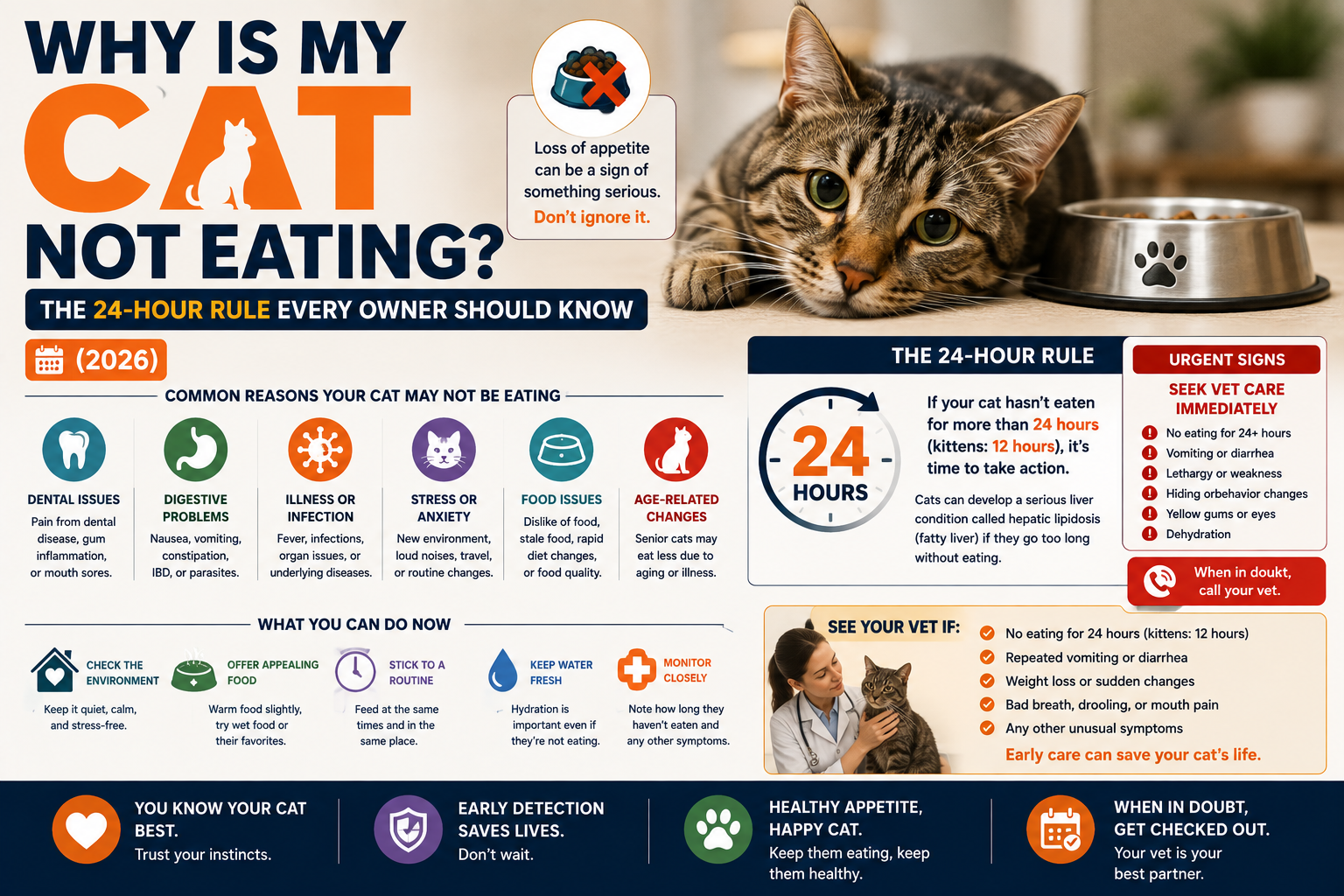
Appetite loss is more urgent in cats than in dogs, and the reason is the liver. When a cat stops eating, the body mobilises fat stores faster than the liver can process them, and fat accumulates in liver cells a condition called hepatic lipidosis, or fatty liver disease. It can develop within two to three days, and overweight cats are at highest risk. The working rule: if your cat has not eaten in 24 hours, call your vet. If they are also vomiting, hiding, or lethargic, call sooner.
Key Takeaways
- Cats cannot safely fast the way dogs can 24 hours is the action threshold.
- Hepatic lipidosis can develop in 2–3 days, and overweight cats are most vulnerable.
- Dental pain and nasal congestion are two very common, easily missed causes.
- Cats hide illness instinctively behaviour change often precedes any visible sign.
- Never force-feed; it risks aspiration and creates lasting food aversion.
- Never give human painkillers paracetamol is fatal to cats even in small doses.
Why Cats Are Different
Dogs are opportunistic omnivores that evolved around feast-and-famine cycles and tolerate a missed meal easily. Cats evolved as solitary hunters eating many small prey meals per day. Their metabolism assumes a near-constant protein supply and never developed an efficient fasting mode.
When food stops, the body sends fat to the liver for energy. The feline liver processes it slowly, so fat builds up inside the liver cells and impairs function. The result is a vicious circle: the cat feels increasingly nauseous, so eats even less, so more fat mobilises.
Overweight cats are at highest risk, because they have more fat to mobilise. This is one of the few situations where being a chunky cat is actively dangerous in the short term.
Treated early, hepatic lipidosis has a good prognosis but treatment often requires a feeding tube and several weeks of intensive support. Preventing it by acting at 24 hours is vastly easier than treating it.
The Common Causes
Dental and oral pain
Extremely common and frequently missed. Tooth resorption affects a large proportion of adult cats and is genuinely painful. Stomatitis, a severe inflammation of the mouth, is intensely so.
Look for: approaching the bowl then backing away, dropping food, chewing on one side, drooling, pawing at the mouth, bad breath, or a preference for wet over dry food.
Nasal congestion
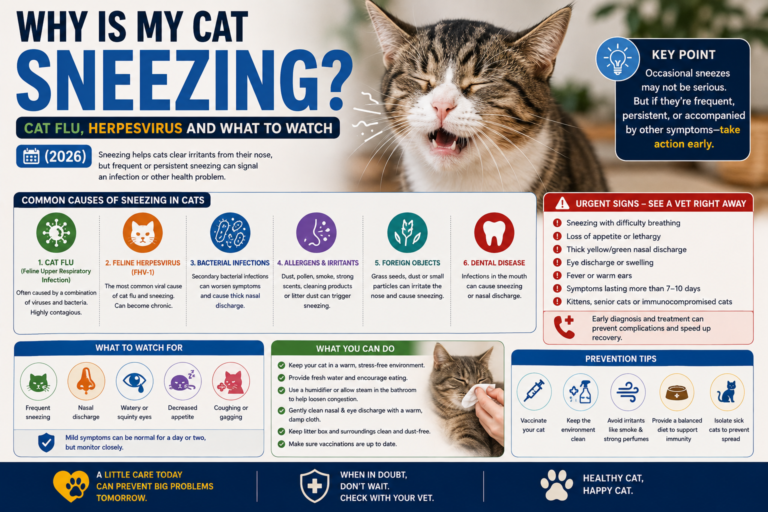
Cats need to smell their food to want it. A cat with an upper respiratory infection often stops eating simply because dinner no longer registers. If sneezing or eye discharge is present, read why is my cat sneezing and treat the combination of sneezing plus appetite loss as urgent.
Nausea and gastrointestinal disease
Inflammatory bowel disease, intestinal parasites, hairballs, food intolerance, and gastritis all suppress appetite. Look for vomiting, drooling, lip licking, and repeated swallowing. Our guide on vomiting in cats covers the diagnostic picture.
Chronic kidney disease
One of the most common conditions in older cats. Toxin build-up causes nausea and mouth ulcers, so appetite falls while thirst rises.
Look for: increased drinking and urination, weight loss, a dull coat, vomiting, and bad breath. Early detection genuinely changes the trajectory blood and urine tests are worth doing rather than waiting.
Hyperthyroidism
Typically causes increased appetite with weight loss, but appetite can fall in advanced cases or where another condition coexists. Watch for weight loss, restlessness, increased vocalisation, and a poor coat in a cat over ten.
Pancreatitis
Common in cats and often subtle. Usually presents as lethargy and appetite loss rather than the dramatic vomiting seen in dogs. Needs veterinary diagnosis.
Foreign body especially string
A specifically feline emergency. Cats swallow thread, tinsel, hair ties, and ribbon. A linear foreign body anchors at the base of the tongue or in the stomach while the rest travels on, bunching the intestine and cutting into it.
Never pull on anything you see hanging from the mouth or anus. Go straight to a vet. Signs include repeated vomiting, refusing food, abdominal pain, and lethargy.
Diabetes
Increased thirst and urination with weight loss. Appetite is usually raised early on but drops if the cat becomes ketoacidotic a serious emergency requiring immediate care.
Stress and change
Cats are strongly routine-driven. Moving house, a new pet or baby, building work, a new sofa, a change of litter, or a bereavement can all suppress appetite. So can something as small as moving the food bowl next to the washing machine.
Food aversion and bowl problems
- Whisker fatigue deep, narrow bowls press on whiskers and put many cats off. Wide, shallow dishes solve this.
- Bowl location beside the litter tray, near a noisy appliance, or in a busy corridor.
- Multi-cat tension a subordinate cat may be quietly blocked from the bowl.
- Stale food cats detect rancid fats before we do. Check the date and how long the bag has been open.
- Recent food change sudden switches often fail; transition over 7–10 days.
Medications and vaccination
Antibiotics, pain medication, and some treatments reduce appetite. Mild reduction for 24 hours after vaccination is normal.
The Timeline: When to Act
| Cat | Contact your vet after |
| Healthy adult cat, otherwise bright | 24 hours |
| Overweight adult cat | 24 hours do not extend |
| Kitten | 12 hours |
| Senior cat | 12–24 hours |
| Diabetic cat on insulin | Immediately |
| Any cat vomiting, hiding, or lethargic | Immediately |
| Pregnant or nursing cat | Immediately |
Go now, regardless of timing, if there is: repeated vomiting or unproductive retching, string visible at the mouth or anus, laboured or open-mouth breathing, collapse or extreme weakness, jaundice (yellow gums, eyes, or ear tips), a painful or swollen abdomen, straining in the litter tray with nothing produced especially in a male cat, which may indicate a urinary blockage, a life-threatening emergency.
Reading a Cat That Hides Illness
Cats evolved as both predator and prey, and concealing weakness is instinctive. By the time a cat looks obviously unwell, it has usually been unwell for a while. Watch for the quieter signals:
- Sitting hunched with paws tucked and eyes half closed
- Hiding under beds or in wardrobes, unusually
- Reduced grooming a coat that looks unkempt or greasy
- Increased grooming of one specific area
- Sleeping in a new, isolated spot
- Reduced interaction, or unusual clinginess
- Sitting near the water bowl without drinking
- Reluctance to jump onto familiar surfaces
Tempting a Cat to Eat (First 24 Hours Only)
Reasonable while you arrange veterinary advice, and only if your cat is bright with no red-flag signs.
- Warm the food to just below body temperature. Aroma drives feline appetite more than flavour.
- Offer strong-smelling wet food fish or liver varieties are usually the most tempting.
- Try plain cooked chicken, shredded small.
- Use a wide, shallow dish to avoid whisker contact.
- Move the bowl somewhere quiet, away from the litter tray and other pets.
- Hand-feed a few pieces this distinguishes “cannot” from “will not.”
- Offer a smear on the paw; grooming instinct sometimes restarts eating.
- Stroke and reassure stress suppresses appetite significantly.
Do not:
- Force-feed it risks aspiration and can create a lasting aversion to that food
- Offer cow’s milk most adult cats are lactose intolerant and it causes diarrhoea
- Offer dog food it lacks taurine and other feline essentials
- Give any human medication, especially paracetamol, ibuprofen, or aspirin, all of which are toxic to cats. See our toxic substances guide
- Wait beyond 24 hours hoping it resolves
Frequently Asked Questions
How long can a cat go without eating? Not long safely. Serious liver changes can begin within two to three days, so 24 hours without food is the point to seek veterinary advice.
What is hepatic lipidosis? Fatty liver disease. When a cat stops eating, fat floods the liver faster than it can be processed, impairing function. It is more likely in overweight cats and needs prompt treatment.
My cat won’t eat but is drinking water is that better? It is better for hydration, but it does not remove the liver risk. It also raises the possibility of kidney disease or diabetes, both of which increase thirst.
Should I force-feed my cat? No. Force-feeding risks aspiration pneumonia and often creates a permanent aversion to that food. If your cat will not eat, that is a veterinary matter.
Why has my cat suddenly become fussy? Sudden fussiness in a previously good eater is usually medical, not behavioural dental pain and nausea are common causes. Treat a genuine change as a symptom.
Can stress stop a cat eating? Yes, and cats are more routine-sensitive than dogs. Even small changes such as a moved bowl or a new litter can do it. The 24-hour rule still applies.
My cat eats treats but not food what does that mean? Often it points to a mouth problem, since treats are usually softer or more strongly scented, or to food aversion. Mention it to your vet, as it is a useful clue.
Is it normal for a cat to skip one meal? An occasional skipped meal in a bright, playful cat is not alarming. What matters is the total time without food and whether anything else has changed.
Final Thoughts
If you take one thing from this article, take the timeline. Cats are not small dogs, and the advice to “wait and see for a couple of days” that works reasonably well for a dog can put a cat in real danger.
Most cases turn out to be something manageable a sore tooth, a blocked nose, a stressful week. But the cost of checking early is a consultation fee, while the cost of waiting can be weeks of intensive treatment for a liver that shut down over a long weekend. Warm the food, try the tempting tricks, and start counting the hours from the last proper meal. At twenty-four, make the call.
Related Reading
- Why Is My Cat Sneezing?
- Why Is My Cat Vomiting?
- Can Cats Eat Chicken?
- Can Cats Drink Milk?
- Emergency Alert: 10 Human Foods That Are Toxic to Cats
A Note on Pet Health
Serlig publishes researched pet care information for everyday owners. It is general guidance, not veterinary advice, and it does not replace an examination by a licensed veterinarian who knows your pet. If your pet is unwell, or anything in this guide does not match what you are seeing at home, contact your vet.
About the Author
The Serlig Pet Care Team creates researched, plain-language pet care guides for everyday owners. Our content is written from hands-on pet-care experience and cross-checked against established veterinary sources so you can make confident decisions for your cat.