
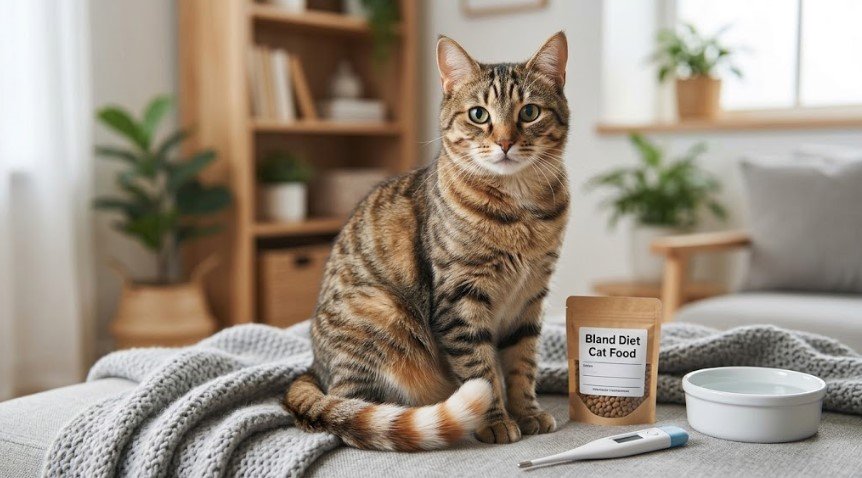
Cat diarrhea most often comes from a sudden food change, stress, parasites or something eaten that disagreed. Most mild cases in an otherwise well adult cat settle within 24 to 48 hours. Call a vet sooner if there is blood, repeated vomiting, lethargy, or if your cat stops eating, and call immediately for a kitten, a senior cat or a cat with an existing condition. Never fast a cat and never give human diarrhoea medication, both of which are dangerous despite being standard advice for dogs.
When to Call the Vet
This is the part most people came for, so it goes first.
| Situation | What to do |
| Mild diarrhoea, cat otherwise bright, eating and drinking normally | Monitor at home for 24 to 48 hours |
| Diarrhoea lasting more than 48 hours | Call your vet |
| Any diarrhoea in a kitten | Call your vet the same day |
| Senior cat, or any cat with a known chronic condition | Call your vet promptly, do not wait 48 hours |
| Fresh red blood in the stool | Call your vet |
| Black, tarry stool | Call your vet. This suggests digested blood from higher up |
| Repeated vomiting alongside the diarrhoea | Call your vet |
| Your cat has stopped eating | Call your vet. See the fasting section below |
| Lethargy, hiding, weakness or collapse | Same day, urgently |
| Possible poisoning or a swallowed object | Emergency, immediately |
| Straining repeatedly with little produced | Call your vet, and mention it clearly |
| Diarrhoea returning again and again over weeks | Call your vet. This is chronic and needs investigation |
Cats conceal illness extremely well, so a quiet cat is not necessarily a comfortable one. Our guide to recognising pain in cats covers the subtler signals.
Do Not Fast Your Cat
This is the single most important thing on this page, and it is where dog advice transfers dangerously.
Withholding food for 12 or 24 hours is a long standing home remedy for canine digestive upset. For dogs it is usually harmless. For cats it is not.
Cats that stop eating, for any reason, can develop hepatic lipidosis, a serious liver condition in which fat accumulates in the liver cells. It can begin after a surprisingly short period without food, and overweight cats are at the highest risk.
So the instruction reverses entirely. With a dog you may be told to rest the gut. With a cat, keeping them eating is part of the treatment.
What this means in practice
- Do not withhold food from a cat with diarrhoea unless a vet has specifically told you to
- If your cat is refusing food, that is a reason to call the vet rather than a reason to wait
- A cat that has eaten nothing for 24 hours needs veterinary attention, regardless of how the diarrhoea itself is behaving
- Palatability matters more than blandness. A food your cat will actually eat beats the theoretically ideal food it refuses
Our guide to changes in a cat’s appetite covers when refusal signals something more serious.
Never Give Human Diarrhoea Medication
Every source says this. Almost none explain why, and the reason is worth knowing because it applies to more than one drug.
Bismuth subsalicylate, the active ingredient in Pepto Bismol, is a salicylate, chemically related to aspirin. Cats process salicylates very poorly because they are deficient in an enzyme pathway that other mammals use to clear them. The result is that a dose which would be trivial in a person can accumulate to toxic levels in a cat.
Loperamide, the active ingredient in Imodium, can cause significant central nervous system effects in cats, including sedation and, at higher doses, more serious signs.
Kaolin and pectin products and various other over the counter remedies are similarly unsuitable.
There is a second problem that applies to all of them. Stopping diarrhoea is not the same as treating it. Diarrhoea is partly a mechanism for clearing something harmful out of the gut. Suppressing it while an infection, a parasite or a toxin is still present can make the underlying problem worse while making your cat look better.
Do not give any medication, including anything you have at home for yourself or for a dog, without veterinary instruction.
Small Bowel or Large Bowel?
This distinction is standard in veterinary practice and almost never explained to owners, which is a shame because a cat owner is far better placed to observe it than a vet is.
Large bowel pattern
- Frequent trips to the tray, small amounts each time
- Obvious straining
- Mucus or jelly like material in the stool
- Fresh red blood
- A sense of urgency, with accidents outside the tray
Small bowel pattern
- Larger volumes, more watery
- Less straining
- Normal frequency or only slightly increased
- Weight loss over time
- No mucus or fresh blood
Why this helps. The two patterns point toward different parts of the gut and therefore toward different causes and different tests. Describing which pattern you are seeing gives your vet genuinely useful information before any test is run.
You do not need to be certain. Saying “many small amounts with straining and some jelly” or “large watery volumes, no straining” is more useful than “diarrhoea.”
What to Observe and Report
Take a note, or a photograph, before you clean up.
- Frequency. How many times in the last 24 hours
- Volume. Large amounts or small repeated ones
- Consistency. Soft and formed, porridge like, or entirely liquid
- Colour. See below
- Blood. Fresh red streaks, or black and tarry
- Mucus. Clear jelly like coating
- Straining or urgency
- Other signs. Vomiting, appetite, energy, drinking, hiding
- Recent changes. New food, new treats, a house move, a new pet, access outdoors, anything eaten that should not have been
- Worming and vaccination dates
What the colour suggests
| Colour | Possible meaning |
| Brown and soft | Usually mild, non specific upset |
| Yellow or orange | Can indicate rapid transit, or liver or bile involvement |
| Green | Often rapid transit, sometimes bile or plant material |
| Grey and greasy | Can suggest fat is not being digested properly |
| Black and tarry | Digested blood from the stomach or small intestine. Call your vet |
| Fresh red streaks | Bleeding lower down, in the colon or rectum |
| Very pale or white specks | Possible parasites. Take a sample |
Colour is a clue rather than a diagnosis, but black tarry stool and fresh blood both justify a call on their own.
Common Causes of Acute Diarrhoea
Most cases of cat diarrhea trace back to something on this list.
- A sudden food change. The most common cause by a wide margin. New food should be introduced over seven to ten days rather than swapped overnight
- Treats, table scraps or something scavenged
- Dairy. Most adult cats are lactose intolerant, so milk and cream are a frequent cause. Our guide to milk and cats explains why
- Stress. A house move, building work, a new pet, boarding or a change in routine
- Intestinal parasites. Roundworms, giardia and others, particularly in kittens and outdoor cats
- Bacterial or viral infection
- Hairballs and indigestible material
- Medication side effects, especially antibiotics
- Toxins or plants
Chronic Diarrhoea Is a Different Problem
If diarrhoea has continued for more than about three weeks, or keeps returning, it is not the same situation and home care is not the answer.
Causes commonly investigated include:
- Food allergy or intolerance
- Inflammatory bowel disease
- Hyperthyroidism, which is common in older cats
- Exocrine pancreatic insufficiency
- Chronic parasitic infection, including giardia and Tritrichomonas
- Intestinal lymphoma
- Kidney or liver disease
Chronic diarrhoea is frequently multifactorial, which is why it can need more than one treatment and why a single diet trial sometimes produces partial improvement rather than a fix. It needs a diagnostic plan rather than a remedy.
Weight loss alongside long term loose stools is a particularly important combination to report.
Safe Home Care
For a mild case in an adult cat that is otherwise well.
- Keep food available. See the fasting section. Small, frequent portions are easier on the gut than one large meal
- Offer a bland or sensitive stomach food. Plain cooked chicken is the usual suggestion, and our guide to chicken and cats covers preparation. Whether rice suits cats is genuinely debated, and our guide to rice and cats sets out both positions
- Ensure water is always available, and consider adding a little water to wet food
- Use a feline probiotic if your vet suggests one. Products formulated for cats, not human ones
- Do not give yogurt. It is widely recommended and it is the wrong answer, because dairy adds to the load on an irritated gut and the probiotic content is too small and too species inappropriate to offset that. Our guide to yogurt and cats explains this in full
- Ask your vet about pumpkin or a feline fibre supplement rather than guessing at a dose
- Keep the litter tray clean and check it frequently
- Reintroduce the normal diet gradually once stools firm up
If there is no improvement within two to three days of starting home care, call your vet rather than continuing.
Checking for Dehydration at Home
Cats dehydrate quickly, and diarrhoea combined with reduced drinking is the main risk.
- Gums. Should feel moist. Tacky or dry gums suggest dehydration
- Skin tent. Gently lift the skin between the shoulder blades and release. It should spring straight back. Slow return suggests dehydration
- Eyes. Sunken or dull eyes are a later sign
- Energy. Lethargy and weakness
The skin tent test is less reliable in very thin or elderly cats, so treat it as one input rather than a verdict. Any suspicion of dehydration is a reason to call rather than to keep monitoring, because cats often need fluids given under the skin or intravenously rather than simply drinking more.
You May Not Notice It
This is worth flagging, because diarrhoea is easier to miss in cats than people expect.
A cat that buries its waste may leave no obvious sign in the tray.
A cat with outdoor access may not use a tray at all.
In a long haired cat, the first sign is often staining or soiling of the fur around the back end rather than anything in the tray.
Other clues include a sudden increase in tray visits, accidents outside the tray from a previously reliable cat, more time spent grooming the rear, or an unusual smell.
If a normally clean cat starts having accidents, do not assume it is behavioural. Check the stool first.
Kittens: Why the Rules Are Different
Every threshold in this article tightens for a kitten, and it is worth saying why rather than just stating it.
They dehydrate far faster. A kitten has a small body, a small blood volume and almost no fluid reserve. A degree of fluid loss that an adult cat shrugs off can become dangerous within hours.
Parasites are much more likely. Roundworms and giardia are common in kittens, often acquired from the mother or from a shared environment before they come home. A faecal sample matters even more here.
Panleukopenia is a real possibility. This viral infection causes severe diarrhoea and vomiting in unvaccinated kittens and is frequently fatal. Diarrhoea in a kitten with an incomplete vaccination history is urgent, not something to monitor.
They have no nutritional reserve. A kitten that misses meals falls behind on growth quickly, and the fasting warning above applies with even more force.
The practical rule: any diarrhoea in a kitten warrants a call to the vet the same day. Do not apply the 48 hour window, and do not attempt home remedies first.
Diet changes are also a frequent trigger at this age, since kittens are moving between foods as they grow. Our kitten feeding schedule covers how to transition without causing cat diarrhea in the first place, and our guide to what cats can eat covers which foods commonly cause trouble.
Two practical problems come up here.
You may not know which cat it is. Separating cats into different rooms with their own trays for a day is the simplest way to find out, and it is worth doing before a vet visit so you take the right cat.
Some causes are contagious. Giardia, Tritrichomonas and several viral and bacterial infections pass between cats, so an infected cat can reinfect the others and itself from a shared tray.
If an infectious cause is suspected
- Separate the affected cat if practical
- Give each cat its own tray, and scoop frequently
- Clean trays thoroughly, since some parasites survive ordinary cleaning
- Wash your hands between cats
- Ask your vet whether the others need testing or treating
What Happens at the Vet
Bring a fresh stool sample. This is the single most useful thing you can do. Collect it in a clean sealed container, keep it as fresh as possible, and refrigerate it if there will be a delay. It allows immediate parasite and pathogen testing.
Physical examination, including abdominal palpation, hydration assessment, weight and temperature.
Faecal testing for parasites and pathogens.
Bloodwork and urinalysis if the picture suggests something systemic, such as kidney disease, hyperthyroidism or liver involvement.
Imaging, by X ray or ultrasound, if an obstruction, a mass or thickened intestinal walls are suspected.
Treatment depends entirely on the cause. It may be a prescription intestinal diet, a wormer, an antibiotic, fluids given under the skin, or management of an underlying condition. There is no single treatment for diarrhoea itself, which is the reason the diagnosis matters.
Vomiting alongside diarrhoea raises the urgency, and our article on why cats vomit covers where that line sits.
Frequently Asked Questions
How long can cat diarrhea last before I should worry? More than 48 hours in an otherwise well adult cat warrants a call. Any diarrhoea in a kitten, a senior cat or a cat with an existing condition warrants a call the same day.
Should I stop feeding my cat if it has diarrhoea? No. Fasting is dog advice and it is dangerous for cats, because cats that stop eating can develop hepatic lipidosis. Keep food available and call your vet if your cat refuses it.
Can I give my cat Imodium or Pepto Bismol? No. Pepto Bismol contains a salicylate, which cats clear very poorly, and Imodium can cause serious nervous system effects. Never give human medication without veterinary instruction.
Is yogurt good for a cat with diarrhoea? No. It commonly makes things worse, since most adult cats are lactose intolerant and the probiotic content is too small and formulated for humans rather than cats.
My cat has diarrhoea but seems completely fine. Do I still need a vet? If your cat is bright, eating, drinking and playing normally, monitoring for a day or two is reasonable. Call if it passes 48 hours, if blood appears, or if anything else changes.
What if my cat has diarrhoea and is also vomiting? Call your vet. The combination raises the risk of dehydration considerably and points toward causes that need investigating rather than monitoring.
Can cat diarrhoea spread to my other cats or to me? Some causes can. Giardia and several infections pass between cats, and a few have some potential to affect people. Wash your hands, keep trays separate and clean, and ask your vet whether your other cats need testing.
The Bottom Line
Cat diarrhea is a symptom rather than a diagnosis, and most mild cases in a well adult cat settle within a day or two. The useful skill is knowing which cases are not that.
Two pieces of advice are worth unlearning if you have kept dogs. Do not fast a cat, because a cat that stops eating risks hepatic lipidosis and keeping them eating is part of the treatment. And do not reach for human diarrhoea medication, because cats clear salicylates very poorly and suppressing diarrhoea can leave the actual cause in place.
Before you clean up, look at what is there. Frequency, volume, colour, blood, mucus and whether your cat is straining all tell your vet something, and a fresh sample tells them more. Kittens, senior cats and cats that have stopped eating do not get the 48 hour window.
One Comment