
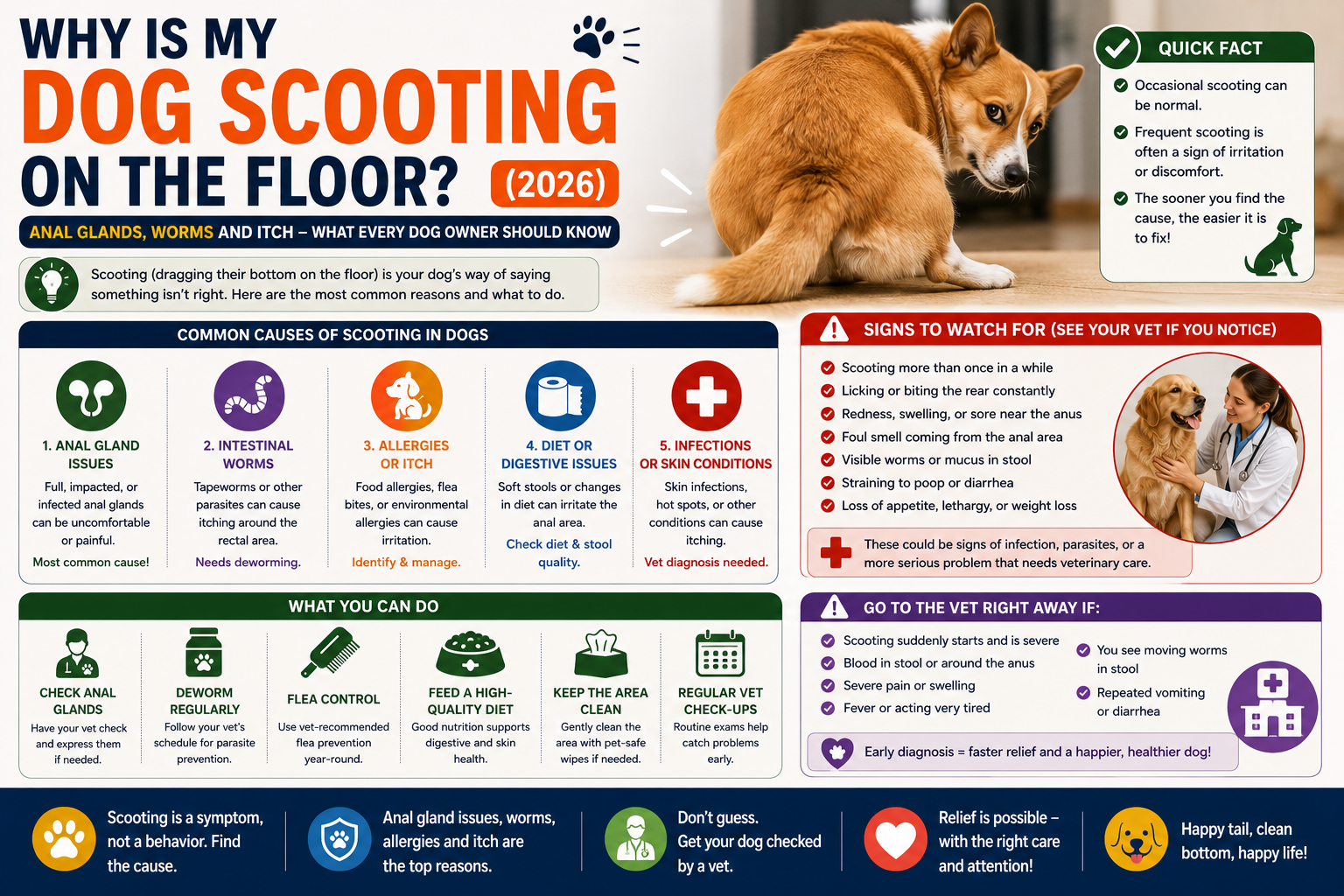
Quick Answer
Scooting means something back there is uncomfortable, and the most common reason is full or impacted anal sacs. Dogs have two small scent glands just inside the anus that normally empty during a firm bowel movement. When they do not, pressure builds, and dragging the bottom along the carpet is your dog’s attempt at relief. Tapeworms, allergies, and skin irritation are the other frequent causes. Occasional scooting can be watched for a day or two, but a swollen, red, or weeping area needs a vet.
Key Takeaways
- Anal sac problems cause the majority of scooting cases.
- A strong fishy or metallic smell is the classic anal gland signature.
- Tapeworm segments look like grains of rice around the tail or in bedding.
- Chronic soft stool is a leading underlying cause firm stool empties the sacs naturally.
- Do not routinely express glands that are not causing problems; it can make things worse.
- Swelling beside the anus, or an open weeping hole, means an abscess see a vet promptly.
What Anal Sacs Actually Are
Every dog has two small pouches sitting roughly at the four o’clock and eight o’clock positions relative to the anus. Each holds a strong-smelling, oily fluid used for scent marking which is why dogs greet each other rear-first, and why a frightened dog can suddenly release a foul smell.
Under normal conditions, a firm stool presses against these sacs on the way out and squeezes them empty. Two things break that system:
- Soft or loose stool does not apply enough pressure, so fluid accumulates.
- Thickened fluid or a narrowed duct blocks the outflow even when stool is normal.
Once the sacs are full, they become uncomfortable and then painful. Scooting, licking, and chasing the tail all follow.
The Progression Worth Understanding
| Stage | What is happening | Signs |
| Full / impacted | Fluid builds up and thickens | Scooting, licking, fishy smell, sitting awkwardly |
| Infected (sacculitis) | Bacteria multiply in stagnant fluid | Pain, swelling, blood or pus in the fluid, reluctance to sit |
| Abscess | Infection walls off into a pocket | Hot red swelling beside the anus, fever, obvious pain |
| Ruptured | Abscess bursts through the skin | Open weeping hole, bloody discharge, distress |
The reason to act at the first stage is that the later ones are painful, expensive, and slow to heal. A dog that scoots for a week and then develops a rupture had a warning you could have used.
The Other Causes
Tapeworms
The second most common cause, and easy to confirm yourself. Tapeworm segments migrate out of the anus and cause irritation.
Look for: small white segments resembling grains of rice or cucumber seeds around the tail, in bedding, or in fresh stool. They may move when fresh and dry into hard yellowish specks.
Tapeworms are usually caught from fleas, which dogs swallow while grooming. Treating the worms without treating the fleas guarantees a repeat, so do both.
Allergies and skin itch
The same allergic itch that drives paw licking affects the skin around the anus. If your dog scoots and licks paws, rubs the face, or has recurrent ear infections, allergy is the likely common thread and treating the bottom alone will not fix it.
Residue and hygiene
Long-coated breeds, dogs with loose stool, and dogs with reduced mobility can end up with matted fur or dried faeces around the anus. This is genuinely uncomfortable and easily fixed by trimming and cleaning. In severe cases the anus becomes blocked entirely, which is an emergency.
Diarrhoea and dietary upset
Ongoing loose stool both irritates the area and prevents the glands from emptying. Our guide to feeding a dog with diarrhoea covers short-term management, but recurring diarrhoea needs a proper diagnosis.
Perianal masses and fistulas
Less common but important in older dogs. Perianal adenomas are benign tumours seen most often in unneutered older males. Anal furunculosis (perianal fistula) is a painful ulcerating condition strongly associated with German Shepherds. Both need veterinary assessment persistent scooting in an older dog should never be dismissed as habit.
Rectal prolapse or foreign material
Occasionally a dog scoots because grass, a piece of string, or hair is partially passed and dangling. Never pull anything protruding from the anus it may be attached further up and pulling can cause serious internal damage. Go to a vet.
Which Dogs Are Most Affected?
Small breeds are over-represented: Chihuahuas, Toy Poodles, Cocker Spaniels, Beagles, Basset Hounds, and Miniature Schnauzers. Overweight dogs are also more prone, because fat around the rectum interferes with the pressure that normally empties the sacs. Dogs with chronic soft stool or ongoing allergies sit in the high-risk group regardless of breed.
What You Can Do at Home
- Look, carefully. In good light, check for redness, swelling beside the anus, matted fur, discharge, or rice-like segments.
- Note the smell. A pungent fishy or metallic odour on bedding or where your dog has been sitting strongly suggests anal glands.
- Increase dietary fibre modestly. Bulkier, firmer stool helps the glands empty naturally. A spoonful of plain pumpkin purée (not pie filling), or a vet-recommended fibre supplement, is a reasonable trial. Introduce gradually.
- Address the stool. Persistent softness is the root cause in many dogs. A complete, well-formulated diet matters more here than any supplement.
- Keep the area clean and trimmed, especially in long-coated breeds.
- Keep flea prevention current. It is the tapeworm control you actually need.
- Manage weight. Reducing excess body fat measurably improves anal gland function.
Should You Express Anal Glands Yourself?
The honest answer for most owners: no.
Routine expression of glands that are not causing problems is now discouraged by many veterinary professionals, because repeated manual emptying can irritate the ducts, cause inflammation and scarring, and create the dependency it was meant to prevent. Done incorrectly at home, it can also rupture the sac.
Have it done professionally when there is a genuine problem, and ask your vet or a qualified groomer to show you what “full” actually feels like. If your dog needs expression every few weeks, that is a signal to investigate why diet, allergy, and weight are usually the real answer.
When to See a Vet
Book an appointment if your dog:
- Has scooted repeatedly for more than two or three days
- Licks or chews at the rear constantly
- Has a persistent fishy smell
- Has visible rice-like segments around the tail
- Scoots and also shows allergy signs elsewhere
Go the same day if there is:
- A hot, red, painful swelling beside the anus
- An open weeping or bleeding hole
- Blood or pus around the anus
- Fever, lethargy, or refusing to sit
- Straining to pass stool, or nothing passing at all
- Anything protruding from the anus
Frequently Asked Questions
Why does my dog scoot after pooping? Usually because the anal sacs did not empty properly during the bowel movement, leaving lingering pressure. Soft stool is the most common reason this happens.
Does scooting always mean worms? No anal sac problems are more common. Tapeworms are a genuine cause, but you would typically see rice-like segments around the tail or in bedding.
Why does my dog smell fishy? That distinctive odour comes from anal sac fluid. A persistent fishy smell means the sacs are full, leaking, or infected.
Can I express my dog’s anal glands at home? It is generally better not to. Routine expression can inflame and scar the ducts, and incorrect technique risks rupture. Have it done by a professional when there is an actual problem.
Will more fibre fix scooting? Often it helps, because firmer stool empties the sacs naturally. It works best when the underlying issue really is soft stool it will not fix an allergy or an infection.
Is scooting painful? Full sacs are uncomfortable; infected or abscessed sacs are genuinely painful. Dogs do not scoot for fun.
Why does my dog scoot on the carpet specifically? Texture. Carpet provides more friction and pressure than a hard floor, which is why it becomes the preferred surface.
Do all dogs need their glands expressed regularly? No. Most dogs empty them naturally and never need intervention. Frequent need is a sign something else requires attention.
Final Thoughts
Scooting is the kind of symptom people laugh about and then ignore, which is exactly why it so often escalates into an abscess that could have been avoided.
The good news is that the underlying causes are largely manageable at home: firmer stool, a healthy weight, current flea control, and a clean, trimmed rear end resolve a large share of cases. What matters is not treating it as a quirk. If your dog is dragging their bottom across your floor, they are telling you something is wrong back there and the sooner you look, the simpler the fix.
Related Reading
- Why Is My Dog Licking His Paws?
- What to Feed a Dog With Diarrhea
- Dog Bad Breath: Causes & How to Fix It
- Best Super Premium Dog Food
A Note on Pet Health
Serlig publishes researched pet care information for everyday owners. It is general guidance, not veterinary advice, and it does not replace an examination by a licensed veterinarian who knows your pet. If your pet is unwell, or anything in this guide does not match what you are seeing at home, contact your vet.
About the Author
The Serlig Pet Care Team creates researched, plain-language pet care guides for everyday owners. Our content is written from hands-on pet-care experience and cross-checked against established veterinary sources so you can make confident decisions for your dog.