
Quick Answer
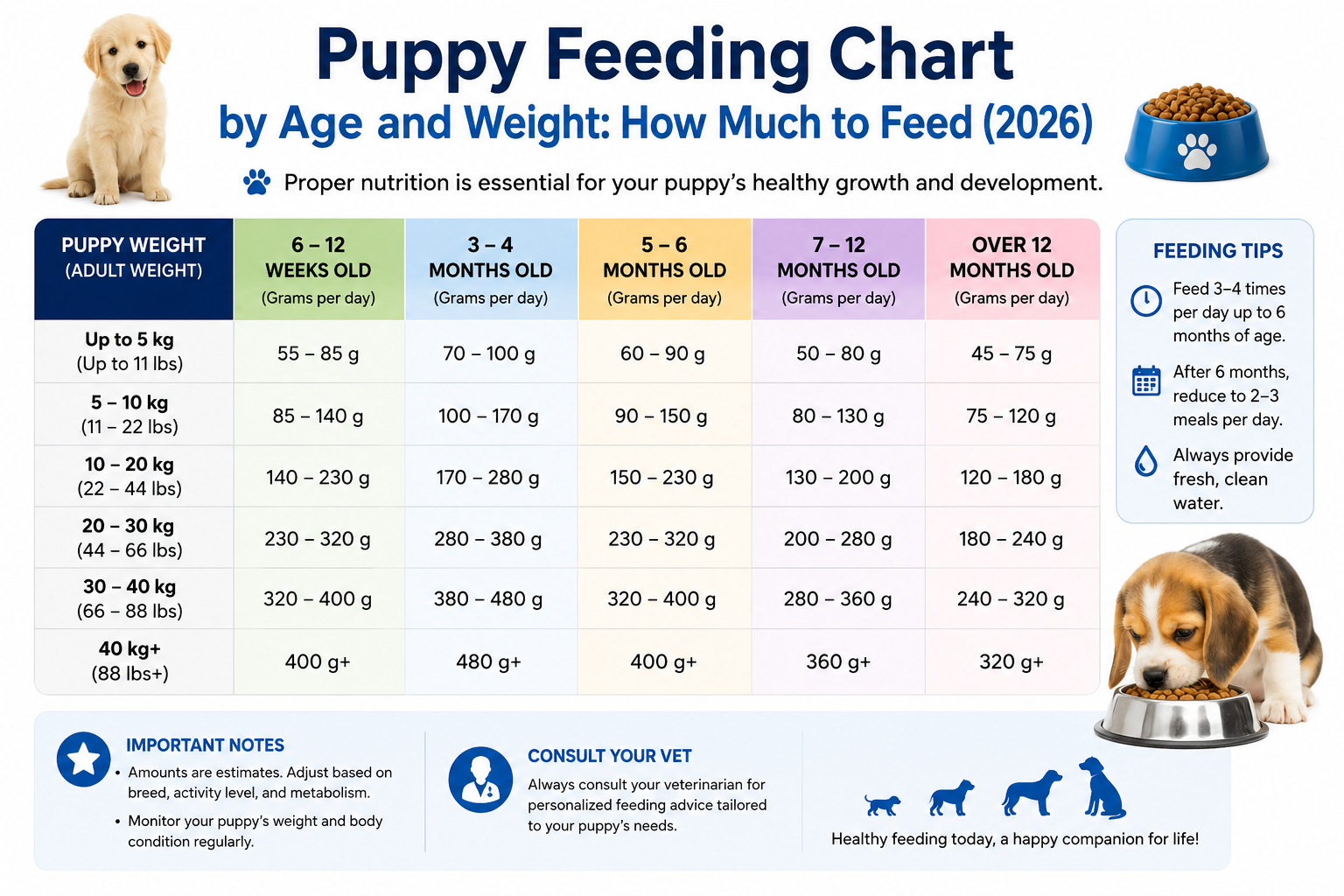
Puppies need frequent small meals of a complete puppy food, reducing in frequency as they grow: four meals a day until around 12 weeks, three until six months, then two for life. Portion size depends far more on the calorie density of your specific food than on any generic chart, so always start from the feeding guide on your bag and then adjust using body condition rather than the number on the scales. The most important rule, especially for large breeds: a lean puppy is a healthy puppy. Overfeeding a growing dog is genuinely harmful, not generous.
Key Takeaways
- Meal frequency follows age; meal size follows weight, food, and body condition.
- Puppies need roughly twice the calories per kilogram of an adult dog.
- Large and giant breeds need large-breed puppy food with controlled calcium and energy.
- Never add calcium supplements to a complete puppy food it causes skeletal disease.
- Body condition score beats any chart: you should feel ribs easily and see a waist.
- Switch to adult food at maturity, which varies from 9 months to 2 years by size.
Feeding Frequency by Age
This part is genuinely universal.
| Age | Meals per day | Notes |
| 0–4 weeks | Mother’s milk or a puppy milk replacer | Never cow’s milk |
| 4–6 weeks | Weaning begins softened food gruel | 4–6 small feeds |
| 6–12 weeks | 4 meals | Blood sugar is unstable; regular meals matter |
| 3–6 months | 3 meals | Growth is fastest during this window |
| 6–12 months | 2 meals | Small breeds may be ready for adult food near the end |
| 12 months + | 2 meals | Large and giant breeds stay on puppy food longer |
Why frequency matters so much early on: small puppies have limited stomach capacity and limited glycogen reserves. Toy breeds in particular can develop hypoglycaemia if meals are spaced too far apart trembling, weakness, and disorientation are the warning signs.
How Much per Meal?
Here is the honest answer that most charts avoid: there is no universal gram figure, because puppy foods range from roughly 330 to well over 450 kcal per 100g. A cup of one food can contain 40% more energy than a cup of another. A generic chart applied to a calorie-dense food will overfeed your puppy considerably.
The correct method, in order:
- Start with the feeding guide on your food’s packaging. It is calculated for that food’s actual calorie density, using your puppy’s current weight and expected adult weight.
- Weigh the food, do not scoop it. Kitchen scales are far more accurate than a cup, and this single change prevents a great deal of accidental overfeeding.
- Divide the daily total by the number of meals for that age.
- Reassess every two weeks puppies grow fast, and the correct amount changes constantly.
- Adjust using body condition, not the chart.
The energy guide (for context)
If you want to sanity-check the bag’s numbers, vets use resting energy requirement:
RER = 70 × (body weight in kg)^0.75
- Puppy under 4 months: roughly 3 × RER
- Puppy over 4 months: roughly 2 × RER
- Neutered adult dog: roughly 1.6 × RER
For example, a 5 kg puppy under four months: RER ≈ 70 × 3.34 ≈ 234 kcal, so a target of around 700 kcal a day. Treat this as a cross-check on the bag, not a replacement for it.
Body Condition: The Rule That Beats Every Chart
Ask any veterinary nutritionist how much to feed a puppy and they will tell you to look at the puppy, not the chart.
Assess weekly:
- Ribs — you should feel them easily with light pressure, like the back of your hand, but not see them prominently.
- Waist — viewed from above, there should be a visible narrowing behind the ribs.
- Tuck — viewed from the side, the belly should rise up toward the hind legs.
| What you find | What to do |
| Ribs hard to feel, no waist | Reduce by 10% and reassess in two weeks |
| Ribs easy to feel, clear waist | Correct — continue |
| Ribs and spine visible and sharp | Increase by 10%; if the puppy is also lethargic, see your vet |
Why lean matters especially for large breeds: rapid growth and excess body weight during development are associated with developmental orthopaedic disease, including hip and elbow dysplasia and osteochondrosis. Growing a large-breed puppy quickly does not produce a bigger dog — it produces the same adult dog with worse joints. Slow, steady, lean growth is the goal.
Large and Giant Breeds Need Different Food
This is the single most consequential decision in puppy nutrition, and it is easy to get wrong.
If your puppy’s expected adult weight is over roughly 25 kg / 55 lb, use a large-breed puppy formula. These differ in three important ways:
- Controlled calcium and phosphorus. Large-breed puppies cannot regulate calcium absorption well, so excess intake directly disrupts bone development.
- Lower energy density, to slow the growth rate.
- Adjusted calcium-to-phosphorus ratio for correct skeletal formation.
Never add calcium, bone meal, or “growth” supplements to a complete puppy food. This is the classic well-intentioned mistake, and it causes skeletal disease rather than preventing it. A complete, properly formulated food already contains the correct amounts.
When to Switch to Adult Food
Timing follows skeletal maturity, not age in months alone.
| Adult size | Examples | Switch at |
| Toy (under 5 kg) | Chihuahua, Yorkshire Terrier | 9–10 months |
| Small (5–10 kg) | Miniature Dachshund, Pug | 10–12 months |
| Medium (10–25 kg) | Cocker Spaniel, Border Collie | 12 months |
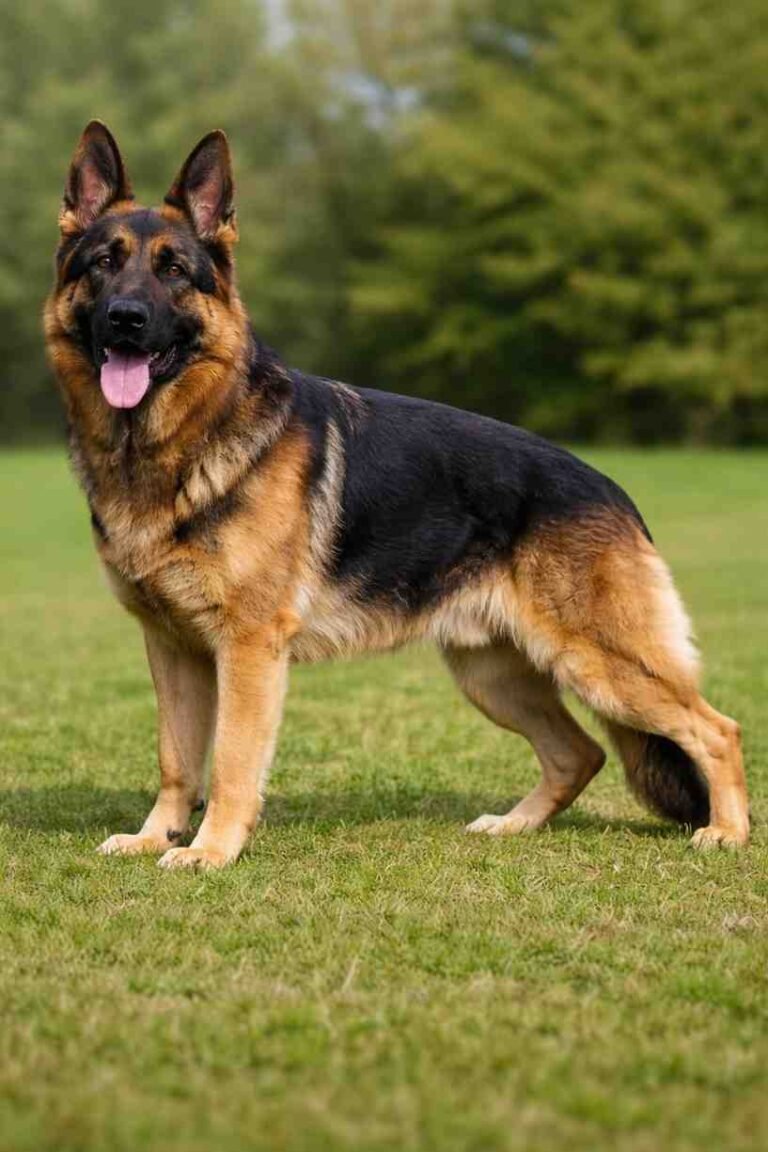
| Large (25–40 kg) | Labrador, German Shepherd | 15–18 months |
| Giant (over 40 kg) | Great Dane, Newfoundland | 18–24 months |
Transition over 7–10 days: days 1–3 at 25% new food, days 4–6 at 50%, days 7–9 at 75%, day 10 fully switched. Sudden changes commonly cause diarrhoea — if that happens, our guide on feeding a dog with diarrhoea covers the recovery approach.
Neutering note: energy requirements typically fall by around 20–30% after neutering. Portions usually need reducing, and this is a very common point at which puppies quietly start gaining excess weight.
Treats, Training and the 10% Rule
Training a puppy means a lot of treats, and the calories add up faster than owners expect.
- Keep all treats under 10% of daily calories, and reduce the meal portion accordingly.
- Use tiny pieces — a puppy values the event, not the size.
- Part of the daily kibble ration makes an excellent training reward and adds nothing extra.
- Our guide to low-calorie treats and the 10% rule covers portioning in more detail.
Foods to keep well away from a puppy: chocolate, xylitol, grapes and raisins, onion and garlic, macadamia nuts, cooked bones, and raw dough. Puppies chew everything, so review our toxic foods guide and puppy-proof accordingly.
Practical Feeding Habits
- Set meal times, 15–20 minutes down, then lift the bowl. Free-feeding makes house-training harder and portion control impossible.
- Fresh water always available.
- A slow-feeder bowl for gulpers — it reduces gas, hiccups, and in deep-chested breeds may help reduce bloat risk.
- Feed in a quiet spot, separate from other pets.
- Allow a calm gap of 30–60 minutes between eating and vigorous exercise.
- Weigh your puppy weekly on the same scales and keep a simple log. Steady upward progress with good body condition is what you want.
Frequently Asked Questions
How much should I feed my puppy? Start from your food’s own feeding guide using your puppy’s current and expected adult weight, weigh portions rather than scooping, and adjust every two weeks based on body condition.
How many times a day should a puppy eat? Four meals until about 12 weeks, three until six months, then two meals daily for life.
When should I switch my puppy to adult food? At skeletal maturity, which ranges from around 9–10 months in toy breeds to 18–24 months in giant breeds.
Can I feed my puppy adult dog food? Not as a main diet. Puppy food is higher in protein, fat, calories, and specific minerals needed for growth, with a controlled calcium-to-phosphorus ratio.
Should I give my large-breed puppy calcium supplements? No. Excess calcium disrupts skeletal development in large-breed puppies. A complete large-breed puppy food already provides the correct amount.
My puppy always seems hungry — should I feed more? Puppies are enthusiastic eaters and will usually act hungry regardless. Judge by body condition, not appetite. If ribs are hard to feel, your puppy is having enough.
Wet or dry food for puppies? Both work if complete and balanced for growth. Dry is convenient and economical; wet is more palatable and adds moisture. Mixed feeding is fine — just count the total calories.
How do I know if my puppy is overweight? You should feel ribs easily with light pressure, see a waist from above, and see an abdominal tuck from the side. If not, reduce the portion by 10% and reassess.
Final Thoughts
Feeding a puppy is one of those tasks that looks like arithmetic and is really observation. The chart on the bag gets you into the right range; your hands on your puppy’s ribs tell you whether you are actually right.
The error worth avoiding above all others is overfeeding particularly in large breeds, where a chubby puppy is not a thriving puppy but a joint problem in development. Feed for a lean, steady climb rather than a fast one, weigh the food instead of scooping it, and reassess every fortnight while your puppy is growing.
Related Reading
- New Puppy Checklist: Everything You Need
- When Do Puppies Stop Biting?
- Best Super Premium Dog Food
- The 10% Rule: Best Low-Calorie Treats for Overweight Pets
- Foods Toxic to Dogs: The Complete List
A Note on Pet Health
Serlig publishes researched pet care information for everyday owners. It is general guidance, not veterinary advice, and it does not replace an examination by a licensed veterinarian who knows your pet. If your pet is unwell, or anything in this guide does not match what you are seeing at home, contact your vet.
About the Author
The Serlig Pet Care Team creates researched, plain-language pet care guides for everyday owners. Our content is written from hands-on pet-care experience and cross-checked against established veterinary sources so you can make confident decisions for your dog.


One Comment