Quick Answer
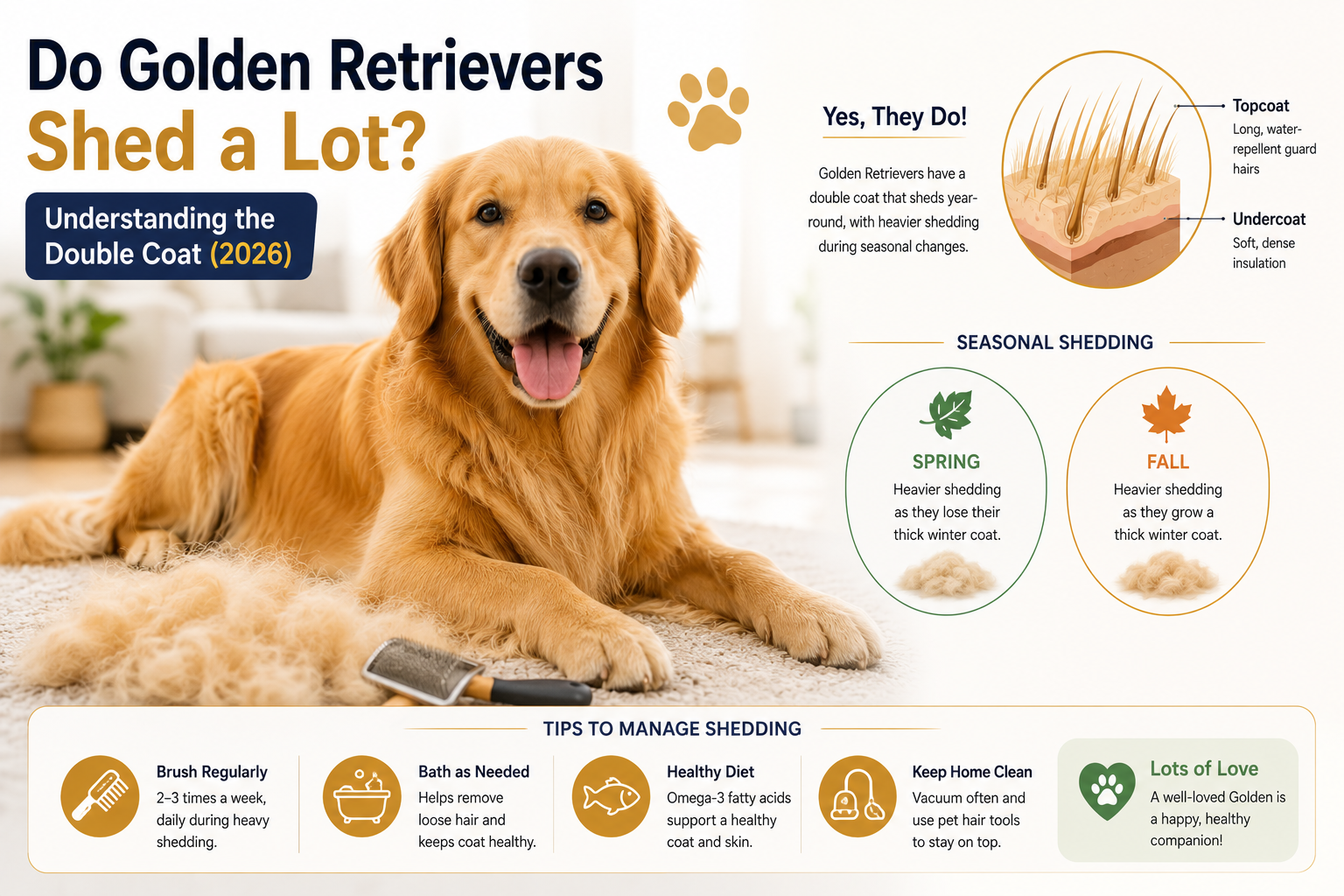
Yes Golden Retrievers shed heavily, and they do it all year plus two intense seasonal periods. They have a double coat: a dense, soft undercoat for insulation beneath a longer, water-repellent outer coat. Moderate hair loss is constant, and twice a year typically spring and autumn they “blow coat,” releasing the undercoat in dramatic quantities over two to four weeks. Regular brushing manages it. Shaving the coat does not, and causes lasting damage.
Key Takeaways
- Goldens shed year-round, with two heavy seasonal blows.
- The undercoat is what comes out in clumps; the outer coat sheds slowly.
- Brush 2–3 times weekly normally, daily during a coat blow.
- Never shave a double-coated dog regrowth is often permanently altered.
- Shedding is driven by daylight hours, not temperature indoor dogs shed more evenly all year.
- Sudden excessive shedding with bald patches or itching is a medical sign, not a coat cycle.
How a Double Coat Works
Understanding the structure explains everything else.
The undercoat is short, dense, and soft thousands of fine hairs per follicle cluster that trap air against the skin. This is the insulation layer, and it works in both directions: it keeps warmth in during winter and keeps heat out during summer.
The outer coat (guard hairs) is longer, coarser, and naturally water-repellent. It sheds rain, deflects dirt, and protects skin from UV and abrasion. Goldens were bred to retrieve waterfowl in cold water, and the coat is the equipment for that job.
Hair growth runs in cycles: anagen (growing), catagen (transition), telogen (resting), and exogen (shedding). Dogs have mosaic hair growth, meaning different follicles are at different stages which is why shedding is constant rather than all at once.
The Shedding Calendar
| Period | What happens | Grooming needed |
| Year-round baseline | Steady moderate shedding | Brush 2–3× weekly |
| Spring (Mar–May) | Heavy blow winter undercoat released | Daily brushing, 2–4 weeks |
| Summer | Lighter shedding | 2–3× weekly |
| Autumn (Sep–Nov) | Second blow summer coat out, winter coat in | Daily brushing, 2–4 weeks |
| Winter | Thick coat, moderate shedding | 2–3× weekly |
The trigger is photoperiod, not temperature. Shedding cycles are regulated primarily by changing daylight hours acting on melatonin production. This has a practical consequence many owners notice: dogs living mostly indoors under artificial light shed more evenly year-round rather than in two clear bursts, because the light signal is blurred.
Puppies: the fluffy puppy coat is gradually replaced by the adult double coat between roughly 3 and 18 months. Expect a scruffy in-between phase it is normal.
The Grooming Rhythm That Works
Consistency beats intensity. Twenty minutes three times a week removes more hair from your house than a two-hour session once a month.
Technique matters more than equipment:
- Work in sections, and brush in the direction of hair growth.
- Get down to the undercoat. Brushing only the surface removes loose guard hairs and leaves the actual problem underneath.
- Line brushing lifting a section of coat and brushing the layer beneath, working upward is how groomers reach the undercoat properly.
- Focus on the friction zones: behind the ears, the ruff, armpits, the feathering on the back of the legs, and the tail. These mat first.
- Never brush a dirty or matted coat dry. Detangle gently, and if mats are tight against the skin, have a groomer remove them.
- Bathe every 6–8 weeks, and brush thoroughly before bathing water tightens existing mats considerably.
- Dry completely. A damp undercoat is a route to hot spots and skin infection.
For specific tool recommendations undercoat rakes, slickers, deshedding blades and how they differ see our dedicated guide on the best brushes for Golden Retriever shedding.
Why You Must Never Shave a Golden Retriever
This comes up every summer, usually with good intentions, and it is one of the most consequential grooming mistakes an owner can make.
What actually happens:
- The insulation is removed in both directions. The undercoat keeps heat out as well as in. A shaved Golden is often hotter, not cooler.
- Sunburn and skin cancer risk rise. The coat is UV protection, and the skin beneath has never been exposed.
- Regrowth is frequently permanently altered. Undercoat regrows faster than guard hairs, producing a patchy, woolly, texture-changed coat that no longer repels water — sometimes called clipper alopecia or post-clipping alopecia. In some dogs the original coat never fully returns.
- Shedding does not stop. It becomes shorter, prickly hair that embeds in fabric more stubbornly than long hair.
What to do instead in hot weather: brush out the dead undercoat thoroughly a well-de-shedded coat breathes efficiently. Provide shade, fresh water, and cooling mats, walk in early morning and evening, and trim only the feathering, paw fur, and sanitary areas.
The only legitimate reasons to clip are veterinary necessity, surgical preparation, or severe pelted matting that cannot be safely brushed out.
When Shedding Is a Medical Problem
Normal shedding is even, all over, and leaves the coat full. If you can see skin, that is different.
| Sign | Possible cause |
| Bald patches with visible skin | Allergy, infection, mites, hormonal disease |
| Intense scratching or biting | Fleas, allergies, mites |
| Red, greasy, or smelly skin | Yeast or bacterial infection |
| Symmetrical thinning on both flanks | Hypothyroidism notably common in Golden Retrievers |
| Dull, brittle, dry coat | Nutritional deficiency, parasites, systemic illness |
| Sudden heavy shedding after illness or surgery | Telogen effluvium usually self-resolving |
| Shedding with weight gain and lethargy | Thyroid disease worth testing |
| Constant paw licking with hair loss | Allergy see why is my dog licking his paws |
Hypothyroidism deserves a specific mention because Golden Retrievers are among the breeds most affected. The classic picture is symmetrical hair loss along the flanks and tail, a dull coat, weight gain despite unchanged feeding, lethargy, and skin that darkens or thickens. It is straightforward to diagnose with a blood test and very manageable with daily medication.
Supporting a Healthy Coat
- Feed a complete, well-formulated diet. Coat quality is one of the first things to suffer from inadequate nutrition, and one of the first to improve. A quality complete food does more for shedding than any topical product.
- Omega-3 fatty acids (EPA and DHA) support skin barrier function discuss dosing with your vet rather than guessing.
- Year-round parasite prevention. Fleas are still the commonest cause of dogs scratching hair out.
- Fresh water always available dehydration shows in the coat.
- Manage stress. Boarding, house moves, and illness all trigger shedding waves.
- Vacuum strategically. A vacuum with a motorised pet head, run two or three times weekly, plus washable throws on sofas and car seats.
Living With the Hair: Practical Reality
Goldens are not a low-maintenance choice, and it helps to plan rather than fight it.
- Keep a rubber glove or squeegee for pulling hair off upholstery far more effective than a lint roller.
- Washable throws on the sofa and in the car, changed weekly.
- Brush outdoors when weather allows, especially during a coat blow.
- Expect hair in your food occasionally. Everyone with a Golden does.
- A grooming table or raised surface saves your back if you are brushing three times a week for a decade.
If shedding is a deciding factor in choosing a breed, our guide on whether French Bulldogs are hypoallergenic explains why “low-shedding” and “allergy-friendly” are not the same question.
Frequently Asked Questions
Do Golden Retrievers shed all year? Yes. They shed moderately year-round, with two heavy seasonal blows in spring and autumn.
How often should I brush a Golden Retriever? Two to three times weekly normally, and daily during a coat blow.
Can I shave my Golden Retriever in summer? No. Shaving removes insulation that keeps heat out, risks sunburn, and often permanently alters coat regrowth. Brush out the undercoat instead.
Why is my Golden shedding so much suddenly? Seasonal blow is the usual answer. If it comes with bald patches, itching, lethargy, or weight gain, see your vet hypothyroidism is common in the breed.
How long does a coat blow last? Typically two to four weeks, twice a year.
Do Golden Retrievers shed more than Labradors? Both shed heavily. Goldens have longer hair so it is more visible, while Labrador hair is shorter and embeds in fabric more stubbornly.
Does diet affect shedding? Yes. Poor nutrition produces a dull, brittle coat and increased hair loss. A complete, well-formulated diet with adequate omega-3 supports coat health.
Will bathing reduce shedding? Bathing loosens dead hair, so brushing before and after a bath removes a lot at once. Over-bathing dries the skin and can worsen shedding, so every 6–8 weeks is plenty.
Final Thoughts
Anyone considering a Golden Retriever should know this from the start: the hair is not a phase, a problem to solve, or a sign of poor care. It is the breed. Twice a year it will look like a second dog has been assembled on your living room floor.
What makes it manageable is rhythm rather than effort a proper undercoat-reaching brush a few times a week, daily during a blow, and the discipline to never reach for the clippers in July. And keep an eye on the pattern: even, all-over shedding with a full coat is normal, while visible skin, itching, or symmetrical thinning along the flanks is your dog telling you to book a blood test.
Related Reading
- Are French Bulldogs Hypoallergenic?
- Why Is My Dog Licking His Paws?
- Best Super Premium Dog Food
- Foods Toxic to Dogs: The Complete List
A Note on Pet Health
Serlig publishes researched pet care information for everyday owners. It is general guidance, not veterinary advice, and it does not replace an examination by a licensed veterinarian who knows your pet. If your pet is unwell, or anything in this guide does not match what you are seeing at home, contact your vet.
About the Author
The Serlig Pet Care Team creates researched, plain-language pet care guides for everyday owners. Our content is written from hands-on pet-care experience and cross-checked against established veterinary sources so you can make confident decisions for your dog.