
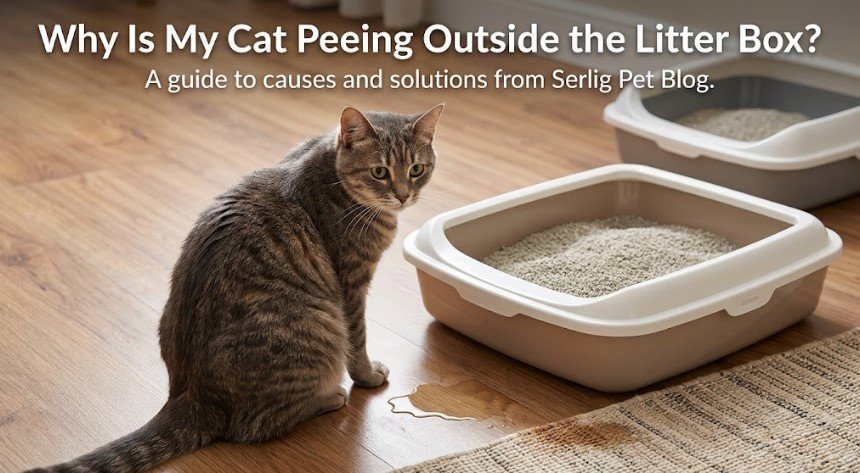
Why is my cat peeing outside the litter box usually comes down to three things, in this order: a medical problem, something about the litter box itself, or stress. Medical causes must be ruled out first, because urinary disease, kidney disease, diabetes and arthritis all change toileting habits. If your cat is straining without producing urine, treat it as an emergency. Never punish a cat for this, since punishment raises stress and stress is a direct cause of one of the most common underlying conditions.
First: Is This an Emergency?
Most articles on this topic start with litter preferences. That ordering is wrong, because one version of this problem kills cats and looks exactly like a behaviour issue from across the room.
Urethral obstruction is when the tube carrying urine out of the bladder becomes blocked, usually by crystals, a plug of material or spasm. Urine cannot leave. Toxins build up, the kidneys fail and the heart is affected. Untreated, it is fatal within a day or two.
Male cats are at far greater risk because their urethra is longer and narrower.
What it looks like from the outside
- Repeated trips to the litter box producing nothing or only a few drops
- Straining, often with obvious effort
- Crying, howling or vocalising in or near the box
- Peeing small amounts in various places around the house
- Excessive licking at the genital area
- Hiding, restlessness or pacing
- Vomiting, lethargy or collapse in later stages
- A firm, painful abdomen
The trap. A cat that keeps going to odd places and producing small puddles looks like a cat with a preference problem. A cat straining in the box looks like a constipated cat. Both can be a blocked cat.
The rule. If your cat is trying to urinate and little or nothing is coming out, that is an emergency regardless of where it is happening. Cats hide pain exceptionally well, and our guide to recognising pain in cats covers the quieter signals.
Medical Causes Come First
Even when there is no blockage, a sudden change in toileting habits is a medical question before it is a behavioural one. Veterinary guidance is consistent on this: book an examination before trying to modify the behaviour.
Common medical causes
- Feline idiopathic cystitis (FIC). Bladder inflammation with no identifiable infection. It is the most common cause of urinary signs in younger cats, and stress plays a major role, which matters for the punishment section below
- Urinary tract infection. More common in older cats and those with other conditions
- Bladder stones or crystals, causing pain and urgency
- Kidney disease, which increases urine volume so the box fills faster than usual
- Diabetes, same effect through increased thirst and urination
- Hyperthyroidism, common in older cats
- Arthritis, which makes climbing into a box painful. See the senior cat section
- Cognitive dysfunction in elderly cats
- Constipation or diarrhoea, which create urgency. Our guides to cat diarrhoea and why cats vomit cover the digestive side
What the vet will do. A physical examination, a urine sample for analysis and possibly culture, and usually blood tests. Imaging if stones or a mass are suspected.
Take a urine sample if you can. Non absorbent litter is available for this, or a clean empty tray works for a short period. A fresh sample saves time and sometimes a second visit.
Is It Urination, Marking or Spraying?
These look similar and mean different things, and telling them apart changes what you do next.
| Inappropriate urination | Spraying or marking | |
| Surface | Horizontal. Floors, beds, carpets, laundry | Vertical. Walls, doors, furniture legs, new objects |
| Volume | A normal full bladder emptying | Small amounts, sometimes just a few drops |
| Posture | Squatting, as normal | Standing, tail upright and often quivering, backing up to the surface |
| Location | Often soft, absorbent surfaces | Often near doors, windows, new items or where other cats have been |
| Usual cause | Medical, litter box aversion, or access problems | Territorial or stress related communication |
Spraying is normal cat communication, not a toileting failure. It is more common in cats that are stressed or anxious, and in cats that have not been neutered.
If your cat is squatting and emptying a full bladder on the carpet, that is a toileting problem and the litter box sections below apply.
If your cat is backing up to the wall with a quivering tail, that is marking, and the answer lies in stress, territory and often neutering rather than in a different litter.
The Litter Box Itself
Once medical causes are excluded, the box is where most cases are solved.
The number rule. One box per cat, plus one spare. Two cats need three boxes. On every floor of the house, so a cat never has to travel far or pass another cat to reach one.
Size. The box should be at least one and a half times the length of your cat from nose to base of tail. Most commercially sold boxes are too small for an adult cat.
Covered or uncovered. Most cats prefer uncovered. Hoods trap odour, restrict the view of approaching threats and leave only one exit. Covered boxes suit owners rather than cats.
Entry height. Low enough to step into without effort. This matters enormously for older cats.
Cleanliness. Scoop at least twice daily. Wash the box and change all the litter weekly. Cats are fastidious and will simply go elsewhere rather than use a soiled box.
Liners. Most cats dislike them, and claws catch in the plastic. Remove them.
Self cleaning boxes. Some cats are frightened by the noise and movement. If the problem began around the time one was introduced, that is your answer.
Litter: What Cats Actually Prefer
Cat preferences are reasonably consistent and are frequently overridden by owner preferences.
- Unscented. Perfumed litter smells pleasant to you and overwhelming to a cat, whose sense of smell is far more sensitive than yours
- Fine grained and soft, which is closest to the sandy substrate cats naturally choose
- Clumping, which most cats prefer
- Depth of about three to four centimetres. Too shallow feels wrong, too deep feels unstable
- Consistent. Sudden changes cause rejection. Transition gradually over a week or two by mixing
If the problem began when you changed litter, change it back. This is one of the easiest fixes available and it is frequently the whole answer.
Running a litter trial. If you are unsure, put two or three boxes side by side with different litters and see which your cat uses. Cats answer this question clearly if asked.
Location Matters
- Away from food and water. Cats do not toilet where they eat, and a box beside the bowls will often be rejected
- Quiet and low traffic, away from washing machines, boilers and doors that slam
- Not in a cupboard or a dead end corner. A cat wants to see approaches and have an escape route
- Accessible without stairs for older or arthritic cats, and on every floor they use
- Not somewhere a dog or child can reach, since being disturbed once can create long lasting avoidance
- Not moved suddenly. If you must relocate a box, move it gradually or add a new one in the new spot first
A useful test. Look at where your cat is actually choosing to go. If it is always the spare room, the box may be too far away or too exposed. If it is always the bath or sink, that can point toward a medical issue or a strong dislike of the current litter.
Stress and Feline Idiopathic Cystitis
Stress deserves more than a passing mention here, because it is not only a behavioural cause. It is a medical one.
Feline idiopathic cystitis is bladder inflammation without infection or stones, and stress is strongly implicated in it. A stressed cat can develop genuine, painful bladder disease, which then causes urgency, straining and urination outside the box.
Common stressors
- A new pet, baby or person in the home
- Building work, redecoration or a house move
- A change in your schedule or an absence
- A cat outside the window
- Changes to furniture, routine or feeding times
- Conflict with another cat in the household
What helps
- Identify and reduce the trigger where you can
- Provide vertical space, hiding places and separate resources
- Keep routines predictable
- Increase water intake, since dilute urine is less irritating. Wet food helps most, and our guide to hydration in cats covers what actually works and what does not
- Ask your vet about synthetic pheromone products and, in some cases, medication
- Play and enrichment, which reduce stress genuinely rather than as a platitude
Older Cats: Arthritis and Cognitive Decline
This is underestimated constantly.
Arthritis affects most cats by around ten years of age. A cat with sore joints may find a high sided box, a covered box with a small opening, or a box that requires stairs simply too difficult. The cat is not refusing the box, it is unable to use it comfortably.
The fix is usually mechanical. Cut down one side of a storage box to make a low entry ramp, place boxes on every floor the cat uses, and use large shallow trays rather than deep ones.
Cognitive dysfunction in elderly cats can mean genuinely forgetting where the box is, or not recognising it. More boxes, in more obvious places, with consistent locations, helps.
Do not assume an old cat is just being difficult. A senior cat that starts having accidents needs a veterinary examination, and our guides to changes in appetite and sleeping more than usual cover the other signs worth mentioning at the same appointment.
Multi Cat Households
Resource competition is the usual problem. One cat guarding or ambushing another near the box is common and easy to miss, because it happens quietly and often at night.
Signs of conflict
- One cat waits before approaching the box
- A cat runs from the box rather than covering
- Accidents happen in a particular room the other cat does not use
What helps
- Boxes in multiple separate locations, not lined up in one room, since a row of boxes can be blocked by one cat sitting at the end
- Boxes with clear sightlines and two escape routes
- Separate feeding stations and resting places as well as boxes
- Gradual reintroduction if tension is recent. Our guide to introducing a kitten to a cat covers the method
If you do not know which cat is responsible, confine cats separately for short periods with their own boxes, or ask your vet about a harmless fluorescent dye that shows up in one cat’s urine under ultraviolet light.
Cleaning: Your Cleaner May Be Making It Worse
This is the most commonly missed practical point on this topic.
Never use ammonia based cleaners on cat urine. Urine contains ammonia compounds, so an ammonia cleaner leaves behind a smell that reads to a cat as urine, which actively invites them to go there again. Bleach has a similar problem.
Use an enzymatic cleaner made for pet urine. Enzymes break down the uric acid crystals that ordinary detergents leave behind. Those crystals are why a spot can smell fine to you and still smell strongly to a cat months later.
How to do it properly
- Blot up as much as possible before it dries
- Saturate the area thoroughly, not just the surface, since urine soaks into padding and floorboards
- Let it sit for the time stated on the label rather than wiping straight away
- Allow it to air dry rather than rubbing
- Repeat if needed, and check with a UV torch, which shows dried urine clearly
Make the spot unattractive afterwards by placing a food bowl, a bed or a plant pot there temporarily. Cats avoid toileting where they eat and rest.
Never Punish, and Why It Backfires
Every source says do not punish. The reason is more concrete than most of them explain.
Punishment raises stress. Stress is a direct contributor to feline idiopathic cystitis, which is one of the most common medical causes of this exact problem. So punishing a cat for peeing outside the box can worsen the condition causing it.
Punishment also teaches the cat to avoid you rather than to use the box, and a cat that starts hiding to urinate is harder to help, not easier.
This is not spite. Cats do not urinate outside the box out of revenge or to make a point. That interpretation is common and wrong, and it leads directly to punishment, frustration and, too often, to a cat being rehomed. Inappropriate elimination is among the leading reasons cats are surrendered to shelters, and a large share of those cases are treatable.
Never rub a cat’s nose in it, shout, or use a spray bottle.
A Step by Step Plan
- Check for straining with little or no urine. If present, emergency vet now
- Book a veterinary examination with a urine sample if you can collect one
- Work out whether it is urination or marking using the table above
- Count your boxes. One per cat plus one, on every floor
- Check box size, height and cover. Bigger, lower, uncovered
- Switch to unscented, fine grained, clumping litter at three to four centimetres
- Review location. Quiet, accessible, away from food, with an escape route
- Clean every soiled spot with an enzymatic cleaner and check with a UV torch
- Identify and reduce stressors, and increase water intake
- Give it time. Habits take weeks to re establish. Keep changes consistent rather than trying something new every few days
- Go back to your vet if there is no improvement in two to three weeks, and ask about referral to a veterinary behaviourist
Frequently Asked Questions
Why is my cat suddenly peeing outside the litter box? A sudden change is most often medical. Urinary disease, kidney disease, diabetes and arthritis all change toileting habits, so a veterinary examination should come before any behavioural changes.
My cat is straining but nothing comes out. What does that mean? Treat it as an emergency, particularly in a male cat. A blocked urethra is fatal within a day or two and is frequently mistaken for constipation or a behaviour problem.
Is my cat doing this out of spite? No. Cats do not urinate outside the box for revenge. It signals a medical problem, a box they cannot or will not use, or stress.
How many litter boxes should I have? One per cat plus one spare, placed in separate locations and on every floor your cat uses.
Will punishing my cat stop it? No, and it makes things worse. Punishment increases stress, and stress directly contributes to feline idiopathic cystitis, which is a leading cause of this problem.
What cleaner should I use on cat urine? An enzymatic cleaner made for pet urine. Avoid ammonia based cleaners and bleach, since the residual smell resembles urine and encourages repeat marking.
How long will it take to fix? Medical causes often resolve quickly once treated. Habits and preferences take longer, typically two to three weeks of consistent changes. Return to your vet if there is no progress by then.
The Bottom Line
Why is my cat peeing outside the litter box has three answers in a fixed order: medical, then the box, then stress. Starting anywhere other than the vet risks missing a treatable illness, and in the case of a blocked cat it risks far worse.
The single most important thing on this page is the first section. A cat straining to urinate and producing little or nothing is an emergency, not a behaviour problem, and male cats are at particular risk.
Everything else is usually fixable. More boxes, bigger and lower, uncovered, unscented fine litter, sensible locations, an enzymatic cleaner and less stress will resolve a large share of cases. What will not help is punishment, which raises the stress that drives one of the most common underlying conditions.
This is among the leading reasons cats are given up to shelters, and most of those cases have a cause that could have been found and treated.