
Quick Answer
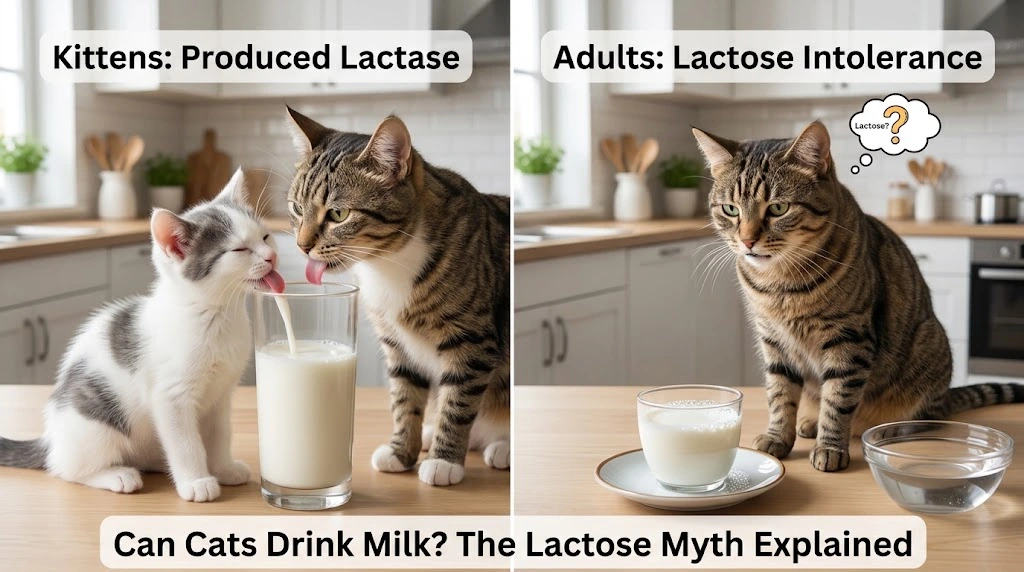
Can cats drink milk? Most adult cats should not. Cats stop producing meaningful amounts of lactase after weaning, so the lactose in cow’s milk passes undigested into the large intestine and ferments, causing gas, cramping and diarrhoea. Symptoms typically appear 8 to 12 hours later, which is why many owners never connect the two. Milk offers cats no nutrient they cannot get from a complete cat food. Water is the only drink a cat needs.
Can Cats Drink Milk?
This is one of the few questions in cat care where the popular image and the biology point in completely opposite directions. The saucer of milk is probably the single most recognisable image of cat care in Western culture, and it is also one of the most consistently wrong.
The reason is simple. Adult cats lose the enzyme needed to digest milk sugar. What they cannot digest, gut bacteria ferment, and the result is a genuinely uncomfortable night for the cat.
There is one detail in this article that matters more than any other, and it is the one almost every guide leaves out: the reaction is delayed by roughly 8 to 12 hours. That delay is why so many owners are convinced their cat handles milk perfectly well.
Where the Milk Myth Came From
Farm life. Before commercial pet food existed, barn cats were kept for pest control and were often given whatever was available, which on a dairy farm meant milk. Fresh unpasteurised milk straight from the cow also separates, and the cats were largely lapping the fat rich cream layer rather than the milk beneath it. Cream contains considerably less lactose than whole milk, so those cats tolerated it better than a cat drinking a saucer of modern supermarket milk.
Storybooks and cartoons. The image was then repeated in children’s books, illustrations and animation for a century until it became something everyone simply knew.
The result is a genuinely rare situation: a piece of pet care advice that is both universally recognised and biologically backwards.
Why Adult Cats Cannot Digest Milk
Milk contains lactose, a sugar made of glucose and galactose joined together. To absorb it, the body has to split it apart first, and the enzyme that does that job is lactase.
Kittens produce lactase in abundance, because milk is their entire diet. As they wean onto solid food, lactase production drops sharply, and published veterinary sources describe most cats as having largely stopped producing it by around a year of age. From the body’s point of view this is efficient. An adult cat eats meat, so an enzyme for digesting milk is no longer worth making.
What happens next is straightforward chemistry. Undigested lactose passes through the small intestine without being absorbed and arrives in the large intestine, where resident bacteria ferment it. Fermentation produces gas. The unabsorbed sugar also draws water into the bowel by osmosis.
Gas plus water in the large intestine produces exactly what you would expect: bloating, abdominal cramping, flatulence and diarrhoea.
This is not an allergy. It is a mechanical digestive failure, and it is the most common food intolerance in cats.
Why the 8 to 12 Hour Delay Matters
This is the part that changes how you should interpret your own cat’s reaction.
Fermentation is not instant. The milk has to travel the length of the small intestine before it reaches the bacteria that act on it. Veterinary sources commonly describe symptoms appearing around 8 to 12 hours after the cat drinks it.
Think about what that means in practice. You offer milk in the evening. Your cat drinks it, seems delighted, and shows no reaction for the rest of the night. You conclude that your cat is one of the ones that tolerates dairy. The diarrhoea then arrives at four in the morning or the following afternoon, by which point you are looking for a different explanation entirely, and the litter tray gets blamed on the new food, or a hairball, or nothing at all.
The delay is the reason the myth survives at household level even after it has been debunked at veterinary level. The cause and the effect are simply too far apart to connect without knowing to look.
If you want to test whether milk affects your cat, you have to watch the following day, not the following hour.
Why Cats Like Milk If They Cannot Digest It
Cats are not drawn to milk by its sweetness. They physically cannot taste sweetness at all, because they lack functioning sweet taste receptors. Sugar is invisible to a cat’s palate.
What they are responding to is fat. Whole milk and especially cream carry a rich mouthfeel and aroma that reads to an obligate carnivore as a concentrated food source. The enthusiasm is real, but it is enthusiasm for fat, not for milk.
This is worth understanding because it explains why offering a lower fat milk usually makes the situation worse rather than better. Skimmed milk has less fat, so less of what the cat actually wants, while the lactose remains. You get the same digestive consequence with less of the appeal.
It also explains why the answer is not to find a milk your cat likes. The thing your cat likes is available in far better forms.
My Cat Drinks Milk and Seems Fine
This comes up constantly and deserves an honest answer rather than a flat contradiction.
Some cats genuinely do tolerate small amounts of dairy better than others. Lactase production declines but does not always vanish completely, and the amount matters enormously. A teaspoon is not a saucer.
However, three things are worth weighing before concluding your cat is unaffected.
The delay hides the connection. As described above, if you are only watching for an hour, you are watching the wrong window.
Mild symptoms are easy to miss. Flatulence, mild cramping and slightly softer stools do not look like an event. A cat that is quieter than usual the next day, or that spends more time hiding, may simply be uncomfortable. Cats conceal discomfort extremely well, and our guide to recognising pain in cats covers how subtle those signals are.
Tolerating something is not a reason to give it. Even in a cat that handles dairy without visible trouble, milk supplies nothing that a complete cat food does not already provide in better form. The upside is zero. The downside is variable but never negative.
So the honest position is this. If your cat has had milk for years with no observable problem, you do not need to feel guilty about the past. But there is no argument for continuing, because there was never anything to gain.
What Kind of Milk Can Cats Drink?
Not all milk is equally problematic. If you are asking whether cats can drink milk of any type at all, this is the practical hierarchy, from worst to least bad.
| Type | Verdict | Why |
| Cow’s milk, whole or skimmed | Avoid | Highest lactose content. The default cause of dairy diarrhoea in cats |
| Soy milk | Avoid | Lactose free, but contains stachyose and raffinose, sugars cats also cannot digest. Soy is a more common allergen in pets |
| Coconut milk | Avoid | Very high in fat. Contributes to weight gain and can trigger digestive upset |
| Macadamia or walnut milk | Never | Both nuts are considered unsafe for cats. Avoid the milks entirely |
| Almond milk | Tolerated, not recommended | Not toxic and lactose free, but commercial versions contain added sugars, oils and thickeners. No nutritional value to a cat |
| Oat milk | Tolerated, not recommended | Same reasoning. Added sugar plus oat fibre can still cause loose stools |
| Goat’s milk | Better, still not advised | Contains roughly 20 to 30 percent less lactose than cow’s milk, so it is easier on some cats. It is still dairy and still lactose |
| Human lactose free milk | Safer | Lactose is largely removed, so the main problem is solved. The fat and calories remain |
| Cat milk formulated for cats | Safest option if you insist | Lactose reduced and made for feline digestion. Still a treat with calories, not a drink |
| Fresh water | Recommended | The only liquid an adult cat actually needs |
The pattern is worth stating plainly. Removing the lactose removes the digestive problem but does not create a benefit. Even the safest option on this list is a treat you are choosing to give, not something your cat needs.
Hard cheeses follow similar logic and are covered in our guide to cheese and cats.
Can Kittens Drink Milk?
This section matters most, because it is where a mistake causes real harm rather than an uncomfortable night.
Kittens with their mother should drink her milk and nothing else. Queen’s milk is species specific and correctly balanced for feline growth.
Orphaned or hand reared kittens must never be given cow’s milk. This is the single most common and most damaging error people make when they find an abandoned kitten. Cow’s milk has the wrong protein, fat and lactose profile for a kitten, and it commonly causes severe diarrhoea. In an animal that small, diarrhoea leads to dehydration very quickly, and dehydration in a neonatal kitten is life threatening within hours.
What to use instead is a kitten milk replacer, sold at veterinary practices and pet shops. If you have found a kitten and cannot obtain replacer immediately, contact a vet or a rescue organisation the same day rather than improvising with anything from your fridge. Kitten feeding also requires correct frequency, volume and temperature, not just the right liquid.
Weaned kittens do not need milk of any kind. Once they are eating solid food, a complete kitten formula supplies everything, including the calcium that people often assume milk is needed for. Our kitten feeding schedule sets out age appropriate portions and stages.
The Calorie Problem Nobody Mentions
Even setting lactose aside completely, milk has a second issue.
Cats are small animals. A typical adult cat needs somewhere around 200 to 300 calories per day, and veterinary nutrition guidance holds that treats should stay under 10 percent of that total. For most cats, that is a treat budget of roughly 20 to 30 calories.
A modest saucer of whole milk can consume a large share of that budget on its own, and it does so while delivering nothing nutritionally useful. Worse, milk given after a full meal is added on top of the daily total rather than subtracted from it, which is precisely how indoor cats gain weight without anyone noticing a change.
If your cat is already overweight, our guide to low calorie treats and portion control explains how to fit treats into a weight management plan properly.
There is also a hydration misconception worth correcting. Milk is not a good way to increase a cat’s fluid intake. If your cat drinks too little water, wet food, a second water bowl away from the food, or a pet water fountain will all help far more, and none of them carry a digestive penalty.
My Cat Just Drank Milk. What Should I Do?
For a one off incident, this is the whole procedure.
- Do not panic: Milk is not toxic to cats. This is a comfort problem, not a poisoning.
- Remove any remaining milk: So your cat cannot go back for more.
- Make sure fresh water is available: If diarrhoea does develop, hydration matters.
- Feed the next meal normally: There is no need to withhold food.
- Watch the following 24 hours, not the next hour: Remember the 8 to 12 hour delay.
Most cats will either show nothing at all or have one episode of loose stools that resolves on its own.
Contact your vet if diarrhoea continues beyond 24 hours, if there is blood in the stool, if your cat vomits repeatedly, if your cat stops eating, or if your cat becomes lethargic. Kittens, senior cats and cats with existing digestive conditions should be assessed sooner rather than later, because they dehydrate faster and have less reserve.
Repeated vomiting in particular deserves attention rather than observation, and our article on why cats vomit explains where the line sits. A cat that goes off its food entirely is also worth taking seriously, as covered in our guide to changes in a cat’s appetite.
What to Give Instead
If the goal is to give your cat something special, these all work better than milk.
- A small piece of plain cooked chicken or fish. Species appropriate, genuinely enjoyed, and it fits the treat budget easily.
- A commercial treat with a stated calorie count on the packet. The label is what makes portion control possible.
- Plain unsalted meat broth. Adds moisture and flavour. Check the ingredients carefully, because most stock cubes and shop bought broths contain onion or garlic, which are toxic to cats.
- A lickable puree treat. These deliver the same ritual of being given something as a saucer of milk, with far fewer calories.
- A water fountain. If your cat is drawn to the act of drinking from a bowl, moving water is often far more interesting to a cat than milk ever was.
- Attention instead of food. A great deal of treat giving is really about interaction. Five minutes of play usually satisfies the same impulse for both of you.
For the full picture of what belongs in a cat’s diet, see our complete guide to what cats can eat.
Frequently Asked Questions
Are all cats lactose intolerant? Effectively yes, as adults. Lactase production drops sharply after weaning, and most cats have largely stopped producing it by around a year old. Individual tolerance varies, but the underlying change is universal.
How much milk is safe for a cat? There is no amount that provides a benefit. If you are determined to offer some, a teaspoon of lactose free or cat formulated milk carries the least risk. A saucer of cow’s milk is a poor idea for any adult cat.
Can cats drink lactose free milk? It is much safer than regular milk, since the specific cause of the problem has been removed. It still contains fat and calories and still offers no nutritional value to a cat.
Is goat’s milk better for cats? Slightly. It contains roughly 20 to 30 percent less lactose than cow’s milk, so some cats handle it better. It is still dairy and still contains lactose.
Can cats drink almond milk or oat milk? A few licks will not harm most cats, since neither is toxic and neither contains lactose. Commercial versions usually contain added sugars, oils and thickeners, and neither offers a cat anything useful.
Why does my cat beg for milk if it upsets them? Cats cannot taste sweetness, so they are responding to the fat content, not the sugar. The attraction is real, and it is entirely disconnected from whether they can digest it.
Can I give a stray kitten cow’s milk? No. Cow’s milk commonly causes severe diarrhoea in kittens, and dehydration in a young kitten becomes dangerous within hours. Use a kitten milk replacer and contact a vet or rescue the same day.
Conclusion:
Can cats drink milk? Most adult cats should not. They lose the lactase needed to digest it, the undigested sugar ferments in the large intestine, and the result is gas, cramping and diarrhoea appearing 8 to 12 hours later.
That delay is the reason the myth persists. Owners watch for a reaction in the wrong window, see nothing, and conclude their cat is fine.
Even in cats that genuinely tolerate dairy, there is no case for it. Milk supplies nothing that a complete cat food does not already deliver, and it spends a meaningful share of a very small daily calorie budget doing so.
The saucer of milk was always about what looked right to us rather than what worked for the cat. Fresh water and a proper treat do the same job better, and your cat will sleep more comfortably for it.
A Note on Pet Health
Serlig publishes researched pet care information for everyday owners. It is general guidance, not veterinary advice, and it does not replace an examination by a licensed veterinarian who knows your pet. If your pet is unwell, or anything in this guide does not match what you are seeing at home, contact your vet.

One Comment