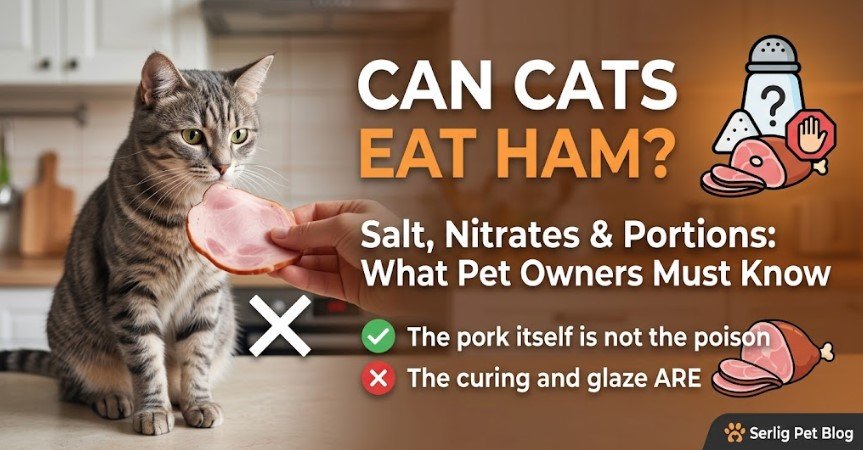
Can cats eat ham? A pea sized piece of plain cooked ham will not harm a healthy cat, but ham is one of the saltiest and fattiest meats in a domestic kitchen and should not be a treat you offer deliberately. The problem is not the pork itself but the curing: heavy salting, nitrates, added sugar and frequently onion or garlic in the glaze. Cats with heart disease, kidney disease or a history of pancreatitis should never have ham. Never give a ham bone.
Can Cats Eat Ham?
Ham occupies an unusual position. It is meat, which sounds ideal for an obligate carnivore, and yet it is one of the least suitable meats you could offer.
The pork is not the issue. A plain roasted pork loin, unsalted and unseasoned, would be a perfectly reasonable occasional treat for a cat. What makes ham different is everything done to the pork before it reaches you. Curing loads it with salt, preservatives are added for shelf life, sugar is common, and holiday hams arrive coated in a glaze that frequently contains ingredients toxic to cats.
So the accurate framing is this: ham is not poison, but it is also not food for a cat. A stolen nibble is not an emergency. A regular habit is a genuinely poor idea, and for some cats it is dangerous from the first slice.
This article covers what the actual risks are, which are not quite the ones most articles emphasise, and which forms of ham are worst.
Why Cats Beg for Ham
Cats respond to ham with unusual enthusiasm, and there is a reason beyond simple hunger.
Curing does not only preserve meat. It develops savoury compounds through the breakdown of proteins during the curing process, producing a concentrated umami flavour that fresh meat does not have. Cats detect umami strongly, since it is the taste that signals animal protein, and they cannot taste sweetness at all. Cured ham is therefore closer to a flavour amplifier than an ordinary meat, from a cat’s perspective.
Add salt and fat, both of which carry aroma, and you have a food engineered by accident to be extremely appealing to a carnivore.
That enthusiasm is not a signal that ham is good for them. It is the same reason a cat will investigate butter or a bag of crisps.
The Sodium Problem, With Real Numbers
Most articles say ham is high in salt. Here is what that actually means for a small animal.
Ham typically contains somewhere between 800 and 1500 milligrams of sodium per 100 grams, depending on the type. Deli and lunch hams sit at the higher end. A cat’s daily sodium requirement is modest, and a complete cat food is already formulated to meet it.
| Portion | Approximate sodium | What that represents for a 4 kg cat |
| One thin deli slice, about 15 g | 130 to 200 mg | Roughly a full day’s sodium intake or more |
| A 30 g cube of glazed ham | 250 to 450 mg | Several days’ worth in one piece |
| A pea sized nibble, about 2 g | 15 to 30 mg | Small, and unlikely to matter for a healthy cat |
| A rasher of bacon | 200 to 400 mg | The worst option in the pork family |
The point is not that one slice will make a healthy cat ill. It is that ham is so salt dense relative to a cat’s size that there is no portion which is both meaningful as a treat and reasonable as a sodium load.
Our guide to low calorie treats and portion control covers how small a cat’s daily treat budget really is.
Is Salt Poisoning Actually the Risk?
This is worth addressing directly, because several articles reach for the most dramatic possible outcome and it distorts what owners should watch for.
What you will read: ham causes sodium ion toxicosis, leading to vomiting, seizures and death.
What is actually true: salt toxicosis is a real condition, but it generally requires ingestion of a very large quantity of salt relative to body weight, and it is far more likely when an animal also lacks access to fresh water. A cat that eats a slice of ham and has a full water bowl is not in that territory.
This is not a reason to relax about ham. It is a reason to know what to actually watch for, because the realistic risks are different and more common:
- Excessive thirst and urination in the hours after a salty meal, which is the body doing its job
- Vomiting or loose stools from a rich, salty food the digestive system is not used to
- Pancreatitis from the fat load, which is the more probable serious outcome
- Worsening of existing disease in cats with heart or kidney conditions, where sodium genuinely matters clinically
That last group is where the real danger sits. For a cat in early kidney disease or with a cardiac condition, sodium is something a vet is actively managing, and a slice of ham is an unmeasured variable in a treatment that depends on control.
Always ensure fresh water is available if your cat has eaten anything salty. That single step addresses most of what people are worried about.
The Fat Problem
This is the risk most likely to send a cat to a vet, and it gets less attention than salt.
Ham contains roughly 10 to 20 grams of fat per 100 grams, and bacon considerably more. A sudden high fat meal can trigger pancreatitis, an inflammation of the pancreas that is painful, potentially serious, and something cats with any prior history are especially vulnerable to.
Fat is also the slowest nutrient to leave the stomach, which is why rich foods commonly cause vomiting several hours after they are eaten rather than immediately.
Signs worth acting on include repeated vomiting, a hunched posture, abdominal pain, lethargy or refusing food. Cats conceal discomfort well, and our guide to recognising pain in cats covers the subtler signals.
Nitrates and Nitrites
Cured hams are preserved with sodium nitrite and sometimes sodium nitrate. These prevent bacterial growth, fix the pink colour and contribute to the cured flavour.
The honest position on these is that the long term effects in cats are not well studied. There is no evidence that a single nibble of cured ham harms a cat through its nitrite content, and it would be overstating the case to describe them as toxic at these quantities.
What can be said fairly is that these are compounds with no nutritional purpose for a cat, present in a food that has no nutritional purpose for a cat either, and that regular exposure is not something anyone can currently justify as safe. Given that ham already fails on salt and fat, the nitrite question does not change the conclusion.
Seasonings and Glazes
This is where ham crosses from unsuitable into genuinely unsafe, and it is underemphasised almost everywhere.
A holiday or roast ham is rarely plain. Typical glazes and rubs include:
- Honey or brown sugar, which adds a substantial sugar load
- Onion or garlic powder, which damages red blood cells in cats and is more concentrated in powdered form than fresh
- Cloves, mustard and mixed spices, none of which suit a feline digestive system
- Pineapple or fruit juice, adding more sugar
Deli hams are equally variable. Flavoured varieties, smoked hams and anything described as seasoned should be assumed to contain something unsuitable until the ingredient list says otherwise.
Our guide to human foods toxic to cats covers why onion and garlic are treated so seriously.
Which Ham Is Worst?
| Type | Verdict | Why |
| Plain pork cooked at home, no salt or seasoning | Acceptable occasionally | This is the only version worth considering. Set a portion aside before you season anything |
| Plain cooked ham, unglazed, trimmed | Tiny amounts only | Already cured and salted during production, even if you serve it plain |
| Deli or lunch ham | Avoid | Among the saltiest and most heavily processed forms |
| Honey roast or glazed ham | Avoid | Sugar plus whatever is in the glaze, frequently onion or garlic |
| Gammon | Avoid | Heavily brined before cooking |
| Prosciutto, parma, serrano | Never | Dry cured rather than cooked, and among the highest salt concentrations of any meat |
| Bacon | Never | Highest in fat, salt and nitrites of the pork family |
| Ham fat and rind | Never | Almost pure fat. A direct pancreatitis risk |
| Raw pork or raw ham | Never | Bacterial and parasite risk, including Trichinella |
| Ham bone | Never | See below |
| Commercial cat treats containing pork | Fine | Formulated with controlled sodium and no toxic additives |
The pattern: the closer a product is to plain cooked pork, the safer it is. The more curing, smoking, glazing and processing involved, the worse it gets. Prosciutto and bacon sit at the far end and should not be offered at all.
Never Give a Ham Bone
This deserves its own section because it is a seasonal problem that almost no article on this topic mentions.
Cooked bones become brittle and splinter into sharp fragments that can cut the mouth, lodge in the throat, or perforate the stomach or intestine. A ham bone carries an additional problem: it is saturated with salt and glaze from cooking, so a cat gnawing at one is taking in concentrated sodium alongside the mechanical risk.
Ham bones are also frequently left out after a meal, on a counter or in an open bin, at exactly the moment a kitchen is busiest and least supervised.
If your cat has swallowed a bone fragment: do not induce vomiting, since a sharp piece travelling back up can cause more damage than it did going down. Call your vet straight away and watch for gagging, drooling, pawing at the mouth, refusing food, a bloated or painful abdomen, or straining to pass stool. Our guide to chicken and cats covers the cooked bone question in more detail.
Which Cats Must Avoid Ham Entirely
For these cats there is no acceptable portion.
Cats with kidney disease. Sodium and phosphorus are controlled through a prescription diet. Ham works directly against it.
Cats with heart disease. Sodium restriction is often part of management, and salt loads matter clinically.
Cats with a history of pancreatitis. Fat is the primary trigger, and ham is a fatty food.
Diabetic cats. Glazed and honey hams add unplanned sugar that interferes with glucose control.
Overweight cats. Calorie dense and nutritionally empty, which is the first thing to cut from a weight plan.
Kittens. High growth requirements and no room for empty calories, and a smaller body means any salt load is proportionally larger. Our kitten feeding schedule sets out what they need.
Cats with a suspected pork allergy. Pork allergy is uncommon but real, presenting as itching, hair loss, chronic vomiting or recurring digestive problems.
If Your Cat Ate Ham
A small piece of plain cooked ham. Not an emergency. Provide fresh water, feed the next meal as normal, and watch for 24 hours. Increased thirst is expected. Mild vomiting or loose stools are possible and usually resolve.
A larger amount, or glazed or seasoned ham. Check what was in the glaze. If it contained onion or garlic in any form, call your vet. Otherwise watch closely for repeated vomiting, lethargy, abdominal pain or refusing food, all of which suggest pancreatitis rather than simple indigestion.
Bacon, prosciutto or ham fat. Higher risk from both salt and fat. Contact your vet for advice, particularly if your cat is small, elderly or has any existing condition.
Any amount in a cat with heart disease, kidney disease or previous pancreatitis. Call your vet regardless of quantity.
A ham bone or fragment. Call your vet now. Do not induce vomiting.
Persistent vomiting always warrants attention rather than observation, and our article on why cats vomit explains when it becomes urgent.
How to Serve Plain Pork Instead
If your cat is drawn to the flavour of ham, plain pork gives them the same meat without any of the curing. It takes very little effort.
- Take a piece from the raw joint before you season anything. This is the step that matters. Once salt, glaze or rub is on, it cannot be taken off.
- Cook it thoroughly by boiling, baking or steaming. No pink in the centre, since pork must be fully cooked.
- Use no salt, oil, butter or seasoning. Plain water is the only cooking medium needed.
- Trim off all fat and rind, which is where the pancreatitis risk sits.
- Remove any bone, including small fragments.
- Cool it completely and cut into pea sized pieces.
- Keep the portion small, a teaspoon or two, and subtract it from the meal rather than adding it on top.
- Refrigerate leftovers in a sealed container and use within two to three days.
Done this way, pork sits alongside chicken and turkey as a perfectly reasonable occasional treat. It is only the curing that makes ham a problem.
Every one of these gives a cat the meaty treat it wants without the curing.
- Plain cooked chicken, shredded small. The best default, and covered fully in our guide to chicken and cats.
- Plain cooked turkey, which has a similar profile to chicken.
- Plain roast pork, set aside before seasoning. If pork is what your cat is drawn to, this is the way to give it.
- Plain cooked fish, boneless and unseasoned, as an occasional treat.
- A commercial cat treat with a stated calorie count, including pork flavoured ones formulated with controlled sodium.
For the full picture of what belongs in a cat’s diet, see our complete guide to what cats can eat.
Frequently Asked Questions
Is ham bad for cats? Ham is not toxic, but it is high in salt and fat, contains preservatives, and often carries seasonings that are genuinely unsafe. It offers a cat nothing a complete diet does not already supply.
How much ham can a cat have? There is no portion that provides a benefit. If you are going to offer any, a pea sized piece of plain unglazed ham on a rare occasion is the sensible ceiling for a healthy cat.
Can cats eat bacon? No. Bacon is the highest in fat, salt and nitrites of the pork family and carries the greatest pancreatitis risk.
Can cats eat prosciutto or parma ham? No. These are dry cured rather than cooked and are among the saltiest meats available.
Can cats eat raw ham or raw pork? No. Raw pork carries bacterial and parasite risks, including Trichinella, for both your cat and your household.
My cat ate glazed holiday ham. Should I worry? Check the glaze ingredients. Onion or garlic in any form warrants a call to your vet. Otherwise watch for 24 hours, ensure water is available, and contact your vet if vomiting repeats or your cat becomes lethargic.
Can kittens eat ham? No. Their smaller size makes any salt load proportionally larger, and they have no room in their diet for food that carries no nutrition.
Conclusion:
Can cats eat ham? A pea sized piece of plain cooked ham will not harm a healthy cat, and a stolen nibble from the counter is not cause for alarm. But there is no version of this food that earns a place in a cat’s diet.
The realistic risks are worth getting right. Dramatic salt poisoning from a slice is unlikely in a cat with water available. Pancreatitis from the fat is the more probable serious outcome, and for cats with heart or kidney disease the sodium matters clinically from the first bite.
The pork was never the problem. The curing, the salt, the glaze and the bone are. If your cat loves the flavour of ham, plain roast pork set aside before seasoning gives them the same thing with none of it.
A Note on Pet Health
Serlig publishes researched pet care information for everyday owners. It is general guidance, not veterinary advice, and it does not replace an examination by a licensed veterinarian who knows your pet. If your pet is unwell, or anything in this guide does not match what you are seeing at home, contact your vet.