
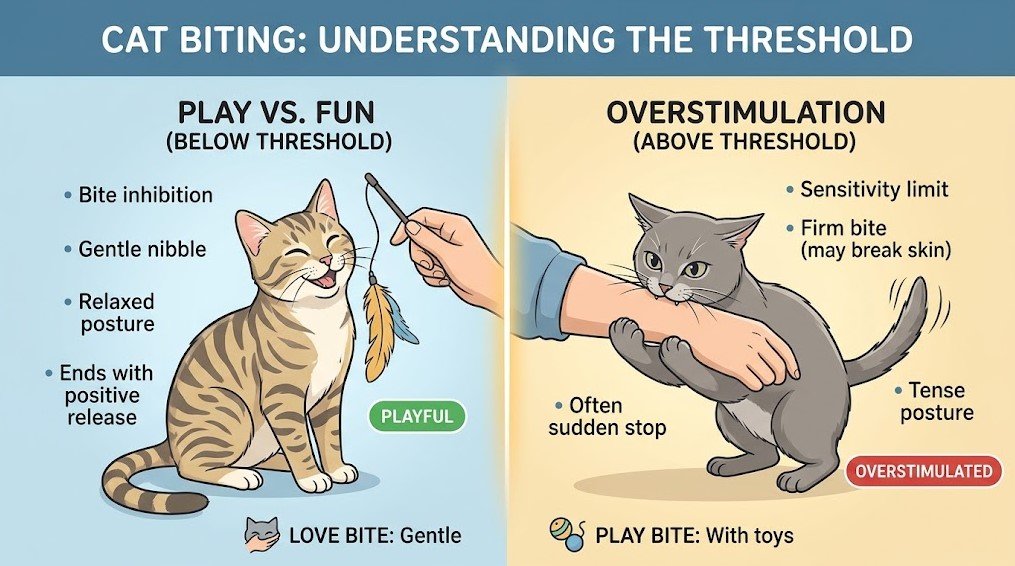
Why does my cat bite me usually has one of four answers: a gentle love bite, overstimulation during petting, play aggression, or fear and redirected aggression. The most common is overstimulation, where a cat enjoys contact up to a point and then reaches a sensitivity threshold. Biting that starts suddenly, or that happens whenever one specific area is touched, is more likely to be pain and needs a vet. Cat bites also carry a high infection risk, so any puncture that breaks the skin needs proper wound care.
Three Different Bites
Most articles treat every bite as the same behaviour. It is not, and telling them apart changes what you should do.
| Love bite | Overstimulation | Petting induced aggression | |
| Pressure | Very gentle, no injury | Firmer, may break skin | Can be genuinely hard |
| When | During relaxed contact, often with kneading or grooming | After a period of petting the cat was enjoying | Sometimes immediately, or on touching one specific area |
| Warning | None needed. It is not aggression | Usually several signals first | Often very little warning |
| Cat’s state | Relaxed, affectionate | Reaching a threshold, becoming conflicted | Uncomfortable, possibly in pain |
| Meaning | Affection or a request | “That is enough now” | “Do not touch me, or do not touch me there” |
| What to do | Nothing. Normal | Learn the warning signs and stop earlier | See a vet. Pain is a common cause |
The important distinction is the third column. A cat that tolerates no petting at all, or that reacts consistently when one part of the body is touched, is a different case from a cat that enjoys five minutes and then has had enough.
Love bites frequently accompany kneading, and our guide to why cats knead covers that relaxed, affectionate state.
Cat Bites Are a Medical Issue
This section is missing from every page we reviewed on this topic, and it matters more than the behaviour advice.
Cat teeth are needle sharp. They create narrow, deep punctures that seal over almost immediately, trapping bacteria beneath the skin. Cat mouths carry bacteria, including Pasteurella multocida, and the combination of deep inoculation and a wound that closes quickly makes infection genuinely likely.
Bites to the hand are the highest risk, because there is very little tissue between skin and tendon sheaths or joints, and infection there can spread rapidly.
What to do with any bite that breaks the skin
- Wash immediately under running water with soap, for several minutes
- Let it bleed a little rather than pinching it closed
- Do not seal it with a plaster straight away. Cover loosely after cleaning
- Apply antiseptic if you have it
- Watch it closely for the next 24 to 48 hours
See a doctor promptly if
- The bite is on a hand, wrist, finger or over a joint
- Redness, swelling, heat or pain increases within hours
- Red streaking spreads from the wound
- You develop a fever or feel unwell
- Pus or discharge appears
- You cannot move the affected finger or joint normally
- You are immunocompromised, diabetic, or on medication that affects immunity
- Your tetanus cover is not up to date
Do not wait and see with a hand bite. Cat bite infections can develop within hours and often need antibiotics started early. This is one of the few places where “it is only a small puncture” is genuinely misleading.
Overstimulation: The Sensitivity Threshold
This is the most common explanation and the most misunderstood.
Petting is not a natural cat behaviour. Cats groom each other and sleep in contact, but sustained stroking of the kind humans enjoy giving is outside their normal repertoire. They tolerate it, many enjoy it, and every cat has a limit.
What happens at the threshold. The cat genuinely enjoys the contact at first. Then repetition becomes irritating, the pleasant sensation tips into something uncomfortable, and the cat says so in the only way available.
Tolerance varies enormously. Some cats will accept twenty minutes. Others reach their limit in thirty seconds. Neither is abnormal.
It is not aggression in the usual sense. It is most often a warning nip rather than an attack, and the cat typically leaves immediately afterwards rather than pressing on.
It is worth noting that the Cornell Feline Health Center describes the underlying reasons as still not fully understood. Overstimulation is the leading explanation, and an attempt by the cat to control when the petting ends is another. The behaviour is well recognised even where the mechanism is not settled.
The Warning Signs, and Why You Should Stop Before Them
Most cats give warnings. Learning them is standard advice. The better advice goes one step further.
The signals, roughly in order
- Tail flicking, twitching or thumping
- Ears rotating sideways or flattening back
- Pupils dilating
- Skin rippling or twitching along the back
- Body tensing, or a subtle shift in position
- Head turning toward your hand
- A low vocalisation or a sudden stillness
- A paw raised toward your hand
Now the part that most sources miss. Everyone says to watch for these signs and stop when you see them. But by the time a cat is flicking its tail, it has already become conflicted. You are managing a problem that has already started.
The better approach is to stop before any warning appears. End the session while the cat is still clearly enjoying it, after a shorter time than you think necessary. Over weeks, a cat that never reaches the conflicted state gradually stops anticipating it, and tolerance often improves on its own.
Let the cat decide. Offer a hand and let them come to you. Pet in short sessions with breaks. Stick to the head, cheeks and under the chin, which most cats prefer, and go easy on the belly, base of the tail and along the back, which are common trigger zones.
Petting Induced Aggression and Pain
This is the version that needs a vet rather than a training plan.
Two patterns should prompt an appointment
- A cat that does not tolerate any petting, where it used to
- A cat that reacts consistently when one particular area is touched
Pain dramatically reduces tolerance to handling, and cats conceal it exceptionally well. Common sources include dental disease, ear problems, arthritis, skin irritation, injury, and pain in the back, neck, limbs or abdomen.
The clearest red flag is sudden onset. A cat that has always accepted being stroked and has recently started biting has changed for a reason, and behaviour is rarely the first explanation worth reaching for.
Our guide to recognising pain in cats covers the other signals to mention at the appointment, and our article on hair loss in patches covers skin discomfort, which is an easily missed cause of touch sensitivity.
Play Biting and Bite Inhibition
This is a different behaviour with a different origin and a different fix.
Play aggression is most common in kittens and young cats, particularly single cats with no other cat to play with.
The root cause is usually missed bite inhibition. Kittens learn how hard they can bite by playing with littermates. When a bite is too hard, the sibling squeals and play stops. A kitten raised without littermates, or separated from them too early, never receives that feedback and grows up not knowing where the limit is.
Our guides to the kitten feeding schedule and introducing a kitten to a cat cover the early weeks, which is where much of this is determined.
The single biggest owner error: using hands as toys. Wiggling fingers under a blanket, letting a kitten wrestle your hand, playing rough with bare skin. It is charming at eight weeks and painful at eight months, and the cat cannot be expected to understand that the rules changed.
How to fix it
- Never use hands or feet as toys. Wand toys only, keeping your body out of the game
- End play instantly if teeth touch skin. Stand up, walk away, no reaction. Play stops, every time
- Give proper daily play, at least two sessions with a wand toy, each ending with a catch so the sequence completes
- Provide a kicker toy the cat can bite and rabbit kick legitimately
- Redirect rather than punish. If an ambush starts, toss a toy rather than pulling away
- Consider a second cat for a young, under stimulated single cat, though only with a proper introduction
Redirected Aggression
This one frightens owners because it seems to come from nowhere, and understanding it prevents the worst outcomes.
What happens. The cat becomes highly aroused by something it cannot reach, most often another cat outside a window, a noise, or a smell. Unable to act on the actual target, it redirects that arousal onto whoever is nearest. That is usually you.
The cat is not angry with you. It is in a state of high arousal and you are simply present.
What to do
- Do not touch or try to comfort the cat. Approaching a cat in this state is the most likely way to be seriously bitten
- Leave the room, or let the cat leave
- Separate it from other pets, since redirected aggression between cats in a household can permanently damage their relationship
- Give it time. Arousal can take hours to settle fully, sometimes longer
- Remove the trigger where you can. Blackout film on lower windows, blocking visual access to outdoor cats, deterring visiting cats from the garden
Household stress shows up in other ways too, and our guides to litter box problems and excessive meowing cover the other signals worth checking.
Fear Biting
A frightened cat that cannot escape will bite, and this is entirely normal defensive behaviour.
Signs a cat is frightened rather than irritated: crouching low, flattened ears, dilated pupils, hissing or growling, an arched back, backing into a corner, and the tail tucked or lashing.
The rule is always to give an escape route. Most defensive biting happens when a cat feels trapped. Cornered cats bite. Cats with somewhere to go, leave.
Do not punish or restrain a frightened cat. It confirms exactly what the cat already believes.
Do not retreat in a way that rewards the behaviour either, if the cat is using aggression to make you go away from something it wants. Withdrawing attention calmly is better than a dramatic retreat.
Common triggers include vet visits, carriers, nail trims, unfamiliar visitors, loud noises and being picked up by someone the cat does not fully trust.
What To Do In The Moment
The instinctive reaction is the wrong one, and this is rarely stated anywhere.
Do not pull your hand away. Jerking away triggers prey drive, and a fast moving hand invites the cat to grip harder. Teeth also tear more on the way out than on the way in.
Instead
- Go completely still. Stop moving the hand entirely
- Relax the hand rather than tensing it
- Push gently toward the cat if it is holding on, which is counterintuitive and loosens the grip
- Stay quiet. No shouting, no dramatic reaction
- Let the cat leave. Do not chase, scold or pick it up
- Walk away yourself if the cat does not
- Clean the wound properly, using the section above
Never respond physically. Cornell guidance is explicit that physical correction and restraint make aggression worse rather than better, and a cat that becomes afraid of hands is a considerably harder problem than a cat that nips.
Counter Conditioning
If overstimulation is the issue, this method is recommended by veterinary behaviour sources and it works slowly and reliably.
- Find the threshold. Count how many strokes your cat accepts happily before any warning sign appears
- Work well below it. If the limit is ten strokes, do three
- Pair each short session with a high value treat. A small piece of cooked chicken after each stroke or two
- Stop while the cat is still enjoying it, always
- Repeat several times a day, keeping every session short
- Increase very gradually, and only once the shorter sessions are consistently calm
- Stop immediately at any sign of irritation, and go back a step next time
Over time the cat begins to associate handling with something genuinely good, and the threshold often rises. This will not turn a low tolerance cat into a lap cat, and that is not the goal. The goal is fewer bites and a cat that is comfortable being touched briefly.
What Makes It Worse
- Physical punishment of any kind. It increases aggression and damages trust
- Shouting or spraying water. Fear does not reduce biting
- Pulling away mid bite
- Hands as toys, at any age
- Petting a cat while it is eating, sleeping or in a carrier
- Picking a cat up that has not invited it
- Ignoring the warning signs and continuing to pet
- Assuming it is spite. Cats do not bite out of malice, and that framing leads to punishment
- Treating a sudden change as behavioural without ruling out pain
When to See a Vet
- Biting has started suddenly in a cat that never did before
- Your cat reacts whenever one specific area is touched
- Your cat no longer tolerates any petting
- Biting comes with hiding, reduced appetite, altered grooming or changes in litter box habits
- Your cat seems generally more irritable
- The cat is elderly, where arthritis and dental disease are common
- Behaviour changes have appeared alongside disorientation or night vocalising
For cases that are genuinely behavioural and not improving, ask about referral to a qualified feline behaviourist. This is a well understood problem with established treatment, and it is worth getting help rather than living with it.
Frequently Asked Questions
Why does my cat bite me when I am petting her? Usually overstimulation. Cats have a much lower tolerance for sustained petting than dogs, and the bite is a warning that the limit has been reached rather than an attack.
Why does my cat bite me gently and then lick me? That is typically a love bite, often accompanied by kneading and grooming. It is affectionate, causes no injury and needs no correction.
Why does my cat bite my feet when I walk past? Play aggression, most common in young single cats. Increase structured play with wand toys, never use hands or feet as toys, and end all play instantly if teeth touch skin.
My cat bit me out of nowhere after looking out the window. Why? Redirected aggression. Your cat was aroused by something it could not reach and you were nearest. Do not approach or comfort the cat, separate it, and give it hours to settle.
Should I punish my cat for biting? No. Physical correction increases aggression and can make a cat fearful of hands, which is a much harder problem to fix.
Do I need to see a doctor for a cat bite? Any bite that breaks the skin needs immediate washing. See a doctor promptly for bites to the hand or over a joint, for any increase in redness, swelling or pain within hours, or if you develop a fever.
Will my cat grow out of biting? Play biting in kittens often reduces with proper play redirection and age. Overstimulation biting is a permanent trait that is managed rather than cured, and sudden onset biting in an adult is a medical question.
The Bottom Line
Why does my cat bite me depends on which bite it is. A gentle nip during kneading is affection. A firmer bite after a few minutes of stroking is a sensitivity threshold being reached. A bite whenever one particular spot is touched, or in a cat that has suddenly stopped tolerating handling, is usually pain.
The practical change that helps most is simple. Stop petting before the warning signs appear, not when you see them. A cat that never reaches the conflicted state has nothing to warn you about.
Two things worth remembering beyond the behaviour. Never use your hands as toys, because a kitten taught that skin is fair game becomes an adult cat that believes it. And take cat bites seriously as wounds. Needle sharp teeth push bacteria deep and the puncture closes over it, so a hand bite that looks trivial can need antibiotics within a day.
Cats do not bite out of spite. They bite because something has become too much, or because something hurts.