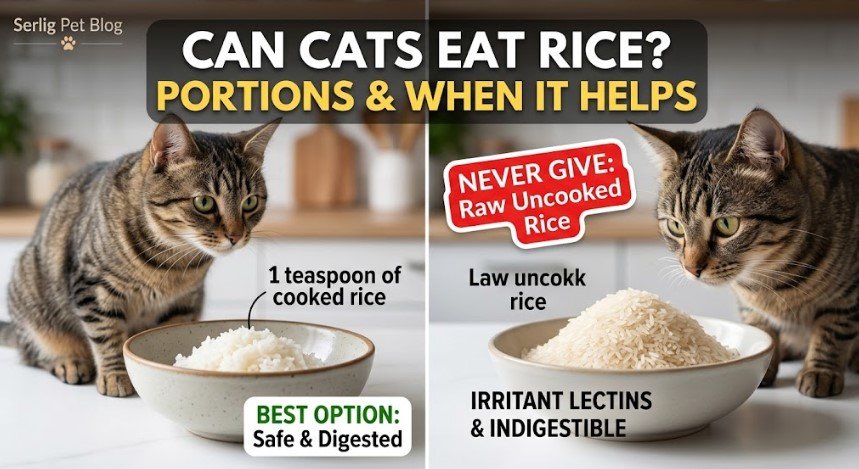
Can cats eat rice? Yes, plain cooked white rice is safe for cats in very small amounts. It is not toxic, but it provides almost nothing a cat needs and should never be more than an occasional teaspoon. The widely repeated advice to feed chicken and rice for an upset stomach comes from dog care, and veterinary sources genuinely disagree about whether it suits cats. Never give raw rice, seasoned rice, or leftover rice that has been left out.
Can Cats Eat Rice?
Yes, but the interesting part of this question is not whether rice is safe. It is whether rice is useful.
Plain cooked white rice contains nothing toxic to cats. A teaspoon mixed into food will do no harm to a healthy adult cat.
Where this topic becomes genuinely worth reading about is the chicken and rice advice that circulates constantly for upset stomachs. That advice originates in dog care, and when you look at what veterinary sources actually say about cats, they do not agree with each other. Some recommend it. Others say plainly that it does not work as well for cats and suggest something different.
That disagreement is the most useful thing on this page, and most articles about cats and rice do not mention it exists.
How Much Rice Is Safe?
Veterinary nutrition guidance holds that treats and extras should stay under 10 percent of a cat’s daily calories. For an average adult cat that is roughly 20 to 30 calories.
| Cat weight | Daily calories | Treat budget | Rice portion |
| 3 kg (7 lb) | 160 to 200 kcal | 16 to 20 kcal | About one teaspoon |
| 4 kg (9 lb) | 200 to 240 kcal | 20 to 24 kcal | One to two teaspoons |
| 5 kg (11 lb) | 240 to 300 kcal | 24 to 30 kcal | Up to one tablespoon |
| 6 kg (13 lb) | 280 to 340 kcal | 28 to 34 kcal | Slightly over one tablespoon |
Two points make this stricter than the table suggests.
Rice is displacing, not adding. Every calorie of rice is a calorie not spent on protein, taurine or animal fat. In a small carnivore that trade is a poor one, and it is worse than the equivalent trade in a dog.
Cats process starch, but not well. Cats do produce amylase, the enzyme that breaks down starch, so rice is not indigestible to them. They simply produce less of the relevant enzymes than an omnivore does and are built to run on protein and fat instead. Our guide to bread and cats covers the carbohydrate question in more detail.
If you are managing your cat’s weight, our guide to low calorie treats and portion control explains how to keep the arithmetic honest.
The Chicken and Rice Myth
This is the section that matters most, because it is the reason most people search for this topic.
Where the Advice Comes From
Boiled chicken and white rice is a long established home remedy for canine digestive upset. It is bland, low in fat, easy to digest and readily eaten by most dogs. For dogs it is reasonable advice.
The problem is that it has been copied across to cats without much scrutiny, and cats are not small dogs.
Why Sources Disagree
Look at what different veterinary publishers say and the split is obvious.
Some recommend it. A number of vets do suggest a small amount of plain white rice with boiled chicken for a mild, short lived upset, on the basis that it is bland and the fibre may firm up loose stools.
Others say it does not transfer. PetMD states directly that rice is harder for cats to digest and does not soothe the feline gastrointestinal tract the way it does a dog’s. Veterinary nutrition specialists have made a related point: a carnivore with an upset stomach is unlikely to voluntarily eat boiled rice at all.
Neither position is fringe. Both come from credible sources, which means the honest answer is that this is not settled, not that one side is obviously right.
The Palatability Trap
There is a specific practical problem here that almost no article mentions, and it is the strongest argument against the home remedy.
A sick cat usually refuses plain rice. It does not smell like meat and holds no interest for an animal that is already off its food. So the owner, trying to help, adds something to make it appealing. Butter, gravy, a spoon of tuna oil, or a splash of stock.
That addition defeats the entire purpose. Fat is the slowest nutrient to leave the stomach and is harder to process than protein or carbohydrate. Adding fat to make a bland diet palatable is the opposite of resting a digestive tract, and stock or gravy frequently contains onion or garlic, which are toxic to cats.
So the home remedy tends to fail in one of two ways. Either the cat will not eat it, which is dangerous for reasons covered in the next section, or it is made palatable in a way that undermines the point.
What Vets Often Recommend Instead
The alternative most commonly suggested is a therapeutic intestinal diet, available over the counter or on prescription. These are formulated specifically for cats with digestive upset, are complete rather than improvised, are highly palatable so a reluctant cat will actually eat them, and often contain fibre chosen to support gut bacteria.
That last point is the practical advantage. A recovering cat needs to eat, and a food it accepts readily is worth more than a theoretically bland one it refuses.
The realistic position. If your vet suggests a small amount of plain rice with boiled chicken for a mild one off upset, that is reasonable advice and you should follow it. Do not start it on your own initiative, do not add fat to make it acceptable, and do not run it for more than a day or two. Our guide to chicken and cats covers how to prepare the chicken component correctly.
The 24 Hour Rule
This is the safety point that gets lost in bland diet discussions, and it matters far more for cats than for dogs.
Cats that stop eating can develop hepatic lipidosis, a serious liver condition, and it can begin after a surprisingly short period without food. Overweight cats are at the highest risk.
That changes the calculation completely. With a dog, a day of refusing a bland diet is an inconvenience. With a cat, a day of not eating is a medical situation developing.
The rule: if your cat has eaten nothing for 24 hours, call your vet. Do not spend a second day trying to persuade them to accept rice.
This is also why palatability outranks blandness for cats. Anything your cat will actually eat is better than the theoretically ideal food it refuses. Our guide to changes in a cat’s appetite covers when a refusal signals something more serious, and our article on why cats vomit explains when vomiting stops being a home care matter.
How to Prepare Rice Safely
If your vet has recommended rice, or you simply want to offer a small amount, preparation matters more than most owners expect.
- Use plain white rice: Basmati and jasmine are fine. Skip brown, wild and anything labelled as a mix, since the extra fibre works against you.
- Cook it in plain water only: No stock, no bouillon cube, no salt, no butter, no oil. Shop bought stock almost always contains onion or garlic.
- Overcook it slightly: Soft, well cooked rice is easier for a cat to digest than rice with any firmness left. Use more water than the packet suggests and cook it a few minutes longer.
- Rinse the cooked rice in cool water: This removes surface starch and speeds cooling.
- Cool it completely before serving. Warm food increases the chance of it coming straight back up.
- Mix it with something: Rice alone is usually refused. A small amount of plain boiled chicken or a spoon of your cat’s usual wet food works, and neither adds fat the way butter or gravy does.
- Start with a teaspoon: If the goal is settling a stomach, several tiny portions across the day work better than one larger bowl.
- Refrigerate leftovers within an hour and discard them after a day.
If your cat refuses the mixture, do not keep trying with added fat to tempt them. Go back to your vet instead, because a cat that will not eat needs a different plan rather than a tastier version of the same one.
| Type | Verdict | Why |
| Plain cooked white rice | Best option | Softest and easiest to digest. The type used in bland diets |
| Plain cooked brown rice | Acceptable | More fibre, which makes it harder for cats to digest. No real advantage for a carnivore |
| Basmati or jasmine, plain | Acceptable | No benefit over white rice, but harmless plain and cooked |
| Wild rice | Avoid | Tougher and higher in fibre. Offers nothing useful |
| Fried rice | Never | Oil, salt, and almost always onion and garlic |
| Risotto, pilaf, seasoned rice | Never | Stock, butter, cheese and seasonings |
| Sushi rice | Avoid | Prepared with vinegar, sugar and salt |
| Leftover takeaway rice | Never | Seasoning plus a genuine food safety risk. See below |
| Raw uncooked rice | Never | Hard, indigestible, and contains lectins that irritate the gut |
| Rice in commercial cat food | Fine | Processed and balanced as part of a complete formula |
The pattern is that the rice itself is rarely the problem. What gets cooked with it usually is.
Never Give Leftover or Reheated Rice
This risk is well known in human food safety and, as far as we can find, is absent from every other article on cats and rice.
Uncooked rice commonly carries spores of Bacillus cereus, a bacterium that survives cooking. If cooked rice is then left at room temperature, those spores germinate and multiply, producing a toxin. That toxin is heat stable, which means reheating the rice does not destroy it. This is the reason food safety authorities warn people about reheated rice, and the same applies to a cat.
The rules
- Cool cooked rice quickly and refrigerate it within one hour
- Keep it no more than one day in the fridge before use
- Never offer rice that has sat out overnight or been left in a pan
- Never give rice from a takeaway container of unknown age
A cat is much smaller than you are, so a dose that would give a person a bad evening represents considerably more per kilogram of body weight. Given that rice offers a cat almost no benefit in the first place, there is no reason to accept any of this risk.
Why Rice in Cat Food Is Different
Owners often notice rice on an ingredient list and conclude that rice must therefore be good for cats. That is not quite the right reading.
Rice appears in commercial cat food as a formulated carbohydrate source. It adds bulk, binds kibble, contributes calories and improves texture, and it is processed in ways that make the starch more digestible than home cooked rice. Crucially, it sits inside a recipe balanced to meet AAFCO nutrient profiles, where the protein, taurine, vitamins and minerals are all accounted for around it.
Rice from your own pan has none of that context. It is the same grain in a completely different nutritional setting.
When rice does become a genuine problem
- Taurine. Research has linked high levels of rice bran in a feline diet to reduced taurine status. Rice bran is not the same as plain white rice, so this is not an argument against a teaspoon of rice. It does illustrate that heavy grain content in a cat’s diet has measurable consequences.
- Fibre. Too much rice can cause either loose stools or constipation, depending on the cat.
- Diabetes. Rice is high glycaemic. For a diabetic cat, unplanned carbohydrate interferes with insulin dosing and glucose stability, so it should be avoided entirely.
- Weight. Rice is calorie dense for its nutritional return, which makes it a poor use of a small daily budget.
Better Options
If the goal is a treat, or a gentle food for a cat that is slightly off colour, these all serve better than rice.
- Plain cooked chicken, shredded small. Species appropriate and readily accepted.
- A therapeutic intestinal diet, if the issue is digestive. This is what most vets will suggest.
- Plain cooked fish, boneless and unseasoned, as an occasional treat.
- A lickable puree treat, which is highly palatable to a cat with a reduced appetite.
- Plain pumpkin, a small amount of which is sometimes suggested for mild constipation and which cats often accept more readily than rice.
For the full picture of what belongs in a cat’s diet, see our complete guide to what cats can eat.
Frequently Asked Questions
No. Rice offers almost no nutritional value to a cat and displaces calories that should go to protein. Keep it to an occasional teaspoon at most.
Sources genuinely disagree. Some vets recommend it for a mild, brief upset. Others note that rice does not soothe a cat’s gut the way it does a dog’s and suggest a therapeutic intestinal diet instead. Follow your own vet’s advice rather than general guidance, and never start it as a substitute for a consultation.
White. It is softer, lower in fibre and easier for a cat to digest. Brown rice has more fibre, which is a benefit for humans and a complication for cats.
No. Uncooked rice is hard, difficult to digest and contains lectins that can irritate the digestive tract. A few grains off the floor is not an emergency, but a larger amount warrants a call to your vet.
It is best avoided. Kittens have high growth requirements and almost no room for calories that carry no nutrition. Our kitten feeding schedule sets out what they need.
Check what was in it. Onion and garlic, including powdered forms, are toxic to cats and warrant a call to your vet. Plain oil and salt are less urgent but may cause digestive upset.
It is a formulated carbohydrate source that adds calories and structure within a complete recipe, processed for digestibility and balanced against everything else in the formula. That is a different situation from rice served on its own.
Conclusion:
Can cats eat rice? Yes, in small amounts, plain and thoroughly cooked. It is safe and almost entirely pointless, which is an unusual combination.
The part worth remembering is the chicken and rice advice. It came from dog care, veterinary sources disagree about whether it suits cats, and the practical problem is that a sick cat usually will not eat plain rice while making it palatable defeats the purpose. If your vet recommends it for a specific short lived upset, follow that. Otherwise a therapeutic diet is the better route, and a cat that has not eaten for 24 hours needs a vet rather than another attempt at the bowl.
Rice is a filler. In a small obligate carnivore, filler is a luxury there is very little room for.
A Note on Pet Health
Serlig publishes researched pet care information for everyday owners. It is general guidance, not veterinary advice, and it does not replace an examination by a licensed veterinarian who knows your pet. If your pet is unwell, or anything in this guide does not match what you are seeing at home, contact your vet.