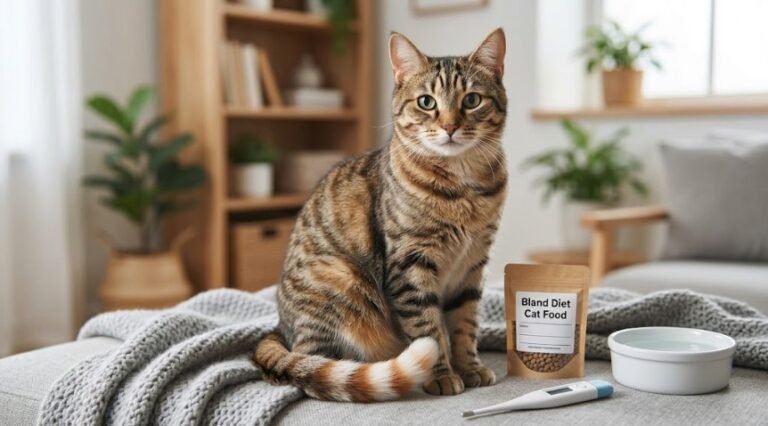
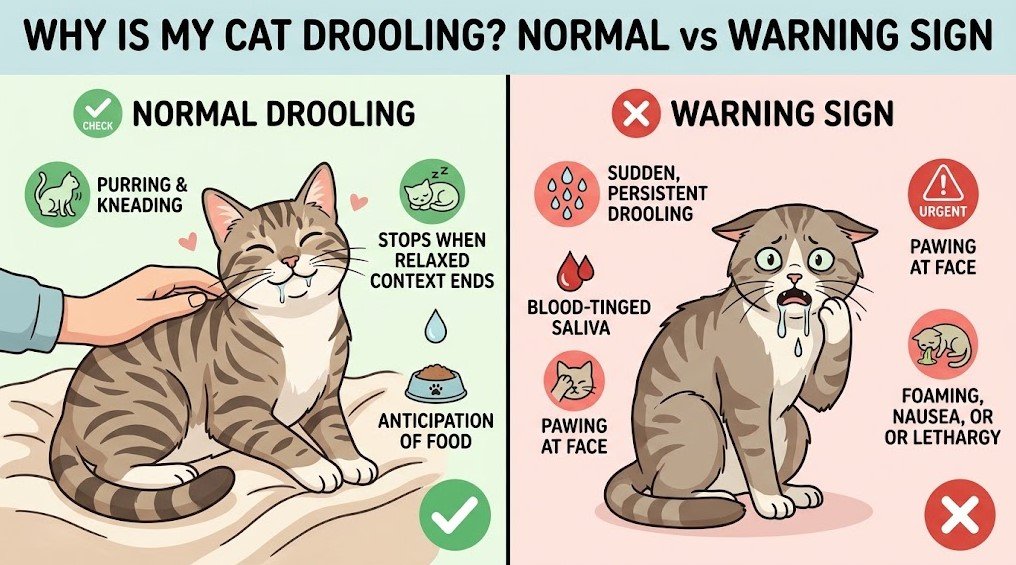
Why is my cat drooling has two very different answers. A small amount of drooling in a relaxed, purring, kneading cat is normal and harmless. New, heavy, one sided or persistent drooling is not, and in cats the most common cause is mouth pain, usually dental disease. Nausea, toxins, bitter medication and foreign objects are the other frequent causes. Because cats conceal pain so well, drooling is sometimes the only outward sign that something hurts, which is why it should not be watched indefinitely.
When Drooling Is Normal
A minority of cats drool when deeply relaxed, and in that context it means nothing worrying.
Normal drooling looks like this
- It happens while purring, kneading or being stroked, and stops when the cat gets up
- It is a small amount, not a steady stream
- It has happened for years and is part of your cat’s pattern
- Your cat is otherwise completely well, eating normally and behaving normally
- It sometimes appears in anticipation of a favourite food or treat
The relaxed version is usually linked back to the nursing association, since a nursing kitten salivates in expectation of milk. Our guide to why cats knead covers that whole contented cluster of purring, kneading and drooling.
The rule that makes this simple: normal drooling has a context and stops when the context does. If you can say “this happens when she is on my lap purring,” it is probably fine. If you cannot explain when it happens, it needs a vet.
The Emergency Causes
Most drooling is not an emergency. These are the exceptions, and they justify the warning at the top of this page.
Linear foreign body. String, thread, tinsel, dental floss or ribbon caught under the tongue. Covered in full below, because it is both the most dangerous and the most commonly mishandled.
Lily poisoning. Every part of a true lily is toxic to cats, including the pollen and the water in the vase. It causes acute kidney failure, and drooling can be an early sign alongside vomiting and lethargy. A cat that has brushed against lily pollen and groomed it off has been exposed. This is an emergency even if your cat looks well.
Permethrin exposure. Many dog flea treatments contain permethrin, which is highly toxic to cats. Drooling, tremors, twitching and seizures after a flea product has been applied, or after contact with a recently treated dog, is a veterinary emergency. Our guide to flea treatment covers this in more detail, and it is one of the most common serious poisonings in multi pet households.
Other toxins. Household cleaners, insecticides, human medications and certain plants. Our guide to foods and substances toxic to cats covers the kitchen side.
Heatstroke. Cats manage heat poorly, and drooling alongside panting, lethargy or bright red gums after warm weather is urgent. Our guide to keeping cats cool covers what actually helps.
Breathing difficulty. A cat breathing with its mouth open is always an emergency, and drooling may accompany it because the cat cannot swallow normally.
Trauma. A fall, a fight or a road accident can fracture a jaw or tooth, and drooling may be the visible sign.
Never Pull a String
This deserves its own section because the instinctive response is the one that causes the most harm, and no other article on this topic says so clearly.
What a linear foreign body is. A cat swallows string, thread, tinsel or ribbon. One end catches, most often around the base of the tongue. The rest travels on into the intestine, which keeps contracting and trying to move it along.
Why it is so dangerous. With one end anchored, the intestine cannot push the string through. Instead it bunches up along it like fabric gathered on a thread. The string then pulls tight against the inside of the bowel and can saw through the intestinal wall. This causes perforation and peritonitis, and it is a surgical emergency.
Why you must not pull it. If you can see string under the tongue and the other end is anchored deep in the intestine, pulling it drags the bowel with it and can cause exactly the damage you are trying to prevent. Cut nothing, pull nothing, and go.
What to do
- Do not pull, cut or attempt to remove anything
- Stop your cat from swallowing more if you safely can
- Go to an emergency vet immediately
- Tell them you suspect a linear foreign body, and describe what you saw
Prevention. Tinsel, ribbon, wool, hair ties, dental floss and sewing thread are all classic culprits. Christmas is the peak season for this. Store them out of reach permanently rather than tidying them away after use.
Dental Disease: The Most Common Cause
If your cat is drooling and it is not normal relaxed drooling, mouth pain is the most likely explanation.
What causes it
- Gingivitis, inflammation of the gums
- Periodontal disease, affecting the deeper structures supporting the teeth
- Tooth resorption, covered separately below
- Stomatitis, severe inflammation of the whole mouth lining
- Mouth ulcers
- Fractured teeth
- Oral tumours, which in early stages can look very similar to dental disease
Other signs of oral pain
- Bad breath, often the earliest sign
- Blood tinged saliva
- Pawing at the face or mouth
- Dropping food while eating
- Chewing on one side only
- Eating less, or approaching food and then walking away
- Reluctance to be touched around the head
- Reduced grooming, leading to a scruffy coat
Stomatitis deserves a specific note. It is severe, immune mediated inflammation of the mouth that is extremely painful, and treatment frequently requires removing most or all of the teeth. Cats do remarkably well afterwards, often eating better than before, because the pain source is gone.
Because cats hide discomfort so effectively, drooling is sometimes the only outward sign of significant mouth pain. Our guide to recognising pain in cats covers the quieter signals.
Tooth Resorption
This condition is common, painful and largely invisible, which is why it deserves more than the passing mention it usually gets.
What it is. The structure of the tooth gradually breaks down and is resorbed by the body. It is one of the most frequently diagnosed dental conditions in cats.
Why it is missed. The damage often begins below the gum line, so a tooth can look normal while being severely affected. Diagnosis usually requires dental X rays under anaesthetic, which is why a visual check at a routine appointment does not rule it out.
Why cats keep eating. Cats are extraordinarily stoic and will continue eating through significant oral pain. Owners frequently say “he cannot be in pain, he is eating fine.” Eating is not evidence of comfort.
Signs that may be present. Drooling, a sudden jaw tremor or chattering when the area is touched, dropping food, preferring soft food, and pulling away when the head is handled.
Treatment is extraction. There is no filling or repair for a resorbing tooth, and cats are usually noticeably brighter afterwards.
This is the single most common reason a cat drools while otherwise seeming completely normal.
Nausea
Drooling is a classic nausea sign in cats, and it often comes before any vomiting.
Common causes
- Hairballs and gastrointestinal upset
- Motion sickness, particularly on car journeys
- Kidney disease, which causes nausea and mouth ulcers
- Liver disease
- Pancreatitis
- Dietary indiscretion
- Medication side effects
Look for the pattern. Nausea related drooling often comes with lip licking, repeated swallowing, hiding, reduced appetite and a hunched posture. Our guides to why cats vomit and changes in appetite cover what else to watch.
Car journeys. Drooling in a carrier is very common and usually motion sickness or stress combined. It should stop once the journey ends. If it does not, that is different.
Bitter Medication and Foaming
This one is common, alarming and usually harmless, and it deserves reassurance rather than a warning.
What happens. A cat given a bitter tasting tablet or liquid may foam heavily at the mouth, drool profusely, gag, paw at its face and look genuinely distressed. Some medications are notorious for this.
It usually settles within a few minutes. Offering a small amount of food or a lickable treat afterwards often helps clear the taste.
When it is not harmless. If the foaming follows a topical product, especially a flea treatment, that is different, and the permethrin warning above applies. If it follows a medication and does not settle, or your cat becomes wobbly or unwell, call your vet.
Tell your vet if a medication causes this. There is often an alternative formulation, a flavoured version, or a different route such as a transdermal gel.
My Cat Is Drooling But Acting Normal
This is the most common real situation, and it deserves a direct answer rather than a list of causes.
The honest answer: it still needs a vet appointment, just not an emergency one.
Here is why. The two most likely explanations for a cat that drools while eating, playing and behaving entirely normally are tooth resorption and mild nausea. Both are genuinely painful or unpleasant. Neither reliably changes behaviour, because cats evolved to conceal weakness and a cat that shows pain in the wild is a cat that gets targeted.
Normal behaviour is therefore not reassurance. It is the default state of a cat with a problem.
What to do
- Book a routine appointment rather than an emergency one
- Note when the drooling happens and whether it is one sided
- Check for bad breath, which is often the giveaway
- Ask specifically about dental X rays, since a visual examination cannot rule out resorption
When to upgrade to urgent. If your cat stops eating, becomes lethargic, starts vomiting, develops bloody saliva, or the drooling becomes heavy and constant.
What the Pattern Tells You
| Pattern | What it suggests |
| Only while purring or kneading, stops afterwards | Normal relaxed drooling |
| Sudden and heavy, with distress | Foreign body, toxin, trauma or severe pain. Urgent |
| Gradual increase over weeks | Dental disease, tooth resorption, or a growing oral lesion |
| One sided only | A focal problem: a tooth, a lesion, a foreign object, or in some cases a nerve issue. Worth mentioning specifically |
| With bad breath | Strongly suggests dental disease |
| With blood tinged saliva | Oral lesion, ulcer, trauma or tumour. Needs prompt assessment |
| With vomiting or lip licking | Nausea |
| Only in the car | Motion sickness or stress |
| Immediately after medication | Bitter taste reaction, usually self limiting |
| After a flea product | Possible permethrin toxicity. Emergency |
| With pawing at the mouth | Foreign body or acute oral pain |
One sided drooling is the pattern owners most often fail to mention and the one that most usefully narrows things down. If saliva is consistently coming from one side of the mouth, say so.
How to Check Your Cat’s Mouth Safely
Only attempt this if your cat is calm and tolerant. A cat in pain may bite, and there is no shame in leaving it to a vet.
- Choose a quiet moment when your cat is relaxed, not immediately after a distressing episode
- Start with the outside. Gently lift the lip on each side to look at the gums and teeth. Red gum margins and visible tartar are both meaningful
- Smell the breath. A strong foul odour is a reliable indicator of dental disease
- Look for asymmetry, swelling on one side of the face, or a jaw that does not close properly
- Do not force the mouth open, and do not put your fingers inside
- If you see string, stop. Do not pull it. Go to a vet
- Stop immediately if your cat resists, and try again another time or not at all
What you cannot see. Tooth resorption below the gum line, lesions at the back of the mouth, anything under the tongue, and the throat. A clear look does not mean a clear mouth.
What the Vet Will Do
Examination first, including the mouth as far as the cat allows, plus temperature, weight and general assessment.
Sedation or anaesthesia is often needed for a proper oral examination in a painful cat, which is normal rather than excessive.
Dental X rays, which are the only way to identify tooth resorption and root disease.
Bloodwork if a systemic cause such as kidney disease is suspected.
Imaging if a foreign body or obstruction is possible.
Treatment depends entirely on the cause, from a dental cleaning and extractions, to surgery for a foreign body, to treatment of an underlying illness.
A word on cost. A basic examination is relatively affordable. A full workup with sedation, dental X rays and extractions runs considerably higher, and it is worth asking for an estimate up front. It is also worth knowing that dental disease left untreated tends to get more expensive rather than less, since more teeth become affected over time.
Frequently Asked Questions
Is it normal for a cat to drool when purring? Yes, for some cats. Relaxed drooling during purring, kneading or stroking is harmless as long as it stops when the cat gets up and your cat is otherwise well.
My cat is drooling but eating normally. Should I worry? Book a routine vet appointment. Cats hide pain well, and tooth resorption and mild nausea both commonly present exactly this way. Eating normally is not evidence that nothing hurts.
What if I see string in my cat’s mouth? Do not pull it. A string anchored under the tongue may extend into the intestine, and pulling can cause serious internal damage. Go to an emergency vet immediately.
Why is my cat drooling from one side only? One sided drooling suggests a focal problem such as a painful tooth, an oral lesion, a foreign object, or in some cases a nerve issue. Mention it specifically, since it helps narrow the diagnosis.
My cat foamed at the mouth after medication. Is that dangerous? Usually not. Bitter tasting medications commonly cause dramatic foaming that settles within minutes. If it follows a topical flea product, or does not settle, contact your vet.
Can stress make a cat drool? Yes. Car journeys, vet visits and other stressful situations can cause drooling, which should stop once the situation ends. Persistent drooling is not stress.
How urgent is cat drooling? It depends entirely on the context. Relaxed purring drooling needs nothing. Drooling with string, breathing difficulty, toxin exposure, collapse or severe distress is an emergency. Everything in between warrants a routine appointment rather than watching indefinitely.
The Bottom Line
Why is my cat drooling comes down to whether you can explain when it happens. Drooling that appears only during purring and kneading, in an otherwise well cat, is normal. Drooling you cannot account for is a symptom, and in cats the most likely cause is mouth pain.
Three things are worth carrying away. If you see string, do not pull it, because a linear foreign body anchored under the tongue can extend into the intestine and pulling makes it far worse. A cat behaving normally is not a cat without pain, since tooth resorption and mild nausea both present exactly that way and cats conceal discomfort by instinct. And ask specifically about dental X rays, because the most common painful dental condition in cats is largely invisible without them.
Bad breath alongside drooling is one of the most reliable pointers there is. It is easy to check and easy to overlook.