
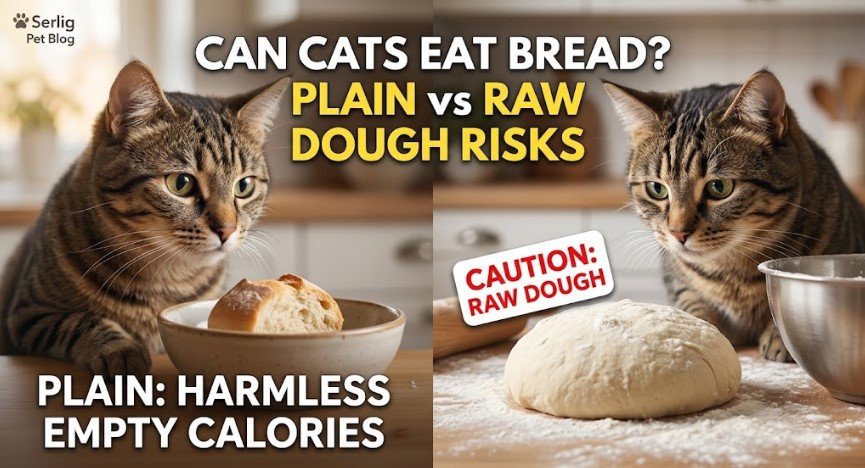
Can cats eat bread? A small piece of plain, fully baked bread will not poison a cat, but it offers no nutritional value and is better skipped. Raw yeast dough is a completely different matter and is a genuine emergency. Dough keeps rising inside a cat’s warm stomach and ferments into ethanol, causing painful bloating and alcohol poisoning. If your cat eats raw dough, call a vet immediately. Also avoid raisin, garlic, onion and sweetened breads entirely.
Can Cats Eat Bread?
This question has two answers that could not be further apart, and the difference is whether the bread has been baked.
Plain baked bread is not toxic. A crumb or a corner of crust will do nothing to a healthy adult cat beyond using up calories that could have gone somewhere useful. It is a non event.
Raw yeast dough is one of the most dangerous things in a domestic kitchen for a cat. It causes two serious problems at once, and cases have been fatal.
Most articles about cats and bread lead with the harmless version and mention the dangerous one near the bottom. That ordering is backwards. If you are reading this because your cat just ate something, skip ahead to the dough section now.
Everything else here is about why baked bread is pointless rather than harmful, which breads contain genuinely toxic ingredients, and one specific mistake involving bread that owners make with medication.
Why Cats Are Drawn to Bread
Cats showing interest in bread confuses most owners, and there is a real explanation for it.
It is not the sweetness. Cats lack functioning sweet taste receptors and physically cannot taste sugar. Whatever draws a cat to a loaf, it is not the flavour humans notice.
It is the yeast. Yeast produces savoury, umami rich aromatic compounds, and umami is the taste category cats detect most strongly, because it signals meat. Nutritional yeast is used as a flavour coating on many commercial cat treats for exactly this reason. When a bag of bread opens, the smell your cat responds to is closely related to the smell of its own treats.
This has a practical implication. A cat interested in bread is not developing a taste for carbohydrates. It is reacting to an aroma that its brain has categorised as food worth investigating, and that instinct does not distinguish between a baked loaf on the table and a bowl of dough rising on the counter.
Plain Baked Bread: Not Toxic, But Not Food
If your cat eats a small piece of plain white or wholemeal bread, nothing needs to happen. There is no emergency and no reason for concern.
The argument against bread is not danger. It is that it takes up space in a very small nutritional budget and gives nothing back.
The calorie problem: An average adult cat needs roughly 200 to 300 calories a day, and veterinary guidance holds that treats should stay under 10 percent of that. That is a budget of about 20 to 30 calories. A single slice of white bread contains somewhere in the region of 70 to 80 calories, which is around three days of a cat’s entire treat allowance in one slice.
The carbohydrate problem: Cats are obligate carnivores with limited capacity to process starch. Their livers produce less of the relevant enzymes than an omnivore’s does, so bread is not simply low in useful nutrients for a cat. It is a form of calorie they are poorly equipped to use.
The displacement problem: Every calorie of bread is a calorie not spent on protein, taurine, vitamin A or the other nutrients a cat genuinely requires. In a small animal this adds up faster than people expect.
Diabetic cats: Refined bread is high glycaemic and raises blood glucose. For a cat managing diabetes, unplanned carbohydrate interferes with insulin dosing and glucose stability. Bread should be off the list entirely.
If you are watching your cat’s weight, our guide to low calorie treats and portion control explains how to keep the arithmetic honest.
Raw Dough Is a Genuine Emergency
This is the section that matters.
Raw, yeasted dough is dangerous to cats in two separate ways, and both begin the moment it is swallowed.
What Happens Inside the Stomach
A cat’s stomach is warm, dark and moist, which is close to ideal proofing conditions. Dough that has stopped rising on a cold counter starts rising again inside the animal.
Physical expansion: The dough mass grows, distending the stomach. This causes severe pain, can obstruct the digestive tract, and in serious cases can lead to bloating that requires surgery. The ASPCA notes that this distension can progress to gastric torsion, in which the stomach twists, which is life threatening.
Alcohol poisoning: As yeast ferments the sugars in the dough, it produces carbon dioxide and ethanol. That ethanol is absorbed into the bloodstream. Cats are extremely sensitive to alcohol, and even the amount produced by a small piece of dough can be enough to cause serious harm.
Signs of alcohol toxicity progress from apparent disorientation and unsteadiness to vomiting, low body temperature, low blood pressure, low blood sugar, tremors, respiratory depression, coma and, in severe cases, death.
The combination is what makes dough so serious. One problem is mechanical and one is chemical, and both are worsening while the cat looks merely uncomfortable.
What to Do
- Call a vet or an emergency clinic immediately: Do not wait for symptoms. The fermentation is already underway, and time is the variable that matters most here.
- Do not induce vomiting: A mass of expanding dough coming back up carries a real risk of choking or airway obstruction. This is a decision for a vet, not a kitchen.
- Do not give food, milk or water in an attempt to dilute it. Additional liquid does not help and may add to the distension.
- Note what was eaten and when: The type of dough, roughly how much, and the time it happened. If a packet is available, keep it.
- Go in even if your cat seems fine: Early signs are subtle, and a cat that appears mildly wobbly may already be intoxicated.
What the Vet Will Do
Knowing this in advance reduces the hesitation that costs time.
Treatment usually involves slowing the fermentation and managing the alcohol. Vets may use cold water gastric lavage, because chilling the dough mass slows yeast activity considerably. Supportive care addresses body temperature, blood sugar and hydration, and in severe cases specific treatment for alcohol toxicity is given. Where the dough mass cannot be removed any other way, surgery is sometimes necessary.
None of this is something to attempt at home, and every hour of delay makes it harder.
The Yeast Packet Exception
Here is a detail almost no other guide includes, and it prevents an unnecessary emergency trip.
If your cat gets into a sealed packet of dry yeast with nothing else, that is not the same situation. Yeast requires a sugar source to ferment, and dry yeast on its own has nothing to work with. The ASPCA states plainly that there is no danger from yeast consumed straight from the packet.
The danger comes from yeast combined with dough, where the flour and sugar provide the fuel for fermentation.
This distinction matters because it separates a genuine emergency from a false alarm. If your cat licked spilled dry yeast off the floor, monitor them normally. If your cat ate dough, call the vet.
Sourdough starter is worth a specific mention here, because it falls firmly on the dangerous side. It is an active, sugar rich yeast culture, and it is frequently left out on a counter for hours where a cat can reach it.
Which Breads Are Dangerous?
Plain bread is the exception rather than the rule. Most bread on a domestic worktop contains something a cat should not have.
| Bread type | Verdict | Why |
| Raw yeast dough of any kind | Emergency | Expands and ferments internally. Call a vet immediately |
| Sourdough starter | Emergency | An active yeast culture. Same risks as dough |
| Pizza dough, raw | Emergency | Same yeast risk, and toppings often add garlic and onion |
| Raisin bread, fruit loaf, hot cross buns | Never | Grapes and raisins are linked to acute kidney failure in cats. No safe dose is known |
| Garlic bread | Never | Garlic damages red blood cells. Concentrated forms are worse |
| Onion bread or seasoned flatbread | Never | Same mechanism as garlic |
| Sweet breads and cakes with xylitol | Never | Xylitol triggers a dangerous insulin release and liver damage |
| Nut breads | Avoid | High fat, and macadamia in particular is unsafe for cats |
| Seeded and grain breads | Avoid | Seeds add choking and digestive risk with no benefit |
| Buttered or oiled toast | Avoid | Added fat with no purpose |
| Plain baked white or wholemeal | Not toxic | Safe in a crumb. Still empty calories |
The practical rule: read the ingredient list before assuming a bread is plain. Raisin and garlic breads are the two that send cats to emergency clinics most often, and neither is always obvious from the crust. Our guide to human foods toxic to cats covers the symptoms of each.
Never Use Bread to Hide a Pill
This is a specific mistake worth naming, because it seems sensible and is not.
Bread is a poor vehicle for medication in cats. It becomes gummy when wet and readily sticks to the roof of the mouth, which causes panic, gagging and a genuine choking risk. Cats also tend to detect and reject the bread rather than swallowing it, so the medication ends up on the floor.
Better options are meat based pill pockets, a small amount of wet food, or a purpose made lickable paste. All of them work with a cat’s instincts rather than against them.
If your cat consistently refuses medication, ask your vet whether the drug is available as a liquid, a transdermal gel applied to the ear, or a long acting injection. This is a common problem with well established solutions, and struggling with it at home is unnecessary.
Kitchen Safety During Baking
The ASPCA has noted a rise in bread related calls to its poison control centre as home baking has grown in popularity, and there is a reason this matters more for cats than for dogs.
Dough is almost always left to prove on a counter or worktop. That places it out of reach of most dogs and directly within reach of most cats.
Practical precautions
- Prove dough inside a closed oven that is switched off, or inside a microwave, rather than on an open counter
- Keep the kitchen door shut while dough is rising
- Cover bowls with a weighted lid rather than a loose cloth
- Store sourdough starter in a closed cupboard or the fridge between feeds
- Clean up flour and dough scraps promptly, since cats investigate residue
- Do not leave cooling loaves unattended on a rack
A cat that has never shown interest in food on a counter may still investigate dough, because the yeast aroma reads as something worth checking. Past behaviour is not a reliable guide here.
Feeding Bread to Stray and Community Cats
This deserves its own answer, because it is a common practice and the people doing it are trying to help.
Bread is cheap, usually available and readily accepted, so it is often the first thing offered to a stray or community cat. Some strays actively seek it out, having learned that bakeries and bins are reliable sources.
The difficulty is that a hungry cat eating bread fills its stomach without meeting any of its actual requirements. A cat living outdoors needs more protein, not fewer hunger signals, and a stomach full of carbohydrate suppresses appetite for several hours without supplying taurine, animal protein or fat. Over weeks this contributes to the poor coat, muscle loss and weakened immunity commonly seen in scavenging cats.
Better options that cost little more
- A pouch of economy wet cat food, which is nutritionally complete and often costs less than people expect
- Plain cooked chicken, including trimmings and offcuts that would otherwise be discarded
- Dry cat food, which stores well and is the cheapest complete option per calorie
- Fresh water, which is frequently harder for an outdoor cat to find than food
If you regularly feed community cats, contacting a local rescue or trap and neuter programme is worth doing. Many hold donated food and will supply it to established feeders.
If the impulse is to share something with your cat, these all work better.
- A small piece of plain cooked chicken: Species appropriate and enthusiastically accepted. Our guide to chicken and cats covers portions and preparation.
- Plain cooked fish, boneless and unseasoned, as an occasional treat.
- A commercial treat with a stated calorie count, which makes portion control possible.
- A lickable puree treat, which delivers the same ritual with far fewer calories.
- Play instead of food: A great deal of treat giving is really about interaction, and five minutes with a wand toy usually satisfies the same impulse.
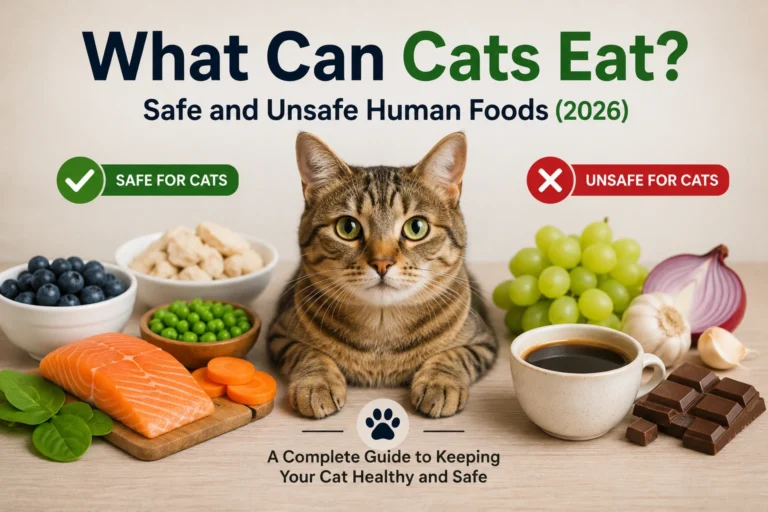
For the full picture of what belongs in a cat’s diet, see our complete guide to what cats can eat.
Frequently Asked Questions
A crumb of plain baked bread is harmless. It provides nothing useful, so there is no reason to offer it, but there is also no reason to worry if your cat has eaten some.
The dough continues rising in the stomach, causing painful distension and possible obstruction, while fermenting yeast produces ethanol that leads to alcohol poisoning. This is an emergency requiring immediate veterinary care.
Plain dry toast carries the same verdict as plain bread: not toxic, not useful. Buttered toast adds unnecessary fat, and anything spread with garlic or containing raisins is unsafe.
Generally no. Yeast needs a sugar source to ferment, and dry yeast alone has none. Monitor your cat as normal. Dough is the dangerous form.
No. Kittens have very little room in their diet for calories that carry no nutrition, and they are more vulnerable to any digestive upset. Our kitten feeding schedule sets out what they need.
The yeast, not the sugar. Cats cannot taste sweetness, but yeast produces savoury umami aromas similar to those used to flavour commercial cat treats.
No. Bread is sometimes used this way for dogs, but cats process carbohydrates poorly. Plain boiled chicken is the more appropriate bland option, and a persistent upset needs a vet rather than home management. Our article on why cats vomit explains when it becomes urgent.
Conclusion:
Can cats eat bread? A small piece of plain baked bread will not hurt your cat, and it will not help either. It is empty calories in an animal with a very small daily budget for them.
The part that genuinely matters is raw dough. It expands inside a warm stomach and ferments into alcohol, and both processes are underway before a cat looks unwell. If your cat eats raw yeast dough, that is a call to the vet immediately, not a situation to watch and wait on.
The everyday version of this advice is simple. Bread is not worth giving, most breads on a kitchen counter contain something worse than plain flour, and rising dough belongs behind a closed door.
A Note on Pet Health
Serlig publishes researched pet care information for everyday owners. It is general guidance, not veterinary advice, and it does not replace an examination by a licensed veterinarian who knows your pet. If your pet is unwell, or anything in this guide does not match what you are seeing at home, contact your vet.


2 Comments