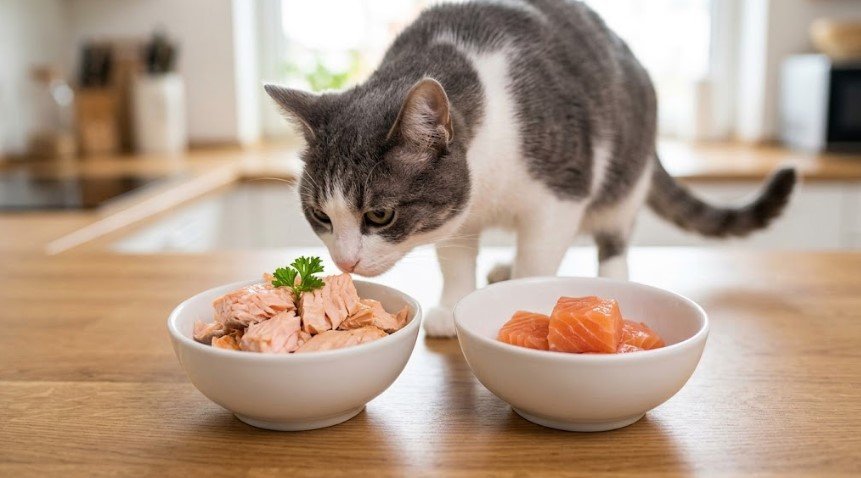
Can cats eat salmon? Yes. Plain cooked salmon, boneless and unseasoned, is one of the better fish treats for a cat and is genuinely lower risk than tuna. Keep it to a tablespoon or so, once or twice a week. Never feed raw salmon, which contains thiaminase and carries bacterial and parasite risks. Smoked salmon is the worst option of all, since it is usually not cooked and is heavily salted. Canned salmon is acceptable only if packed in water with no salt added.
Can Cats Eat Salmon? The Short Answer
Yes, and of the fish that commonly appear in a domestic kitchen, salmon is one of the better choices for a cat.
Plain cooked salmon is rich in complete animal protein and in the long chain omega 3 fatty acids EPA and DHA, which genuinely do support skin, coat and joint health in cats. Unlike some foods in this series, salmon is not simply harmless. It has a real, if modest, nutritional case behind it.
The complications are all about preparation rather than the fish. Raw is unsafe. Smoked is worse than most people realise. Canned is more nuanced than you will read elsewhere. And there is one specific error that appears repeatedly in articles about cats and raw salmon, which is addressed below.
Why Salmon Suits Cats Better Than Tuna
Both are oily fish and both are popular with cats, but the risk profile is meaningfully different.
Mercury: Salmon carries substantially less mercury than tuna, because it is a shorter lived fish lower down the marine food chain. Tuna is a large predatory fish that accumulates mercury over years. This is the main reason salmon can be offered more comfortably. That difference is why tuna is best kept to an occasional treat, while salmon can be offered a little more freely.
Omega 3 profile: Salmon is a strong source of EPA and DHA, the forms of omega 3 that cats can actually use. If coat condition is what you are after, salmon has a better case than most foods.
Fixation risk: Salmon is less likely than tuna to create a total food fixation, though it is not immune. Cats that begin refusing balanced food in favour of any single fish are heading somewhere unhelpful.
The one thing salmon does not solve is completeness. It is still a topper on a balanced diet rather than a food a cat can live on.
How Much Salmon Is Safe?
Veterinary guidance holds that treats should stay under 10 percent of a cat’s daily calories. For an average adult cat that is roughly 20 to 30 calories.
Cooked salmon contains around 200 calories per 100 grams, which makes it calorie dense compared with chicken breast.
| Cat weight | Daily calories | Treat budget | Salmon portion |
| 3 kg (7 lb) | 160 to 200 kcal | 16 to 20 kcal | About one teaspoon, 8 g |
| 4 kg (9 lb) | 200 to 240 kcal | 20 to 24 kcal | One to two teaspoons, 10 g |
| 5 kg (11 lb) | 240 to 300 kcal | 24 to 30 kcal | Up to one tablespoon, 15 g |
| 6 kg (13 lb) | 280 to 340 kcal | 28 to 34 kcal | Slightly over a tablespoon, 17 g |
Once or twice a week is a reasonable frequency for a healthy adult cat, and treat calories should be subtracted from the meal rather than added to it. Our guide to low calorie treats and portion control covers how quickly the budget disappears.
Why Raw Salmon Is Not Safe
Three separate problems, and one commonly repeated error worth correcting.
Thiaminase
Raw salmon contains thiaminase, an enzyme that destroys thiamine, also known as vitamin B1. Cats have a high thiamine requirement, and a deficiency produces neurological signs including dilated pupils, an unsteady gait, head tilt, weakness and in advanced cases seizures.
Cooking inactivates thiaminase completely, which is why this risk disappears entirely with proper preparation. Our guide to signs of vitamin deficiency in cats covers the earlier stages.
Bacteria and Parasites
Raw fish can carry Salmonella, Listeria and E. coli, along with parasites. These pose a risk to your cat and to everyone in the household, since bacteria shed in a cat’s stool can spread to people and other pets.
Sushi grade salmon is not an exception. That grading refers to handling standards for human consumption and does not make raw fish appropriate for a cat.
A Correction: Salmon Poisoning Disease Is a Dog Problem
You will find articles warning that raw salmon causes salmon poisoning disease in cats. That is an error worth flagging.
Salmon poisoning disease is a real and serious condition caused by an organism carried within a fluke found in raw Pacific salmonids. It affects dogs and other canids. Cats are not susceptible to the clinical disease.
This matters for two reasons. If you keep both a cat and a dog, the raw salmon warning is genuinely urgent for the dog and the cat guidance is different. And if you are trying to work out how worried to be about a cat that stole a piece of raw fish, searching for the wrong condition will not help.
None of this makes raw salmon safe for cats: Thiaminase, bacteria and parasites remain entirely valid reasons to cook it. The point is accuracy about which risk applies to which animal.
Smoked Salmon Is the Worst Option
Smoked salmon deserves a clear warning, because most people assume smoking counts as cooking.
Cold smoked salmon, which is the common supermarket kind, is not cooked. It is cured with salt and then smoked at a low temperature that preserves the texture without cooking the flesh. That means every raw fish risk still applies, including thiaminase and bacterial contamination.
On top of that, it is heavily salted. A small portion of smoked salmon can carry a considerable sodium load for an animal weighing four kilograms.
So smoked salmon combines the raw risks with a salt problem, which makes it worse than either plain raw salmon or plain cooked salmon. Hot smoked salmon is cooked through, but is still cured and salted.
The same applies to gravlax, salmon pâté and anything cured rather than cooked.
Canned Salmon: More Nuanced Than You Read
Most articles say to avoid canned salmon entirely because of sodium. That is too blunt.
What matters is the packing liquid and the salt.
- Canned in spring water, no salt added: perfectly reasonable as an occasional treat. Drain it well.
- Canned in brine: avoid. High sodium.
- Canned in oil: avoid. Adds substantial fat and calories.
- Flavoured or seasoned pouches: avoid. Frequently contain onion or garlic powder.
There is also a detail in favour of canned salmon that nobody mentions. The soft bones in canned salmon are edible and are a genuine calcium source, having been softened by the canning process. Since plain fish fillet is high in phosphorus and low in calcium, those soft bones actually improve the balance rather than presenting the hazard that hard bones do.
Check the ingredient list rather than the front of the tin, since salted varieties are not always obviously labelled.
Salmon Skin and Bones
Skin. Sources disagree on this, and the honest answer is that it depends. Cooked plain salmon skin is not dangerous and does carry a higher concentration of omega 3 oils than the flesh. It is also where most of the fat sits, so it is a poor choice for an overweight cat or one with a history of pancreatitis, and skin from a fillet you seasoned for yourself carries all of that seasoning. Plain and occasional, it is fine. As a routine addition, leave it off.
Bones. Salmon bones are a different problem from poultry bones. The small pin bones running through a fillet are fine and sharp rather than brittle, and they are numerous and easy to miss. Run your fingers along the fillet before serving and remove every one. Larger bones from the head and frame should never be offered.
The exception, as above, is the soft bone in canned salmon, which is safe to leave in.
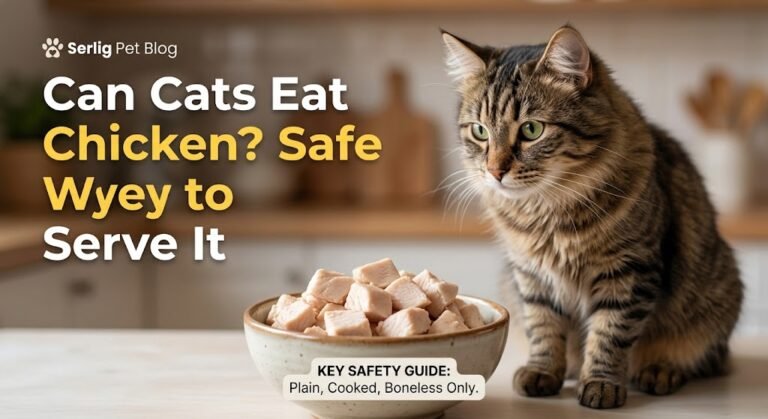
Our guide to chicken and cats covers the cooked bone question more broadly.
Farmed or Wild?
This is another point where sources contradict each other, so it is worth being careful.
Some articles state that wild salmon has less mercury. Others state that farmed salmon does. The reality is less dramatic than either claim: salmon of any kind is low in mercury compared with tuna, and the difference between farmed and wild is small enough that it should not drive your decision for an occasional cat treat.
Farmed salmon tends to be higher in fat, including omega 3, because of controlled feeding. Wild salmon tends to be leaner. Concerns about contaminants in farmed fish have been raised historically, and farming practices have changed considerably since those studies.
The practical answer: either is acceptable for a small occasional portion. Preparation matters far more than provenance, and the seasoning on the fillet is a bigger risk to your cat than its origin.
How to Cook Salmon for Your Cat
- Take a portion before you season anything: Once butter, garlic, lemon or salt is on, it cannot be removed.
- Poach, steam, bake or grill it: All work. No oil is needed.
- Cook it thoroughly, to at least 63 degrees Celsius internally, with no translucent centre.
- Use no salt, oil, butter, garlic, onion or seasoning of any kind: Garlic and onion are toxic to cats.
- Remove the skin unless you are deliberately including it, and remove every pin bone.
- Cool it completely and flake into small pieces.
- Keep the portion small, a teaspoon or two, subtracted from the meal.
- Refrigerate leftovers in a sealed container and use within two days, or freeze in portions.
If Your Cat Ate Raw or Smoked Salmon
The response differs depending on what was eaten and how much.
A small piece of raw salmon, once: Not an emergency. A single mouthful will not cause thiamine deficiency, which develops from repeated feeding over weeks. The realistic concern is a bacterial upset. Watch for 24 to 48 hours for vomiting, diarrhoea, reduced appetite or lethargy, and make sure fresh water is available.
Repeated raw fish feeding over weeks or months: This is the situation that warrants a veterinary appointment rather than just a change of diet. Ask specifically about thiamine status. Deficiency is treatable when caught, and the neurological signs can improve with supplementation.
Smoked salmon: Watch for both the raw risks and the salt load. Increased thirst and urination are expected. Contact your vet if your cat has heart or kidney disease, since the sodium matters clinically for them, or if vomiting repeats.
Any amount in a kitten, a senior cat or a cat with an existing condition: Call your vet for advice rather than monitoring at home. These cats have less reserve and deteriorate faster.
Signs that need attention regardless: repeated vomiting, diarrhoea lasting beyond a day, an unsteady or wobbly walk, dilated pupils, weakness, or refusing food entirely.
Hygiene matters too. Wash any surface, board or knife that touched raw fish, and wash your hands, since bacteria from raw fish can spread through the household.
Salmon is one of the better treats in this series, but three issues are worth knowing.
Vitamin E: Diets high in unsaturated fish oils increase a cat’s vitamin E requirement. A diet heavy in oily fish without adequate vitamin E is the classic cause of pansteatitis, a painful inflammation of body fat. This is a risk of feeding fish as a staple, not of an occasional treat.
Fish allergy: Fish is among the most commonly reported feline food allergens, alongside chicken and beef, precisely because it appears so often in commercial cat food. Signs are usually skin related: persistent itching around the head and neck, overgrooming, hair loss in patches or recurrent ear inflammation. Our guide to hair loss in patches covers what else to rule out.
Fixation: A cat that starts holding out for salmon and refusing balanced food is developing a problem. Rule out medical causes first, since a genuine appetite change is not fussiness. Our guide to changes in a cat’s appetite covers when to be concerned.
If coat condition is your actual goal, a measured supplement is more reliable than food scraps, and our comparison of fish oil options for cats explains dosing properly.
Which Cats Should Skip It
Cats with a history of pancreatitis: Salmon is a fatty fish, and fat is the primary trigger.
Overweight cats: Calorie dense at around 200 calories per 100 grams, which uses the treat budget quickly.
Cats with kidney disease: Phosphorus is controlled through a prescription diet, and fish is phosphorus rich.
Cats with a suspected fish allergy: One clear reaction is enough information.
Kittens. Small amounts of plain cooked salmon are not harmful, but kittens have high growth requirements and little room for extras. Our kitten feeding schedule sets out what they need.
Frequently Asked Questions
No. Despite its lower mercury content compared with tuna, salmon is not a complete food and is calorie dense. Once or twice a week is a sensible ceiling.
No. Raw salmon contains thiaminase, which destroys vitamin B1, and carries bacterial and parasite risks for your cat and your household. Sushi grade is not an exception.
No, and it is the worst option. Cold smoked salmon is cured rather than cooked, so the raw risks remain, and it is heavily salted on top.
Only if it is packed in spring water with no salt added, and drained well. Brine, oil and flavoured varieties should be avoided. The soft bones in canned salmon are safe and provide calcium.
Plain cooked skin is not dangerous and is high in omega 3, but it is also where most of the fat sits. Fine occasionally, best left off routinely, and never if it carries seasoning.
No. That condition affects dogs and other canids, not cats. Raw salmon is still unsafe for cats for other reasons, principally thiaminase and bacterial contamination.
Either is fine for an occasional small portion. Both are low in mercury compared with tuna, and the difference between them matters far less than how the fish is prepared.
The Bottom Line
Can cats eat salmon? Yes, and it is one of the better treats covered in this series. Plain cooked salmon, boneless and unseasoned, offers real omega 3 benefit and carries considerably less mercury risk than tuna. A teaspoon or two once or twice a week is a sensible amount.
Preparation is where this goes wrong. Raw salmon is unsafe because of thiaminase and bacteria, though not because of salmon poisoning disease, which is a canine condition. Smoked salmon is worse than raw, since it is usually cured rather than cooked and salted heavily on top. Canned salmon in spring water with no salt added is genuinely fine, and its soft bones are a useful calcium source rather than a hazard.
Cook it plain, take your cat’s portion before you season your own, check for pin bones, and keep it a topper rather than a habit.
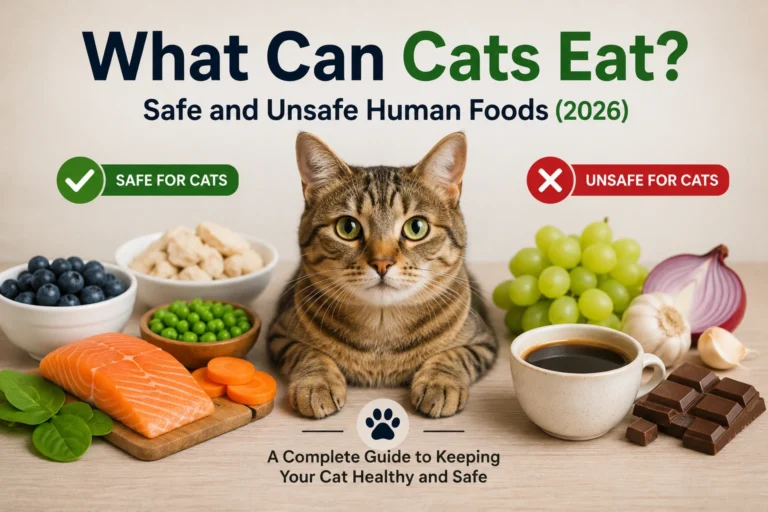
That completes our series on what belongs in a cat’s bowl. For the full picture, see our guide to what cats can eat.
A Note on Pet Health
Serlig publishes researched pet care information for everyday owners. It is general guidance, not veterinary advice, and it does not replace an examination by a licensed veterinarian who knows your pet. If your pet is unwell, or anything in this guide does not match what you are seeing at home, contact your vet.