Quick Answer
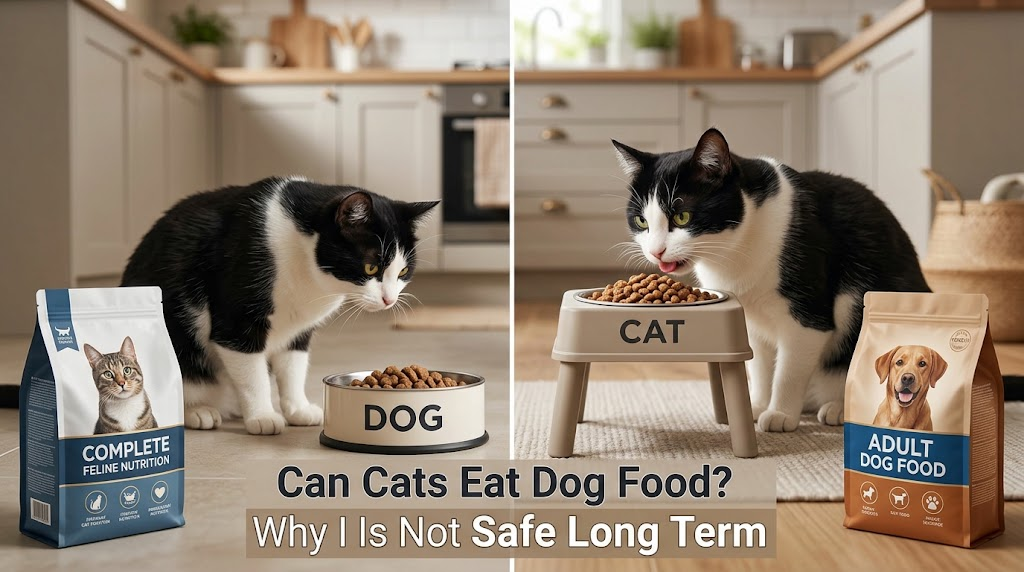
Cats can eat dog food occasionally without harm, but they cannot live on it. Dog food does not contain enough taurine, vitamin A, arachidonic acid or protein for feline health. A single stolen mouthful is not an emergency. Weeks or months of dog food as a main diet can cause heart disease and permanent blindness. If your cat has been eating dog food regularly, book a veterinary check rather than simply switching the bowl.
Can Cats Eat Dog Food?
If your cat has just stolen a mouthful from the dog’s bowl, you do not need to panic. Dog food is not toxic to cats. It contains no ingredient that poisons them, and one meal will do nothing worse than possibly upset a sensitive stomach.
Dog food is formulated for an animal that can manufacture nutrients your cat cannot. Where dog food is simply adequate for a dog, it is incomplete for a cat, and the gaps are in nutrients that the feline body cannot compensate for. That makes this a question of duration rather than danger. An occasional theft is harmless. A steady diet causes damage that builds quietly over months and, in one case, cannot be undone.
This article explains exactly which nutrients are missing, how long it takes before harm appears, which damage is reversible, and what to do about a cat that keeps raiding the dog’s bowl.
Why Dog Food Cannot Meet a Cat’s Needs
Cats and dogs look like similar pets. Nutritionally they are not close relatives at all. Dogs are flexible omnivores. Cats are obligate carnivores, which means their metabolism has specialised so far toward eating animal tissue that it has lost several biochemical shortcuts other mammals still have.
Five specific gaps matter here.
Taurine
Taurine is an amino acid required for heart muscle contraction, retinal cell health, bile salt production, immune function and foetal development.
Dogs and humans build their own taurine from other amino acids. Cats have extremely low activity of the enzymes needed for that conversion, so taurine is classed as an essential nutrient for them. It must arrive in the food, every single day, because cats also cannot store it.
AAFCO sets minimum taurine levels for complete cat food at 0.10 percent in dry formulas and 0.20 percent in canned formulas on a dry matter basis. Dog food carries no such requirement, because dogs do not need one. Many dog foods contain some taurine incidentally from meat content, but nothing guarantees it, and nothing guarantees enough.
This is the single most important reason a cat cannot live on dog food.
Vitamin A
Dogs convert beta carotene from plant sources into vitamin A. Cats cannot perform that conversion at all. They need preformed vitamin A, also called retinol, which comes from animal tissue such as liver.
Dog foods often rely partly on beta carotene, which is nutritionally useless to a cat. Vitamin A deficiency in cats affects vision, skin, coat quality and immune resistance. Our guide to signs of vitamin deficiency in cats covers what the early stages look like.
Arachidonic Acid
This is an omega 6 fatty acid involved in inflammation control, blood clotting, skin barrier function and reproduction. Dogs synthesise it from linoleic acid. Cats lack the enzyme to do so and must eat it directly, and it is found only in animal fat.
Deficiency shows first in the coat and skin, which become dull, dry and flaky. If your cat’s coat has changed while eating an unsuitable diet, our article on why cats shed excessively explains which changes are dietary and which are not.
Protein Quantity
Adult cat food typically contains substantially more protein than adult dog food. Cats use protein continuously for energy rather than sparing it the way dogs and humans do, so they cannot reduce protein breakdown when intake falls. A cat on a lower protein diet begins breaking down its own muscle to fill the gap.
Niacin
Cats cannot produce meaningful amounts of niacin, or vitamin B3, from the amino acid tryptophan. Dogs can. Niacin deficiency affects appetite, the mouth and the digestive tract.
Put together, dog food is not a slightly weaker cat food. It is a diet built around biochemical abilities your cat does not have.
How Long Is Too Long?
This is the question owners actually want answered, and most articles avoid it. The honest answer is that risk scales with duration and with how much of the diet the dog food represents.
| Exposure | Risk level | What to do |
| One stolen mouthful | Essentially none | Nothing. Watch for mild stomach upset |
| One or two full meals | Very low | Return to cat food. No lasting effect expected |
| A few days as the main diet | Low but not zero | Switch back now. Watch appetite and energy |
| Two to four weeks | Moderate | Switch back and mention it at your next vet visit |
| Two months or more | Significant | Book a veterinary appointment, not just a food change |
| Several months as the sole diet | Serious | Veterinary examination including heart and eye assessment |
The reason the top of this table is so relaxed and the bottom so serious is that taurine depletion is cumulative. The body draws on what it has, then on what is in circulation, and only then do symptoms appear. Published veterinary sources describe deficiency signs typically taking months to develop, which means the cat looks completely normal throughout the period when damage is beginning.
There is no reliable home test. A cat eating dog food does not act unwell until the shortfall has already been running for a long time.
What Happens to a Cat Fed Dog Food Over Time
Symptoms appear gradually and rarely point obviously at diet. This is what makes the problem easy to miss.
Early and easy to overlook
- Dull, dry or flaky coat
- Increased shedding
- Slow or poor wound healing
- Mild weight loss despite a normal appetite
- Reduced activity that is mistaken for the cat getting older
Later and more serious
- Reduced vision, especially in dim light, and bumping into objects
- Lethargy and unwillingness to jump or climb
- Rapid or laboured breathing
- Poor appetite and further weight loss
- Digestive upset and vomiting
Advanced
- Dilated cardiomyopathy, in which the heart muscle enlarges and pumps poorly, potentially leading to congestive heart failure
- Retinal degeneration progressing to blindness
- Reproductive failure and poor kitten development in breeding cats
Cats conceal illness extremely well, which delays diagnosis further. If your cat has been eating an unsuitable diet and something feels different, our guide to recognising pain and illness in cats covers the subtle signals owners commonly miss.
Which Damage Can Be Reversed and Which Cannot
This distinction matters more than anything else in this article, and almost no other page states it clearly.
Heart damage is often reversible. Taurine responsive dilated cardiomyopathy in cats frequently improves with supplementation and a correct diet, sometimes substantially. This was one of the major veterinary findings of the 1980s, when the link between taurine and feline heart disease was established and commercial cat food formulations were changed as a result. Recovery is not guaranteed and depends on how advanced the disease is, but the heart muscle can respond.
Eye damage is not reversible. Retinal photoreceptor cells that have degenerated do not regenerate. Vision already lost stays lost. Supplementation halts further deterioration but restores nothing.
The practical implication is straightforward. Time matters enormously, and it matters most for eyesight. A cat brought in early may recover completely. A cat brought in after visible sight loss will keep whatever vision remains and no more.
If you have adopted a rescue or stray cat with an unknown feeding history, mention that history to your vet. Some vets recommend a short period of taurine supplementation in those cases as a precaution rather than waiting for a problem to appear.
My Cat Just Ate Dog Food. What Should I Do?
For a one off incident, follow this sequence.
- Do not panic and do not induce vomiting. Dog food is not toxic. Attempting to make a cat vomit is unsafe and unnecessary here.
- Remove the dog’s bowl so your cat cannot return for more.
- Offer fresh water and let your cat settle normally.
- Feed the next meal as usual. There is no need to skip or reduce it.
- Watch for 24 hours. Mild vomiting or loose stools from the sudden change are the most likely outcome, and both usually resolve on their own.
Contact your vet if vomiting is repeated, if diarrhoea continues beyond a day, if your cat refuses food entirely, or if your cat becomes lethargic. Persistent vomiting in particular is worth taking seriously, and our article on why cats vomit explains where the line sits between an upset stomach and a problem.
One additional caution applies. If the dog food was a prescription formula, contained supplements, or had medication mixed into it, call your vet even if your cat seems fine. In that situation the issue is the additive, not the dog food.
Why Cats Eat Dog Food in the First Place
Understanding the motive makes the behaviour much easier to stop.
Novelty. Cats investigate. A different bowl in a different place is interesting purely because it is not theirs.
Texture. Wet dog food is often softer and stronger smelling than dry cat kibble. Cats with dental discomfort in particular may prefer something easier to chew, which is worth mentioning to your vet.
Competition. In multi pet households, eating quickly from another animal’s bowl can be a learned strategy rather than a preference.
Hunger. A cat that is genuinely underfed will look for calories anywhere. If your cat is eating dog food and losing weight or seeming constantly hungry, portion size is the first thing to check.
Free access. By far the most common reason. A dog bowl left down all day is an open invitation.
Worth noting: a sudden new obsession with food in a cat that never showed it before can indicate a medical issue such as hyperthyroidism or diabetes. A genuine change in appetite deserves a veterinary opinion rather than just a management fix, and our guide to changes in a cat’s appetite covers both directions of that change.
How to Stop Your Cat Eating the Dog’s Food
These solutions are listed roughly in order of how reliably they work.
Feed both animals at set times rather than leaving food down. Most pets finish a meal within 10 to 20 minutes. Put the bowls down, wait, then lift whatever is left. This single change resolves the majority of cases, because it removes the unsupervised window entirely.
Feed in separate rooms behind a closed door. Simple, free and effective. Neither animal can reach the other’s bowl at all.
Use a microchip activated feeder. The bowl opens only for the registered pet. This is the most reliable option for households where supervision is not possible, and it also helps when one animal is on a prescription diet. Our review of microchip pet feeders covers how to choose one.
Raise the cat’s food and lower the dog’s. Cats climb easily and most dogs do not. Feeding your cat on a counter or shelf solves the reverse problem at the same time.
Use a baby gate with a cat sized gap at the bottom. This creates a dog free feeding zone without needing a spare room.
Store food securely. Cats open bags and knock over containers. A sealed container removes the temptation between meals.
Reassess portions. If your cat is genuinely hungry, no barrier will hold. Confirm that portions match your cat’s weight and life stage before investing in equipment. Our kitten feeding schedule covers growth stage requirements, which are frequently underestimated.
Training alone is the least reliable approach with cats. Managing access works far better than trying to teach restraint.
What If You Are Feeding Dog Food to Save Money?
This deserves a direct answer, because it happens more often than most pet content acknowledges and the people doing it are usually trying to do right by their animals under real financial pressure.
Stretching cat food with dog food is not a safe economy. The cost of treating dilated cardiomyopathy far exceeds any saving on food, and lost vision cannot be bought back at any price.
If cost is the constraint, these options are genuinely safer:
- Buy a larger bag of a basic complete cat food. An economy cat food that meets AAFCO nutrient profiles is far safer than a premium dog food. Completeness matters more than tier.
- Check the packaging for a complete and balanced statement. That statement is the thing you are actually buying. Everything else is marketing.
- Prioritise dry food if budget is tight. It costs less per calorie than wet food, and completeness is what matters most here.
- Ask your vet about assistance. Many clinics know of local food banks or charity schemes and will not judge the question.
- Avoid unsupervised homemade diets. Home prepared cat food without professional formulation is one of the other leading causes of taurine deficiency, so it is not a safe alternative.
What About Dogs Eating Cat Food?
The reverse situation is common in the same households, and the risk profile is different.
Cat food is not toxic to dogs. It is, however, considerably higher in protein and fat, so dogs that raid the cat’s bowl regularly tend to gain weight, and rich food can trigger digestive upset. In dogs prone to pancreatitis, a high fat meal can cause a serious flare.
The severity difference is worth understanding. A dog eating cat food long term risks obesity and digestive problems, which are manageable. A cat eating dog food long term risks heart failure and blindness, which are not. Both should be prevented, but the cat is the one facing irreversible harm.
Every solution in the previous section works in both directions.
Frequently Asked Questions
For one or two meals, yes, if there is genuinely no alternative. It will not poison your cat. Buy cat food as soon as possible and treat it as a stopgap of hours, not days.
No. Kittens are at higher risk than adults because they are growing rapidly and have almost no nutritional reserve. Even short periods on an inadequate diet can affect development.
No. Wet dog food is usually more appealing to cats, which makes them eat more of it, but the nutritional gaps are the same. Appeal is not safety.
Book a veterinary appointment rather than only changing the food. Ask specifically about a cardiac assessment and an eye examination, and mention the feeding history clearly.
No. Taurine is the largest gap but not the only one. Vitamin A, arachidonic acid, protein levels and niacin all remain wrong. Supplementing one nutrient does not convert dog food into cat food.
Occasionally and in tiny amounts, most plain dog treats will not harm a cat. They provide nothing useful, and any treat should stay within your cat’s overall treat allowance.
Published veterinary sources generally describe months rather than weeks for visible signs, though the depletion begins much earlier. This delay is exactly why the problem is usually caught late.
Conclusion:
Can cats eat dog food? For one meal, yes, and there is no need to worry about a stolen mouthful. As a diet, no, and the reason is not toxicity but omission. Dog food lacks the taurine, vitamin A, arachidonic acid, protein density and niacin that a cat’s metabolism cannot supply for itself.
The harm is slow, silent and partly permanent. Heart damage often responds to correction. Lost vision does not.
If your cat occasionally steals from the dog’s bowl, manage the access and move on. If your cat has been eating dog food as a regular part of its diet for weeks or longer, treat that as a reason to see a vet rather than simply a reason to buy different food.
For the wider picture of what belongs in a cat’s bowl and what does not, see our complete guide to what cats can eat.
A Note on Pet Health
Serlig publishes researched pet care information for everyday owners. It is general guidance, not veterinary advice, and it does not replace an examination by a licensed veterinarian who knows your pet. If your pet is unwell, or anything in this guide does not match what you are seeing at home, contact your vet.
About the Author
Written by Alex, Serlig Pet Blog. Alex writes Serlig’s cat and dog nutrition guides and has spent several years researching feeding routines in multi pet households. Every nutrition article on Serlig is checked against current guidance from recognised veterinary bodies before publication.