
Quick Answer
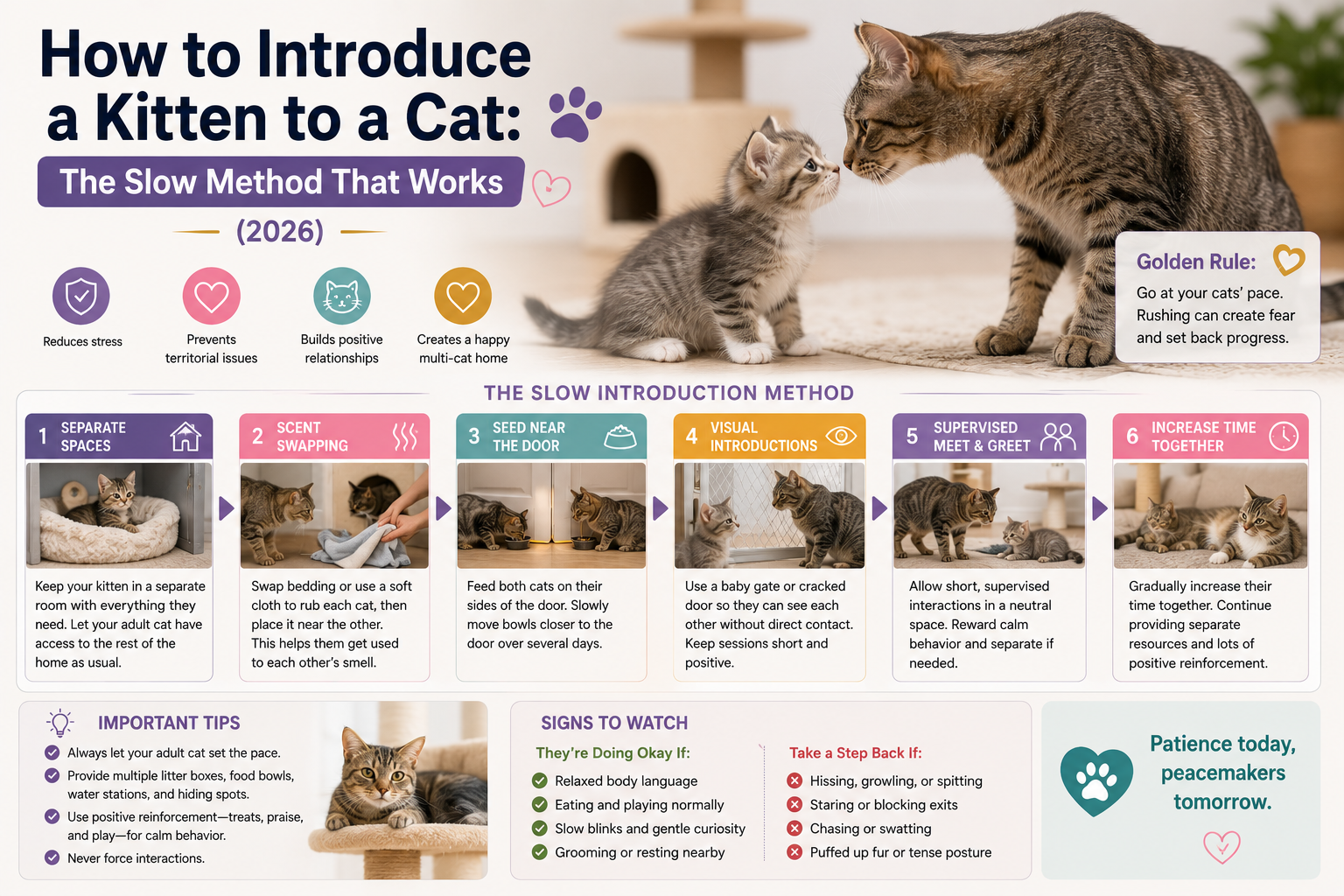
Never put a new kitten and a resident cat in a room together and hope for the best. Cats are territorial and solitary by nature, and first impressions are extremely durable a bad one can take months to undo. The method that works is gradual and scent-led: keep them fully separated at first, swap scents for several days, feed on either side of a closed door, then allow brief visual contact before any face-to-face meeting. Expect the process to take two weeks to two months. Rushing is the single most common mistake.
Key Takeaways
- Quarantine the kitten for 1–2 weeks first for disease control as well as introduction.
- Cats lead with smell, not sight. Scent swapping does most of the work.
- Hissing early on is normal. Sustained stalking, blocking, and ambushing is not.
- Resources must be duplicated: litter trays, bowls, beds, and vertical space.
- Protect the resident cat’s routine they have more to lose than the kitten does.
- If your resident cat is elderly or arthritic, a boisterous kitten may be genuinely unfair.
Before You Bring the Kitten Home
Vet check first. New kittens should be seen by a vet before meeting your cat, and ideally tested for FeLV and FIV. Ringworm, ear mites, fleas, and intestinal parasites are all common in kittens from rescues and multi-cat environments, and all spread readily. A 1–2 week quarantine period protects your resident cat and conveniently doubles as the separation phase of the introduction.
Set up a base camp. Prepare one room a spare bedroom or bathroom works with everything the kitten needs: litter tray, food and water in separate spots, a bed, hiding places (a cardboard box is ideal), a scratching post, and toys. This is the kitten’s whole world at first, and it should feel secure.
Duplicate resources throughout the house. The rule for litter trays is one per cat plus one spare, placed in different locations. Same for feeding stations and water bowls. Most inter-cat conflict traces back to competition over resources, and prevention is far easier than resolution.
Add vertical space. Cat trees, shelves, and window perches. Height is how cats manage social distance a cat that can go up does not need to fight.
Consider a pheromone diffuser designed for multi-cat households, started a few days before the kitten arrives.
The Five Stages
Stage 1 Full separation (days 1–7)
The kitten stays in base camp. The resident cat has the rest of the house, unchanged.
They will hear and smell each other, which is exactly the point. Do not allow visual contact yet. Spend time with both separately, and make sure the resident cat’s routine, feeding times, and attention are unchanged or better than before.
Wash your hands between cats during the quarantine period.
Stage 2 Scent swapping (days 3–10, overlapping)
Cats identify each other by smell long before sight matters.
- Swap bedding between the two, daily.
- Rub a soft cloth gently on each cat’s cheeks (where their scent glands are) and leave it near the other’s resting spot.
- Swap rooms for an hour let the kitten explore the house while the resident cat investigates base camp. This is one of the most effective single steps, because it lets each explore the other’s scent without confrontation.
What good progress looks like: sniffing the cloth with curiosity, or ignoring it. What to watch for: hissing at the cloth, urine marking, or refusing to enter the swapped room. If so, slow down and repeat for a few more days.
Stage 3 Feeding either side of the door (days 7–14)
Feed both cats at the same time on opposite sides of the closed door, starting far enough back that both eat comfortably. Over several days, move the bowls a little closer.
This builds a simple association: the other cat’s smell means good things happen. If either stops eating, you have moved too fast go back to the previous distance.
Stage 4 Visual contact, barrier in place (days 10–21)
Use a tall baby gate, a door wedged open a few inches, or a mesh screen. A carrier can work for very short sessions, but never leave a cat trapped in one while the other approaches freely.
Keep sessions short five minutes to begin and end while things are still calm. Feed treats or play on both sides so the association stays positive. Increase duration gradually over several sessions.
Stage 5 Supervised free contact
Only when barrier sessions are consistently relaxed.
- Keep the first meetings short and supervised.
- Have escape routes never introduce them in a small room with one exit.
- Use a wand toy to keep both engaged rather than fixated on each other.
- Never hold either cat up to the other, and never physically force contact.
- End on a good note, before either gets tense.
- Separate again when unsupervised, until you are confident.
Reading the Signals
| Going well | Slow down | Stop and reassess |
| Curious sniffing | Prolonged staring | Sustained low growling |
| Relaxed body, tail up | Tail flicking, ears back | Flattened ears, puffed fur |
| Eating with the other nearby | Hiding more than usual | Ambushing or cornering |
| Ignoring each other | Refusing to eat | Blocking litter tray access |
| Play bows, chase games | Blocking doorways | Fighting with contact |
| Sleeping in the same room | Overgrooming | Litter tray accidents |
Hissing is not failure. It is a cat saying “give me space,” and it is a normal, healthy part of early negotiation. What matters is whether it reduces over days.
The signs that genuinely worry behaviourists are the quiet ones: a resident cat that stops using the litter tray, stops eating, hides constantly, or starts overgrooming. Stress in cats shows up physically. If your resident cat goes off food, treat that seriously see why is my cat not eating, because cats cannot safely skip meals.
Protecting Your Resident Cat
Owners naturally focus on the kitten. The resident cat is the one whose world just changed.
- Do not reduce their attention. Keep lap time, play, and routine consistent.
- Feed them first, in their usual place.
- Do not move their litter tray, bed, or feeding station to accommodate the kitten.
- Never punish hissing or growling. That is communication, and suppressing it removes the warning system leaving you with a cat that goes straight to swiping.
- Give them a kitten-free zone, ideally high up where a young kitten cannot follow.
A word about older cats. A boisterous kitten pouncing on a fourteen-year-old arthritic cat is not a bonding opportunity it is harassment your cat cannot escape. If your resident cat is elderly, or you suspect joint pain, read signs your cat is in pain first and think carefully about whether the timing is right. A calm adult cat is often a better match for a senior than a kitten.
Common Mistakes
- Going too fast. By far the most common. Days saved at the start cost months later.
- Face-to-face on day one. A single frightening encounter can define the relationship.
- Not enough litter trays. One tray for two cats is a reliable route to house-soiling.
- Punishing hissing. Removes the warning, not the feeling.
- Assuming a kitten is “easier.” Kittens have relentless energy that many adult cats find genuinely stressful.
- Feeding from one bowl. Competition builds resentment.
- Giving up at two weeks. Many pairs take a month or more to settle.
Realistic Timelines
| Outcome | Typical time |
| Tolerating each other in the same room | 2–4 weeks |
| Comfortable coexistence | 1–2 months |
| Playing together | 1–3 months |
| Grooming each other, sleeping together | 3+ months, and not guaranteed |
Set expectations honestly: peaceful coexistence is a success. Many cats never become close friends, and that is a perfectly good outcome. Cats that mutually groom and sleep curled together are a bonus, not the standard.
When to Get Help
Contact your vet or a qualified feline behaviourist if:
- Fighting causes injuries
- Either cat stops eating for 24 hours
- Either cat stops using the litter tray
- Your resident cat is hiding constantly weeks in
- Overgrooming or bald patches appear
- There is no improvement after 6–8 weeks of proper, gradual work
- Your resident cat’s behaviour has changed dramatically in any way
Sudden behaviour change can also be medical. Stress-related cystitis is common in cats under social pressure, and a vet check should come before a behaviour diagnosis.
Frequently Asked Questions
How long does it take to introduce a kitten to a cat? Typically two weeks to two months for comfortable coexistence. Some pairs settle faster; some take longer.
Is it normal for my cat to hiss at the new kitten? Yes. Hissing is normal early communication meaning “give me space.” It should reduce over days. Sustained growling, stalking, or ambushing is different.
Should I let them fight it out? No. Cats do not resolve conflict by fighting the way some dogs do. A serious fight can permanently damage the relationship and cause injuries.
My cat is hiding since the kitten arrived what do I do? Slow the introduction right down, make sure your cat has kitten-free high spaces, and keep their routine unchanged. If they stop eating or using the litter tray, see your vet.
Is it easier to introduce a kitten than an adult cat? Often yes, because kittens are less threatening territorially. But kitten energy can be genuinely stressful for older or quieter cats.
How many litter trays do I need for two cats? Three one per cat plus one spare, in separate locations.
Should I get two kittens instead of one? For a household with a settled adult cat, two kittens often work well: they entertain each other and pester the resident cat less. It does mean two of everything.
What if they never get along? Some cats coexist without ever becoming friends, which is fine with enough resources and space. Persistent conflict warrants a behaviourist, and occasionally the kindest answer is separate territories within the home.
Final Thoughts
The instinct when bringing home a kitten is to let everyone meet, because that is how the story is supposed to go. With cats, that instinct is almost always wrong.
Cats build their sense of safety through scent and predictability, and both take time. The weeks you spend on swapped bedding and meals through a closed door feel like doing nothing, but they are the whole intervention. Go slower than feels necessary, protect the cat who was there first, and let peaceful coexistence not friendship be the definition of success.
Related Reading
- Kitten Feeding Schedule by Age
- Signs Your Cat Is in Pain
- Why Is My Cat Not Eating?
- Why Is My Cat Sleeping So Much?
A Note on Pet Health
Serlig publishes researched pet care information for everyday owners. It is general guidance, not veterinary advice, and it does not replace an examination by a licensed veterinarian who knows your pet. If your pet is unwell, or anything in this guide does not match what you are seeing at home, contact your vet.
About the Author
The Serlig Pet Care Team creates researched, plain-language pet care guides for everyday owners. Our content is written from hands-on pet-care experience and cross-checked against established veterinary sources so you can make confident decisions for your cat.





2 Comments