Quick Answer
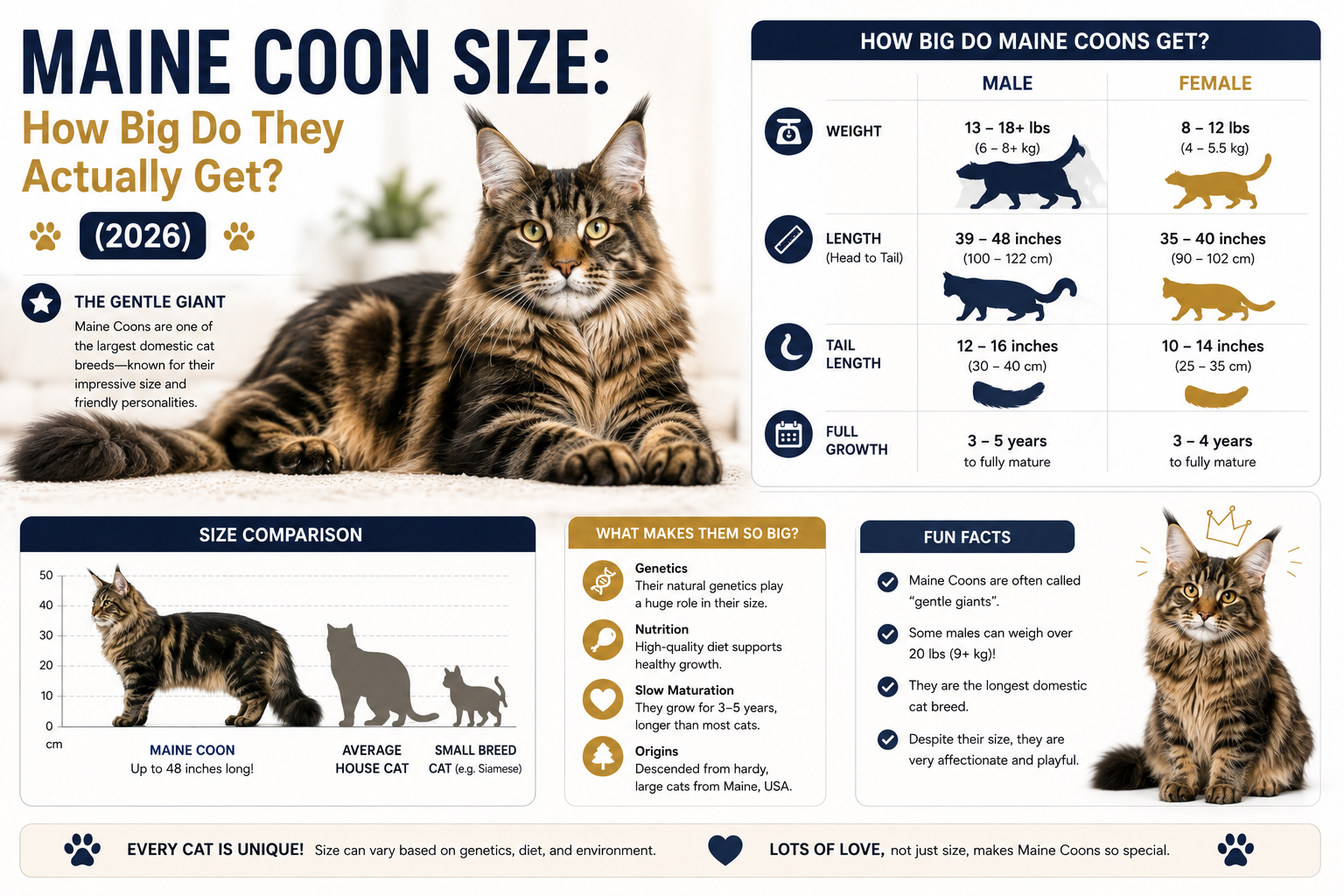
Maine Coons are the largest domestic cat breed, but most are considerably smaller than the internet suggests. A typical adult male weighs 13–18 lb (6–8 kg) and a female 8–12 lb (3.6–5.4 kg), with body length around 30–40 inches (75–100 cm) including the tail. The genuinely enormous 25 lb cats that go viral are outliers, not the standard. Maine Coons also grow unusually slowly they do not reach full size until three to five years old, roughly triple the time most cats take.
Key Takeaways
- Males: 13–18 lb; females: 8–12 lb. Anything over 20 lb is exceptional.
- Length of 30–40 inches nose to tail tip is where the “huge” impression comes from.
- Full maturity at 3–5 years, versus 12–18 months for most breeds.
- A long, dense coat and a bushy tail make them look larger than they weigh.
- Big does not mean overweight body condition still matters, and obesity is a real risk.
- Genetics set the ceiling. You cannot feed a Maine Coon into being bigger, only into being fat.
The Real Numbers
| Measurement | Male | Female |
| Weight (adult) | 13–18 lb / 6–8 kg | 8–12 lb / 3.6–5.4 kg |
| Height at shoulder | 10–16 in / 25–40 cm | 8–14 in / 20–35 cm |
| Body length (nose to tail tip) | Up to 40 in / 100 cm | Up to 35 in / 90 cm |
| Lifespan | 12–15 years | 12–15 years |
For comparison, an average domestic shorthair weighs 8–10 lb. So a typical male Maine Coon is roughly 1.5 to 2 times an average cat substantial, but not the small leopard that photographs suggest.
Why they look bigger than they are. Three things exaggerate the impression: a long, dense, shaggy coat (particularly the ruff around the neck); a plumed tail that can be a foot long on its own; and a rectangular, long-bodied build rather than a compact one. Wet a Maine Coon and a surprising amount of the cat disappears.
About the record-holders. Guinness-recognised Maine Coons have measured over 47 inches nose to tail. These are genuine, but they are extreme outliers within an already large breed the feline equivalent of a seven-foot human. Buying a Maine Coon expecting one is a route to disappointment.
The Growth Timeline
This is the part that most surprises new owners: Maine Coons are still filling out long after other cats have finished.
| Age | What is happening |
| 0–3 months | Rapid early growth; similar to other kittens |
| 3–9 months | Fast growth, often leggy and awkward-looking |
| 9–12 months | Most breeds are done. Maine Coons are roughly two-thirds grown |
| 1–2 years | Continued lengthening; the coat begins thickening properly |
| 2–3 years | Chest broadens, muscle fills in, the ruff develops |
| 3–5 years | Full physical maturity |
Practical implications:
- Feed a complete kitten or growth formula until 18–24 months, not 12 see our kitten feeding schedule for the transition.
- Expect an awkward adolescent phase. Many Maine Coons look gangly and thin-coated at a year old and transform by three.
- Do not judge adult size at 12 months. There is a great deal still to come.
- Behaviour matures slowly too. Maine Coons stay kittenish and playful well into adulthood, which is part of their charm.
What Determines Size
Genetics does most of it. Parents’ size is the best predictor available. A reputable breeder can show you both, and that tells you more than any chart.
Sex creates a substantial gap males typically run 30–50% heavier than females.
Neutering timing can slightly increase final height, because sex hormones signal growth plates to close. The effect is modest, and the health benefits of neutering at the age your vet recommends outweigh it.
Nutrition determines whether a cat reaches its genetic potential, not what that potential is. Adequate protein, energy, and correct calcium-to-phosphorus balance during growth matter. Overfeeding does not produce a bigger cat it produces an obese one, and in a breed already predisposed to hip and heart problems, that is genuinely harmful.
Big Cat, Bigger Requirements
Practical adjustments most new owners underestimate:
- Litter trays. Standard trays are too small. Look for at least 22 inches long, or use a large storage box with a cut-down entry side. Cramped trays cause litter-tray avoidance.
- Food and water bowls. Wide and shallow to avoid whisker contact, and raised slightly to reduce neck strain. If you run a multi-cat household or need portion control for a large appetite, a microchip feeder solves several problems at once.
- Cat trees. Most commercial trees are built for 10 lb cats. Look for sturdy bases and platforms rated for 20 lb+, with wide perches a Maine Coon overhanging a small platform will simply stop using it.
- Scratching posts. Tall enough for a full stretch, which for this breed means at least 32 inches.
- Carriers. Buy for the adult size, not the kitten. Many owners end up buying twice.
- Grooming. The semi-long coat needs brushing 2–3 times weekly, more during seasonal moults, with particular attention to the ruff, armpits, and britches where mats form.
Health Considerations for a Large Breed
Size brings specific risks, and responsible breeders test for them.
| Condition | What to know |
| Hypertrophic cardiomyopathy (HCM) | The most significant concern. A DNA test exists for the MyBPC3 mutation associated with the breed, and echocardiogram screening is used alongside it |
| Hip dysplasia | More common in large, heavy cats than in the general cat population |
| Spinal muscular atrophy (SMA) | A genetic condition with a DNA test available |
| Polycystic kidney disease (PKD) | Testable |
| Obesity | A large frame makes excess weight harder to spot and joints suffer |
Ask any breeder for HCM and SMA test results on both parents. A breeder who cannot produce them is not one to buy from.
Because large cats hide joint pain particularly well, learning what discomfort looks like is worth the time our guide to signs your cat is in pain covers the subtle behavioural changes that come long before any limp.
Is It Really a Maine Coon?
“Maine Coon mix” and “Maine Coon type” are used loosely, and a large fluffy cat is not necessarily one.
Breed characteristics to look for: a rectangular body, a long bushy tail, lynx tips on the ears, tufted paws, a square muzzle, high cheekbones, large ears set high and wide, and a shaggy coat that is shorter over the shoulders and longer on the belly and britches.
Registered pedigree from a recognised cat association is the only real confirmation. Many wonderful large fluffy cats in rescues are not pedigree Maine Coons and are none the worse for it.
Frequently Asked Questions
How big do Maine Coons get? Males typically 13–18 lb and up to 40 inches long including the tail; females 8–12 lb. Cats over 20 lb are exceptional.
When do Maine Coons stop growing? Between three and five years much later than most breeds, which finish around 12–18 months.
Are Maine Coons the biggest cat breed? Yes, among domestic breeds. Savannahs can be taller but are a hybrid rather than a fully domestic breed.
How can I make my Maine Coon bigger? You cannot. Genetics sets adult size. Overfeeding produces obesity, not size, and harms joints and heart.
Why is my Maine Coon small? Genetics, sex, or simply being a mix rather than a pedigree. A smaller Maine Coon is not unhealthy body condition matters far more than the number on the scale.
Do Maine Coons need special food? They need a complete cat food and a longer time on a growth formula typically until 18–24 months.
Are Maine Coons good with children and dogs? Generally yes. They are known for being sociable, tolerant, and dog-friendly, which is part of their popularity.
How much does a Maine Coon eat? More than an average cat, proportional to body weight. Follow your food’s guide by weight and adjust to body condition rather than appetite.
Final Thoughts
Maine Coons are genuinely the biggest domestic cats, and they are also consistently smaller than the internet has led people to expect. A healthy 15 lb male with a magnificent ruff and a tail like a feather duster is exactly what the breed is not a disappointing version of the 30 lb cat in a photograph.
Plan for the slow timeline. Buy the big litter tray and the sturdy cat tree at the start, keep them on growth food longer than feels normal, and resist the urge to feed for size. The cat you have at five will be considerably more impressive than the one you had at one.
Related Reading
- Ragdoll Cat Personality & Care Guide
- Kitten Feeding Schedule by Age
- Signs Your Cat Is in Pain
- Best Microchip Cat Feeder
A Note on Pet Health
Serlig publishes researched pet care information for everyday owners. It is general guidance, not veterinary advice, and it does not replace an examination by a licensed veterinarian who knows your pet. If your pet is unwell, or anything in this guide does not match what you are seeing at home, contact your vet.
About the Author
The Serlig Pet Care Team creates researched, plain-language pet care guides for everyday owners. Our content is written from hands-on pet-care experience and cross-checked against established veterinary sources so you can make confident decisions for your cat.