How to litter train a kitten is mostly a matter of giving access rather than teaching a skill, because kittens understand litter instinctively. Start at around three to four weeks, when voluntary control develops. Use a shallow box with sides no more than five to seven centimetres, non clumping litter until four to five months, and place the box near where the kitten sleeps and eats. Confine them to one room at first, place them in the box after meals and naps, and reward every success. Most kittens are reliable within a week.
You Are Not Really Training Anything
This is the most useful thing to understand before you start, and it will save you a great deal of worry.
Kittens are drawn to litter instinctively. The urge to dig in a loose, granular substrate and bury waste is hardwired. You are not teaching a behaviour that does not exist. You are providing a surface that satisfies one the kitten already has.
As the term is usually used, “litter training” is a slight misnomer. The work is almost entirely about access, suitability and cleanliness, not instruction.
What that means practically
- Most kittens use the box within days of being shown it
- Failures are almost always a problem with the box, the litter or the location rather than the kitten
- If it is going badly, change the setup rather than trying harder with the same setup
- Punishment has no role at all, because there is no disobedience to correct
The one real variable is upbringing. A kitten raised by its mother usually learns by watching her and needs almost nothing from you. An orphaned or bottle fed kitten has had no demonstration and needs a human to take that role. That difference explains most of the variation in how long this takes.
When to Start
| Kitten age | What is happening | What to do |
| 0 to 3 weeks | No voluntary control. The mother stimulates elimination | No litter box. See the next section |
| 3 to 4 weeks | Voluntary control develops as the nervous system matures | Introduce a very shallow tray beside the nest |
| 4 to 8 weeks | Coordination improves, weaning begins | Regular use, still supervised. Non clumping litter |
| 8 to 12 weeks | Typical adoption age. Most are already box trained | Set up before arrival, confine to one room |
| 4 to 6 months | Growing out of the kitten box | Transition to a full size box and adult litter |
If you are adopting at eight to twelve weeks, your kitten has almost certainly used a box already. Your job is to make the new one recognisable and easy to reach, not to start from scratch.
Set up before the kitten arrives. A box already in place lets the kitten find it while exploring rather than needing to be introduced to it during a stressful first day.
Under Three Weeks: Stimulation, Not Training
This section matters for anyone fostering, bottle feeding or caring for an orphaned litter, and most articles skip it.
Kittens under about three weeks cannot urinate or defecate on their own. The mother licks the genital and anal area to stimulate elimination. Without her, a human has to do it.
How it is done. After each feed, gently wipe the genital and anal area with a soft cloth or cotton pad moistened with warm water, using a light circular motion, until the kitten eliminates. This is necessary after every feeding.
Why it matters. A kitten that cannot eliminate becomes unwell quickly. Retained urine and faeces cause discomfort, then genuine illness. If a bottle fed kitten has not urinated within a day, or has not passed faeces in two, contact a vet.
When to stop. Continue until the kitten is reliably eliminating on its own, usually around three to four weeks. Overlap the two for a while rather than stopping abruptly.
Introduce the box at three weeks, shallow enough that an unsteady kitten can step in without climbing. At this age an entry height of around two to three centimetres is appropriate.
Our kitten feeding schedule covers the feeding side of the same period.
The Right Box
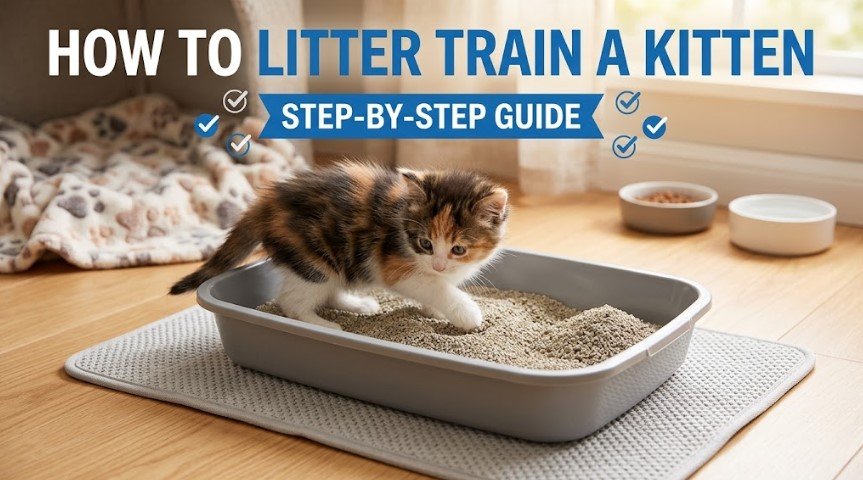
Size. Around 33 by 23 centimetres, or roughly 13 by 9 inches, suits most kittens. A full size adult box can be intimidating and hard to enter.
Sides. Low. Two to three inches, roughly five to seven centimetres, for a kitten that is walking confidently, and lower still for a very young one. A kitten that has to climb will find somewhere easier.
Uncovered. Hoods restrict the view, trap odour and leave one exit. Most cats prefer open boxes and kittens especially so.
Stable. A box that slides on a smooth floor when a kitten steps in is unsettling. A mat underneath helps, and also catches tracked litter.
How many. One per kitten plus one. Even a single kitten should have two, in separate locations rather than side by side. Two boxes in the same corner function as one box.
Cheap is fine. A plastic storage tray with one side cut down makes an excellent low entry kitten box.
The Right Litter, and the Clumping Warning
This is the most important safety point in the whole article.
Use Non Clumping Litter Until Four to Five Months
Why. Clumping clay litters work by absorbing moisture and binding into a solid mass. Kittens explore with their mouths, groom litter off their paws, and sometimes eat it outright. Clumping clay that is swallowed can absorb moisture and expand inside the digestive tract, and in a very small animal that creates a genuine obstruction risk.
Safer options for young kittens
- Paper based pellet litter
- Corn or wheat based litter
- Wood pellet litter
- Non clumping clay
Switch to clumping at around four to five months, once the kitten has stopped mouthing everything and is reliably using the box.
Other Litter Rules
- Unscented, always. Perfumed litter smells pleasant to you and overwhelming to an animal whose sense of smell is far more acute
- Fine grained and soft. Closest to the sandy substrate cats naturally choose
- Shallow depth. Around two to three centimetres for a kitten, less than you would use for an adult. Deep litter feels unstable underfoot
- No liners. Claws catch in the plastic and most cats dislike them
- Consistent. Once something works, do not change it. If you must switch, mix the new in gradually over a week or two
Placement
- Close to where the kitten sleeps and eats, but not immediately beside the food bowls. Cats do not toilet where they eat, and a kitten cannot travel far
- On every floor the kitten uses, and in more than one room
- Quiet, but not hidden. A cupboard or a dead end corner leaves no escape route and many cats refuse them
- Not in darkness. Cats see well in dim light but not in none
- Away from washing machines, boilers and slamming doors. One frightening noise near a box can create lasting avoidance
- Reachable without stairs for a small kitten
A note on confinement. Restricting a new kitten to one room for the first few days genuinely helps, because it keeps the box close and the choices simple. If you use a bathroom, close the shower or bath, since a smooth basin is an appealing alternative surface and that habit is hard to undo.
The Step by Step Method
- Set up before arrival. Boxes in place, litter in, mat down
- Show the kitten the box on arrival. Let them sniff and step in. Do not hold them in it
- Place them in the box after every meal, every nap and every play session. These are the three moments a kitten is most likely to need it
- Also place them in it roughly every two to three hours while very young
- Watch for the signals: sniffing the floor, circling, crouching, scratching at a surface. Carry them to the box immediately
- Let them investigate and dig. Do not hover directly over them
- Reward every success with quiet praise or a small treat, immediately afterwards rather than minutes later
- Leave one small soiled clump in a newly introduced box, since the scent marks it as the right place. Clean the rest
- Scoop at least twice daily and change the litter completely weekly
- Expand their space gradually once they are using the box reliably, adding rooms one at a time with a box available in each
The Paw Trick, Done Correctly
Several guides suggest taking the kitten’s paw and using it to scratch the litter. This needs a caution.
The risk. Holding a kitten’s paws and moving them against their will creates a negative association with the box, and cats strongly dislike having their paws handled. It is the same mistake as forcing a cat’s paws onto a scratching post, and it achieves the opposite of what is intended.
What to do instead
- Scratch the litter yourself with your fingers while the kitten watches. The sound and movement attract them
- Let the kitten stand in the box and make the movement themselves
- Never restrain them in the box, and let them leave whenever they choose
If your kitten steps in, sniffs and steps out again, that is fine. Repetition will do the work.
A Realistic Timeline
| When | What to expect |
| Days 1 to 2 | Investigation. Possibly first use. Accidents are normal |
| Days 3 to 5 | Most kittens are using the box for most eliminations |
| Day 7 | The majority are reliable within confinement |
| Weeks 2 to 3 | Near full reliability. Begin expanding access to more rooms |
| Month 1 to 3 | Habit becomes solid. Occasional accidents during changes are normal |
| Months 4 to 6 | Transition to adult litter and a full size box |
Most kittens master this in about a week. If you are still having frequent accidents after two weeks of consistent setup, the problem is the setup rather than the kitten, and the troubleshooting section below applies.
Accidents and What Not to Do
Accidents are part of the process. How you handle them matters more than whether they happen.
Do
- Clean with an enzymatic cleaner made for pet urine. This is the only thing that fully breaks down the uric acid crystals that keep attracting the kitten back
- Clean thoroughly and deeply, since urine soaks into padding and floorboards
- Move the kitten to the box if you catch them mid accident, calmly and without fuss
- Add a box if accidents cluster in one spot. Your kitten has chosen a location for a reason
Do not
- Never punish, shout, scold or rub the kitten’s nose in it. It creates fear and teaches the kitten to hide to eliminate, which is far harder to fix
- Never use ammonia based cleaners or bleach. Urine contains ammonia compounds, so an ammonia cleaner leaves a smell that reads as urine and invites repeat use
- Do not use vinegar as your main cleaner. Cats dislike the smell, which may deter them, but it does not break down the residue an enzymatic cleaner removes
- Do not over clean the box itself with strong disinfectant. A faint trace of the kitten’s own scent makes the box recognisable
Troubleshooting
Work through these in order if things are not going well.
The box is too soiled. Kittens are fastidious. Scoop more often and do a full change.
The sides are too high or the kitten has to climb. Cut one side down.
The litter is wrong. Too deep, scented, too coarse, or recently changed. Try offering two boxes side by side with different litters and let the kitten choose.
The location is wrong. Too far, too exposed, too noisy, or beside the food. Move it, or add another.
Something frightened them near the box. A noise, another pet, or being picked up mid use. Move the box and add a second elsewhere.
Too much space too soon. Reduce their range and rebuild gradually.
Another pet is guarding the box. Add boxes in separate locations. Our guide to introducing a kitten to a cat covers resource competition.
It might be medical. Diarrhoea, constipation, urinary problems and parasites all cause accidents. A kitten straining without producing anything needs a vet promptly. Our guides to cat diarrhoea and recognising pain in cats cover the signs worth acting on.
For an older cat or a previously reliable kitten that suddenly regresses, that is a different problem with a different diagnostic order. Our guide to a cat peeing outside the litter box covers it, and medical causes come first there.
Litter Eating
Some kittens taste or eat litter, which is usually harmless curiosity and occasionally is not.
Usually normal. Very young kittens explore with their mouths and often mouth litter once or twice. This is why litter choice matters so much at this age.
Reduce the risk by using non clumping paper or plant based litter, keeping depth shallow, and making sure the kitten is well fed, since hunger increases exploratory eating. Our guide to changes in appetite covers when eating habits signal something else.
When to mention it to a vet. If litter eating continues beyond about eight weeks, or if a kitten eats litter persistently rather than occasionally, it is worth raising. Persistent eating of non food items can occasionally indicate a nutritional deficiency or anaemia, both of which are treatable and neither of which resolves on its own.
Seek advice promptly if a kitten has eaten a significant quantity of clumping litter, or shows vomiting, straining, a swollen abdomen or lethargy afterwards.
Moving to Adult Litter and Boxes
Between four and six months, two changes are due.
A bigger box. The rule for an adult cat is a box at least one and a half times their body length from nose to tail base. Most kittens outgrow their first tray well before they are fully grown.
Adult litter. Clumping litter becomes appropriate once the kitten no longer mouths everything.
Make both changes gradually. Introduce the larger box alongside the small one rather than swapping it, and mix the new litter into the old over a week or two. Changing box, litter and location at once is the most reliable way to cause a regression.
Frequently Asked Questions
At what age can you litter train a kitten? Around three to four weeks, when voluntary elimination control develops. Before that, kittens need physical stimulation to eliminate and cannot use a box.
How long does it take to litter train a kitten? Most kittens are using the box reliably within about a week, with near full reliability by two to three weeks. If accidents are frequent after two weeks, the setup needs changing.
What litter is safest for kittens? Non clumping paper, corn, wheat or wood pellet litter until around four to five months. Clumping clay can expand if swallowed and poses an obstruction risk in a small animal.
How many litter boxes does one kitten need? Two. The rule is one per cat plus one, placed in separate locations rather than side by side.
Should I put my kitten’s paws in the litter? No. Handling a kitten’s paws against their will creates a negative association with the box. Scratch the litter yourself with your fingers instead and let them copy.
My kitten keeps having accidents. What am I doing wrong? Usually nothing you are doing, and something about the setup. Check cleanliness, side height, litter type and depth, location and the number of boxes, in that order. Persistent problems warrant a vet check.
Do kittens learn from their mother? Yes, and kittens raised with their mother often need very little from you. Orphaned and bottle fed kittens have had no demonstration and need more guidance.
The Bottom Line
How to litter train a kitten is genuinely one of the easier parts of owning a cat, because the instinct is already there. Your job is access and suitability, not instruction.
Three things matter most. Use non clumping litter until four to five months, because clumping clay can swell if swallowed and kittens explore with their mouths. Keep the sides low enough to step into, since a kitten that has to climb will find somewhere easier. And place boxes where the kitten already is, close to sleeping and eating areas, on every floor they use.
Expect reliability within about a week. If it is taking much longer, change the setup rather than the approach, because a kitten refusing a box is telling you something about the box. And if a kitten who was reliable suddenly starts having accidents, that is a medical question before it is a training one.