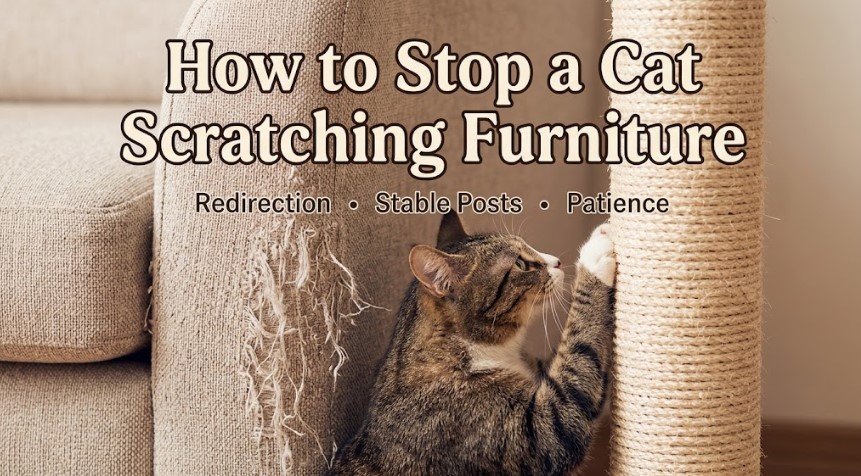
How to stop a cat scratching furniture is really a question about redirection, because scratching is a need rather than a habit and cannot be trained away. The fix is a post that is tall enough for a full stretch and completely stable, placed directly beside the damaged furniture rather than in a corner, in a material that matches what your cat is already choosing. Then make the furniture temporarily unappealing while the new habit forms. Most cats switch within two to four weeks. Never punish, never force paws onto a post, and never declaw.
You Cannot Stop It, Only Redirect It
This has to come first, because the goal most owners set is the wrong one.
Scratching does three jobs at once:
- Claw maintenance. It removes the worn outer sheath of the claw, revealing the sharp layer beneath
- A full body stretch. Scratching extends the shoulders, back and forelimbs, which is why cats often do it immediately after waking
- Territory marking. Cats have scent glands in their paws, so scratching leaves both a visible groove and a scent signal
A cat deprived of every acceptable surface does not stop scratching. It scratches something you would rather it did not.
So the objective is not “stop scratching.” It is “scratch that, not this.” Every technique below follows from that, and any approach that tries to eliminate the behaviour entirely will fail and cause stress in the process.
Why Cats Scratch Where They Do
The spots cats choose are not random, and understanding the logic explains why some post placements never work.
Because scratching is partly territorial signalling, cats choose visible, prominent locations. The arm of the sofa nearest the door. The corner by the hallway. The chair in the middle of the room. These are places you and other pets pass constantly, which is exactly the point of a territorial mark.
They also choose after sleeping. A cat wakes, stretches, and scratches whatever is nearest.
And they choose stable surfaces. A sofa arm does not move. That matters more than most owners realise, as the next section explains.
The practical consequence. A scratching post placed in a spare room, behind a door, or tucked into a quiet corner fails by design. It is in exactly the kind of place a cat has no reason to mark.
Why Most Scratching Posts Fail
If you have bought a post and your cat ignored it and carried on scratching furniture, the post is almost certainly the problem rather than the cat. Two specifications matter more than anything else, and getting them wrong is the most common reason attempts to stop a cat scratching furniture fail.
Height
Veterinary guidance is specific: a post should be at least as tall as your cat standing on its hind legs with its front legs fully outstretched.
For an average adult cat that is roughly 75 centimetres or more. Many posts sold in pet shops are 40 to 50 centimetres, which is tall enough for a kitten and useless for the adult it becomes.
Measure your cat. Encourage them to stretch up against a door frame and mark the height. Then buy a post taller than that. A cat that cannot get a full stretch will go back to the sofa, which does allow one.
Stability
This is the most common reason a good post gets rejected, and it is rarely stated plainly.
Cats put real force into a scratch. If a post wobbles, tips or shifts even slightly under that force, the cat will abandon it, often permanently, and will not give it a second chance.
What to look for
- A wide, heavy base
- No movement at all when you push the top firmly
- Wall mounted or floor to ceiling options if you have a large or enthusiastic cat
- Weight rather than height alone. A tall, light post is worse than a short, solid one
Test it yourself. Push the top hard with one hand. If it moves, your cat has already decided.
Match the Material to the Damage
This is the diagnostic step almost everyone skips, and it turns post selection from guesswork into an answer.
Go and look at what your cat is actually scratching. The damage tells you what they want.
| What the cat is scratching | What to buy |
| Vertical surfaces: sofa arms, chair backs, door frames | A tall vertical post |
| Horizontal surfaces: carpet, rugs, the floor by a doorway | A flat cardboard or sisal mat |
| Both | Both. Many cats have two preferences |
| Woven or rough fabric | Sisal rope or sisal fabric |
| Soft upholstery | Carpet covered posts, or plush sisal |
| Loose weave, loops pulled out | Sisal fabric, which shreds similarly |
| Cardboard boxes | Cardboard scratchers |
| Wood, door frames, skirting | A bare wood or log style scratcher |
Most cats prefer sisal for vertical scratching and cardboard for horizontal, which is a reasonable default if the damage does not point clearly one way.
Angle matters too. Some cats prefer an inclined surface over a strictly vertical one. If both a post and a mat are ignored, an angled scratcher is worth trying.
Placement
Placement decides whether the plan works, more than the post itself does.
Put the first scratcher directly beside the damaged spot. Not across the room, not in the hallway. Immediately next to the sofa arm your cat has been using. Your cat has already told you that location works.
Then add more in these places
- Beside favourite sleeping spots, since cats scratch on waking
- Near entryways and hallways, which are greeting and marking routes
- In the main living space, since scratching is partly social signalling
- Near windows and cat trees, where cats become aroused watching outside
Move it only after it is working. Once your cat uses the new scratcher reliably for a few weeks, move it gradually, a few centimetres at a time. If use stops, move it back.
Do not hide it. A scratcher that clashes with your décor is still better than an unused one behind a door.
How Many Posts?
The same principle as litter boxes applies here.
One scratching surface per cat, plus one, distributed around the home rather than grouped together. Cornell guidance is that if a cat scratches in several locations, there should be a post near each one.
In a multi cat household this matters more, because a scratcher is a territorial resource and one cat can monopolise it. Separate locations prevent that. Our guide to introducing a kitten to a cat covers resource competition more broadly.
Making the Post Attractive
- Rub or sprinkle catnip on it, or try silvervine or valerian if your cat does not respond to catnip
- Play around the base with a wand toy, dragging it up the post so the claws make contact naturally
- Reward immediately. Timing matters more than the size of the reward
- Scratch it yourself with your fingernails. The sound attracts many cats
- Be patient with the first contact. Even one second deserves a reward
Never Throw Away a Ragged Post
This is genuinely counterintuitive and almost nobody says it.
A worn, shredded, scruffy looking post is a successful post. It carries weeks of accumulated scent marks that tell your cat this is their approved scratching place.
Replacing it with a clean new one removes all of that and effectively restarts the training. Cornell guidance is explicit that a ragged post means it is doing its job.
If you must replace it, put the new one beside the old one for several weeks before removing the original, and rub the old post against the new one to transfer scent.
Making the Furniture Boring
Adding a post alone rarely works, because the sofa is still there and still satisfying. You need both halves.
Effective and humane options
- Double sided tape on the target area. Cats dislike sticky paws
- Smooth plastic furniture guards or scratch protection film
- Aluminium foil taped over the spot, which most cats avoid
- A tightly tucked throw or cover, which removes the texture they want
- Blocking access with a laundry basket or small piece of furniture while the habit changes
These are temporary. Most can come off after a few weeks once the new habit is established. They are a bridge, not a permanent solution.
A caution on scent deterrents. Citrus and menthol sprays are widely recommended because cats dislike those smells, and mild commercial deterrent sprays are generally fine. Do not use undiluted essential oils. Citrus, tea tree, eucalyptus and several others are genuinely toxic to cats, who cannot process them the way other animals do, and applying them to furniture a cat rubs against is a real risk. Our guide to essential oils and pets covers which are dangerous.
A caution on motion activated deterrents. Compressed air devices that hiss when a cat approaches can work, provided the burst is brief. Prolonged or loud noise increases fear and anxiety, which is counterproductive, since anxious cats scratch more rather than less.
Never Do These
- Never punish. Shouting, smacking, scruffing or chasing creates fear and teaches your cat to scratch when you are not there
- Never spray water. It damages trust and does not teach an alternative
- Never force paws onto the post. This is a common and well meaning mistake. Holding a cat’s paws and moving them against a scratcher creates a negative association with the post itself, which is precisely the opposite of the goal. Cats also strongly dislike having their paws held
- Never remove all scratching options in the hope the behaviour stops. It will not
- Never use undiluted essential oils as deterrents
- Never declaw. See below
- Do not expect results in days. See the timeline
Nail Trimming and Nail Caps
Trimming reduces damage and, for some cats, slightly reduces the urge, since one purpose of scratching is removing the worn claw sheath.
- Every two to three weeks for most indoor cats
- Trim only the clear tip, well away from the pink quick
- One or two claws at a time is fine. It does not need to be done in one session
- Keep styptic powder available in case you catch the quick
- Start young where possible, and pair it with treats
Nail caps are soft vinyl covers glued over the claws, and they are a legitimate humane option that rarely gets mentioned. They blunt the claw so scratching causes no damage, they last four to six weeks as the claw grows out, and the cat retains full normal behaviour including retraction.
They are not right for every cat, some will not tolerate application, and they are unsuitable for outdoor cats who need their claws for climbing and defence. Ask your vet or a groomer to demonstrate the first application.
Declawing Is Not an Option
This needs to be stated plainly, because it is still marketed in some places as a solution to furniture damage.
Declawing is not a nail trim. It is the surgical amputation of the last bone of every toe. The equivalent in a human would be removing each finger at the final joint.
The consequences are well documented
- Chronic pain and altered gait
- Litter box avoidance, because digging in litter hurts, which is a leading cause of cats being surrendered. Our guide to litter box problems covers the broader picture
- Increased biting, because a cat without claws has lost its first line of defence and escalates straight to teeth. Our guide to why cats bite covers what that looks like
- Behavioural changes including aggression and withdrawal
It is banned in the UK, across much of Europe, and in a growing number of US states and cities.
Everything in this article achieves the same goal without it. A tall stable post in the right place, plus temporary furniture protection, plus trimmed claws or nail caps, solves furniture damage in the overwhelming majority of cases.
A Realistic Timeline
Most sources say “be patient” without saying what patience looks like. Here is a realistic expectation.
| When | What to expect |
| Days 1 to 3 | Set up. Post beside the damage, furniture protection on, deterrents in place. Your cat may investigate or ignore it entirely |
| Days 3 to 7 | First contact with the scratcher, often brief. Reward every instance immediately. Furniture scratching continues |
| Week 2 | Mixed use. Some scratching on the post, some attempts at the covered furniture. This is normal and not failure |
| Weeks 2 to 4 | The post becomes the default for most cats. Furniture attempts drop noticeably |
| Week 4 onward | Begin removing furniture protection gradually, one item at a time. If scratching resumes, put it back for another two weeks |
| Month 2 onward | Habit established. The post should look increasingly ragged, which is the goal |
If there is no progress at all by week three, something structural is wrong. Check the height, check the stability by pushing it, check the material against what your cat actually scratches, and check that it is beside the damage rather than across the room.
When Scratching Suddenly Increases
A sudden change in scratching is different from an ongoing furniture problem, and it is worth a separate look.
Stress is the usual cause. Scratching is territorial marking, and a cat that feels its territory is threatened marks more. Common triggers include a new pet or baby, a house move, building work, rearranged furniture, a new person in the home, or a cat outside the window.
Look for other stress signals at the same time. Litter box changes, overgrooming, hiding, appetite changes and increased vocalising often appear together. Our guides to hair loss in patches and litter box problems cover the related signs.
Occasionally it is medical. Changes in claw health, skin irritation or discomfort can alter scratching patterns, and arthritis can change where and how a cat scratches, sometimes causing them to abandon a post they previously used. A cat that suddenly stops using a familiar post is worth a check, and our guide to recognising pain in cats covers the quieter signals.
What helps. Reduce the identified stressor, add more vertical space and hiding places, keep routines predictable, add more scratching surfaces rather than fewer, and ask your vet about pheromone products.
Frequently Asked Questions
Why does my cat scratch the furniture instead of the post? Usually because the sofa is taller, steadier or in a better location than the post. Cats need a full stretch and absolute stability, and they choose prominent spots because scratching is territorial marking.
Where should I put the scratching post? Directly beside the furniture your cat is already scratching. Once they use it reliably for a few weeks, you can move it gradually.
Does trimming claws stop furniture scratching? No, but it reduces the damage considerably while you redirect the behaviour. The urge to scratch remains regardless of claw length.
How long does it take to redirect scratching? Two to four weeks for most cats with consistent setup. If there is no progress by week three, check the post height, stability, material and placement.
Should I replace my cat’s worn out scratching post? Not if you can avoid it. A shredded post carries accumulated scent marks that make it your cat’s approved spot. If you must replace it, run both side by side for several weeks first.
Are citrus sprays safe to deter cats? Mild commercial deterrent sprays are generally fine. Undiluted essential oils, including citrus and tea tree, are toxic to cats and should never be used on furniture.
Is declawing ever justified for furniture damage? No. It is amputation of the last toe bone and causes chronic pain, litter box avoidance and increased biting. It is banned in many countries. Nail caps and proper redirection achieve the same result.
The Bottom Line
How to stop a cat scratching furniture comes down to one realisation: you are not stopping a behaviour, you are relocating it. Scratching maintains claws, stretches the body and marks territory, and a cat with no acceptable surface will use an unacceptable one.
Three things fix most cases. Buy a post taller than your cat’s full stretch, which is usually 75 centimetres or more and considerably taller than most posts sold. Push the top of it hard before you buy, because a post that wobbles is a post your cat will reject once and never revisit. And put it directly beside the damaged sofa arm, not in a corner, because your cat chose that spot for a reason.
Then make the furniture temporarily boring, reward every single use of the post, and give it two to four weeks. When the post looks ruined, you have won. Do not throw it away.