Quick Answer
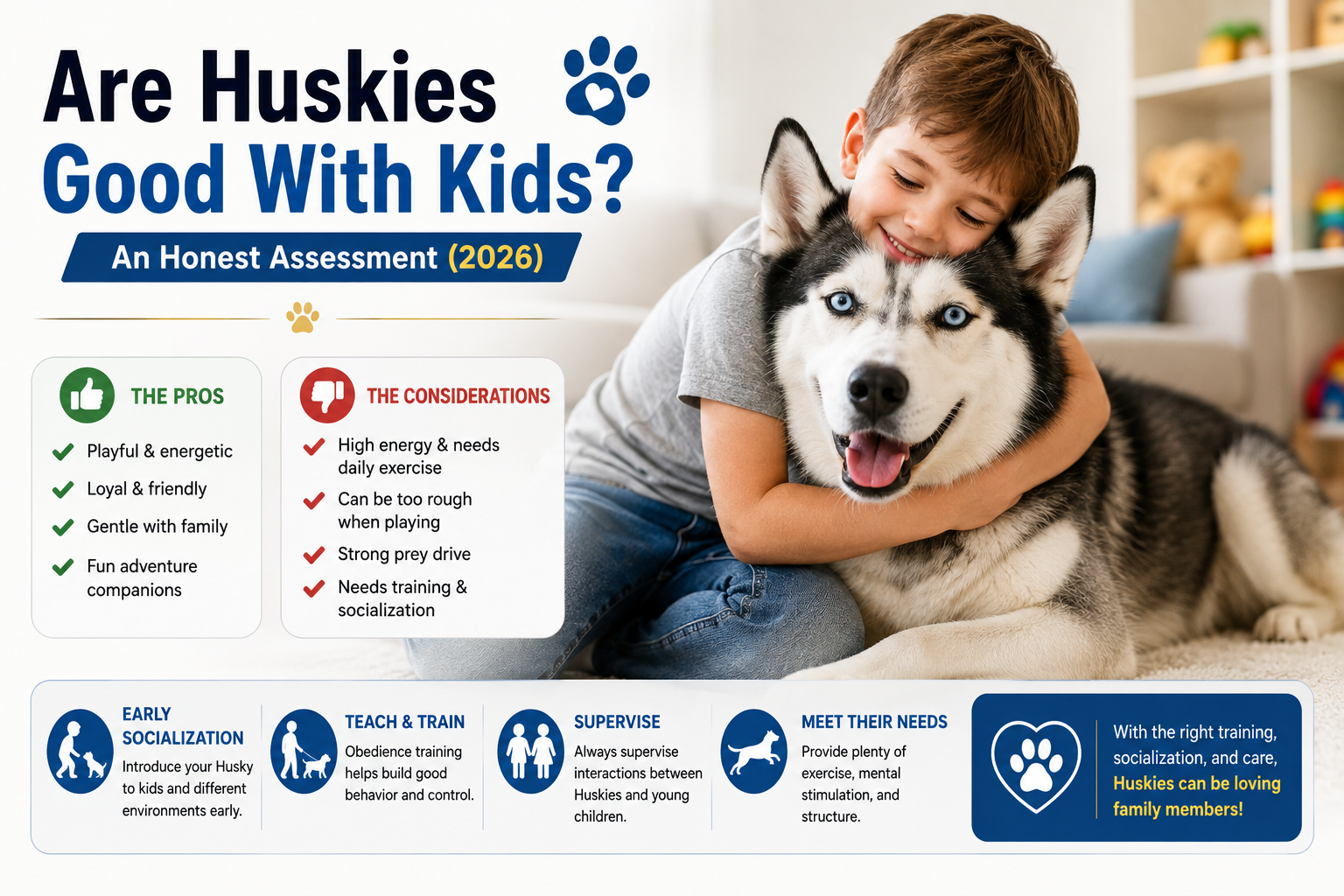
Temperamentally, yes Siberian Huskies are generally excellent with children. Practically, they are a difficult family dog for most households. Huskies were bred to work in teams and live closely with people, so they are typically friendly, sociable, and notably non-guarding. The problems are not temperament but logistics: enormous exercise needs, a strong prey drive, world-class escape ability, heavy shedding, and an independent streak that makes training genuinely hard. A Husky suits an active family with older children and time. It is a poor match for a busy household with toddlers.
Key Takeaways
- Huskies are rarely aggressive toward people and make poor guard dogs by design.
- They need 1.5–2+ hours of real exercise daily, in all seasons, for life.
- Prey drive is high. Small pets are a genuine concern; running toddlers can trigger chase.
- They are notorious escape artists fences must be tall and dug in.
- Heavy year-round shedding plus two intense coat blows.
- Not recommended for first-time owners, regardless of children.
Where the Temperament Comes From
The Siberian Husky was developed by the Chukchi people of northeastern Siberia as a sled dog that lived among the family, including with children, for warmth and companionship. Two traits were selected for and both persist strongly.
Aggression toward humans was actively bred out. A dog that lived in close quarters with a family and worked in large teams could not be human-aggressive or dog-aggressive. This is why Huskies are typically friendly with strangers, tolerant of handling, and to the frustration of some owners completely useless as guard dogs. A Husky is more likely to show a burglar around than to challenge them.
Independence was bred in. Sled dogs had to make decisions on trail and ice without waiting for instruction. That produces a dog that hears a command, understands it perfectly, and considers whether it is worth doing. Owners used to biddable breeds find this genuinely challenging.
The Case For Huskies as Family Dogs
- Very tolerant of children. Generally patient with noise, handling, and chaos.
- Not typically resource-guarding around food or toys, compared with many breeds.
- Playful and energetic, with a genuinely goofy streak that children enjoy.
- Sociable, wanting to be part of family activity rather than apart from it.
- Sturdy, so less easily injured by clumsy handling than a small or fine-boned breed.
- Enjoy older children’s activities hiking, running, cycling, snow.
- Rarely aggressive, with bite statistics that compare favourably to their fearsome appearance.
The Case Against Honestly
Exercise needs are the deal-breaker
1.5 to 2 hours minimum, every day, for 12–15 years. Not a wander around the block real, sustained exercise. An under-exercised Husky does not become calm; it becomes destructive, vocal, and difficult. Chewed furniture, dug-up gardens, and howling that upsets neighbours are the classic outcomes.
Ask honestly whether that happens on a wet Tuesday in February when someone has flu and there is a school run.
Prey drive
Huskies retain a strong chase instinct. This means:
- Small pets are a real risk. Cats, rabbits, guinea pigs, and chickens should be considered incompatible unless raised together very carefully and even then, supervised.
- Off-lead recall is unreliable in most Huskies. Many owners never achieve safe off-lead freedom, and long lines become permanent equipment.
- Fast-moving small children can trigger chase behaviour. This is not aggression it is instinct but a 25 kg dog chasing and knocking over a toddler causes real injuries regardless of intent.
Escape artistry
Huskies are legendary for it. They climb fences, dig under them, open gates, and squeeze through gaps that look impossible. Secure containment means a six-foot fence, dug in at the base or with a concrete footing, and gates that latch properly. Many rescue Huskies are strays for exactly this reason.
Vocal, not barky
Huskies howl, “talk,” and make an extraordinary range of noises. Charming in videos, less so in a terraced house at 6am with a baby asleep.
Shedding
A dense double coat with year-round shedding and two dramatic seasonal blows. If shedding is a factor, our guide on Golden Retriever shedding explains the double-coat cycle in detail and note that the same rule applies here: never shave a Husky.
Heat sensitivity
Built for Arctic conditions. In hot climates they need shade, air conditioning, and exercise restricted to early morning and evening. They cope with cold far better see why is my dog shivering for the flip side of coat insulation.
Training difficulty
Intelligent and entirely capable of learning, but selective about compliance. Reward-based training, high-value motivation, and consistency work. Repetition-heavy or force-based methods produce a Husky that disengages entirely.
Age of Child Matters Enormously
| Child’s age | Realistic assessment |
| Under 3 | Not recommended. Toddlers are unsteady, and an exuberant Husky knocks them over. Parents also have no spare capacity for a dog needing two hours daily. |
| 3–6 | Possible with constant supervision and a settled adult dog. A Husky puppy plus a preschooler is very demanding. |
| 7–12 | Best fit. Children can participate in walks and training, understand boundaries, and enjoy the dog’s energy. |
| Teenagers | Excellent old enough to genuinely share exercise duties. |
Rules for Any Dog With Children
- Supervise all interactions. Every time, regardless of how trustworthy the dog is.
- Teach children to respect the dog’s space no disturbing a sleeping or eating dog, no hugging around the neck, no riding or climbing.
- Give the dog a retreat a crate or bed that children never enter.
- Teach children to read dog body language: lip licking, yawning, turning away, and whale eye are all “I need space.”
- Never leave a baby or toddler alone with any dog, for any length of time.
- Involve children in training so the dog learns to respond to them too.
- Manage puppy mouthing carefully see when do puppies stop biting, because a Husky puppy’s nipping phase coincides with a lot of excited small-child energy.
Setting a Husky Up to Succeed
- Exercise before anything else. A tired Husky is a pleasant Husky.
- Mental work counts double. Puzzle feeders, scent games, and training sessions tire them more than distance alone.
- Give them a job canicross, bikejoring, scootering, and skijoring all suit the breed’s build and drive beautifully.
- Secure the garden properly before the dog arrives, not after the first escape.
- Never off-lead unless you have exceptional recall in a fully enclosed space.
- Feed a good complete diet appropriate to activity level see choosing a complete food.
- Start socialisation early, especially around small animals and children.
- Consider a rescue adult. Huskies fill rescues, and an adult with a known temperament removes most of the guesswork often a better family choice than a puppy.
Frequently Asked Questions
Are Huskies aggressive? Rarely toward people. Human aggression was selected against in the breed’s development, and they make notably poor guard dogs.
Are Huskies good for first-time owners? Generally no. Their exercise needs, independence, escape ability, and prey drive make them demanding even for experienced owners.
Can Huskies live with cats? It is risky. Prey drive is high, and while some Huskies raised with cats coexist peacefully, many cannot be trusted. Never leave them unsupervised together.
Do Huskies bite children? Bites are uncommon and the breed is generally tolerant, but any dog can bite if frightened, hurt, or pushed too far. Supervision is non-negotiable with all breeds.
How much exercise does a Husky need? At least 1.5–2 hours of genuine exercise daily, every day, in all weather — plus mental enrichment.
Are Huskies good apartment dogs? Very difficult. Not because of size but because of exercise needs and vocalisation. It requires an exceptionally committed owner.
Do Huskies get along with other dogs? Usually yes — they were bred to work in teams and are typically sociable with other dogs.
Should I get a Husky if I have a toddler? Generally not. It is less about temperament than practicality: toddlers get knocked over, and parents of toddlers rarely have two hours a day for a dog.
Final Thoughts
The question “are Huskies good with kids” has a slightly awkward answer: the dog is usually fine, and the household usually is not.
Huskies genuinely are among the more child-tolerant breeds. What defeats families is everything around that — the two hours of daily exercise that never lets up, the fence that has to be rebuilt, the recall that never quite becomes reliable, the fur, the howling, the cat that has to be rehomed. These are the reasons Husky rescues are consistently full, and almost none of them are about temperament.
If you are an active family with children over seven, time to spare, and a properly secured garden, a Husky can be a wonderful companion. If you are hoping for a low-maintenance family dog that will fit around a busy life, this is not the breed — and recognising that before you commit is the kindest decision you can make.
Related Reading
- When Do Puppies Stop Biting?
- New Puppy Checklist: Everything You Need
- Do Golden Retrievers Shed a Lot?
- Why Is My Dog Shivering?
A Note on Pet Health
Serlig publishes researched pet care information for everyday owners. It is general guidance, not veterinary advice, and it does not replace an examination by a licensed veterinarian who knows your pet. If your pet is unwell, or anything in this guide does not match what you are seeing at home, contact your vet.
About the Author
The Serlig Pet Care Team creates researched, plain-language pet care guides for everyday owners. Our content is written from hands-on pet-care experience and cross-checked against established veterinary sources so you can make confident decisions for your dog.