
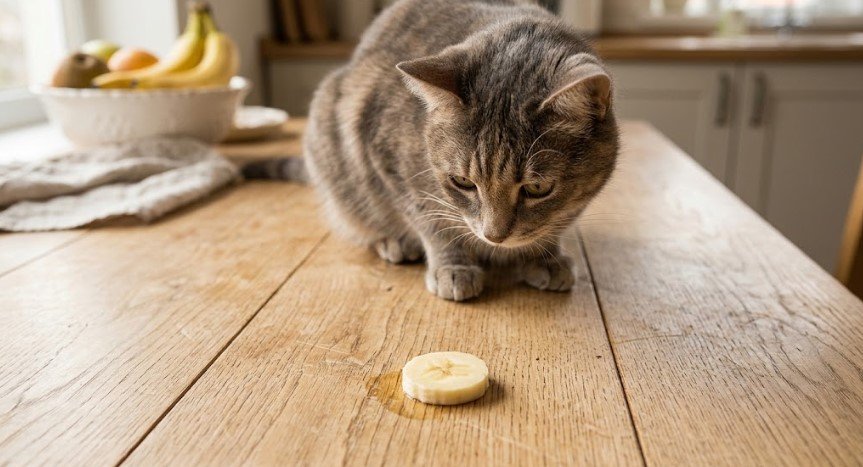
Can cats eat bananas? Yes. Bananas are not toxic to cats, and a piece the size of a coin slice is safe for a healthy adult cat as an occasional treat. They are also high in sugar and offer a cat almost nothing nutritionally. Never give banana peel, banana bread or dried banana chips. Cats with diabetes, obesity or kidney disease should not have banana at all, and the kidney case is more complicated than most articles suggest.
Can Cats Eat Bananas?
Yes, and for most healthy cats this is a low stakes question.
Banana flesh contains nothing toxic. A small piece will not harm a healthy adult cat, and if yours has already stolen a bite there is no reason for concern.
The rest of the answer is about proportion. Bananas are a sugar rich food given to an animal that cannot taste sweetness, cannot use plant nutrients efficiently, and has a daily calorie budget small enough that a single slice matters more than it would for you.
There is also one genuinely contested point buried in this topic. Some sources suggest banana may help cats with kidney disease because of its potassium content. Others say cats with kidney disease should avoid banana for exactly the same reason. Both appear on the first page of search results, and the disagreement is not trivial. That section is further down and is the most important part of this article.
Why Your Cat Is Interested, or Terrified
Cats respond to bananas in two opposite ways, and both have the same explanation.
Cats cannot taste sweetness: They lack functioning sweet taste receptors, so the quality that makes a banana appealing to you is invisible to them. A cat sniffing at your banana is responding to texture, smell or simple curiosity about what you are holding.
Banana peel is aromatic in a way cats often dislike: Ripening bananas release volatile compounds, including esters that produce the characteristic banana smell. Some cats find these genuinely aversive, which is the reason behind the well known videos of cats leaping backwards from a banana on the floor.
So a cat that ignores bananas is behaving normally, and a cat that appears alarmed by one is also behaving normally. Neither reaction says anything about whether banana is good for them.
This matters practically because it removes the main argument for offering fruit. Your cat is not missing out on a flavour it would enjoy. There is no sweetness in it for them.
How Much Banana Is Safe?
Veterinary guidance holds that treats should stay under 10 percent of daily calories. For an average adult cat that is roughly 20 to 30 calories.
A medium banana weighs around 118 grams and contains roughly 105 calories, of which about 14 grams is sugar. That means a whole banana is close to half a cat’s entire daily calorie requirement, and around four times its total treat allowance.
| Cat weight | Daily calories | Treat budget | Banana portion |
| 3 kg (7 lb) | 160 to 200 kcal | 16 to 20 kcal | A thin coin slice, roughly 5 grams |
| 4 kg (9 lb) | 200 to 240 kcal | 20 to 24 kcal | A coin slice, roughly 8 grams |
| 5 kg (11 lb) | 240 to 300 kcal | 24 to 30 kcal | A slightly thicker slice, roughly 10 grams |
| 6 kg (13 lb) | 280 to 340 kcal | 28 to 34 kcal | Up to about 12 grams |
Those figures assume banana is the only treat that day. If your cat is also getting commercial treats or a piece of chicken, the banana portion shrinks accordingly.
Frequency matters more than portion: Once a week at most, and only if your cat actually wants it. Our guide to low calorie treats and portion control covers how to keep the arithmetic honest.
What Bananas Actually Give a Cat
Several articles list banana’s nutrients as though the list itself is an argument. It is worth going through them, because a few of these are not benefits at all for a cat.
Potassium: Real, but a complete cat food already supplies potassium in appropriate amounts. More is not automatically better, and in some cats it is actively unhelpful, as the next section explains.
Fibre: Banana contains fibre, and some sources present this as digestive support. Plain pumpkin is a better choice for that purpose, is more readily accepted by cats, and carries far less sugar.
Vitamin B6: Present, and genuinely used by cats. The quantity in a safe portion is negligible, and a cat would have to eat an unsafe amount to obtain a meaningful dose. A complete diet already covers it.
Vitamin C: Frequently listed, and not a benefit. Cats synthesise their own vitamin C internally: It is not a dietary requirement for them, so its presence in banana is irrelevant.
Protein: Occasionally listed. A medium banana contains around one gram of protein, and plant protein is poorly used by an obligate carnivore. This is not a meaningful contribution.
Antioxidants and flavonoids: Present in fruit generally. The evidence for a clinical benefit in cats fed occasional fruit is thin, and the portion sizes involved are too small to test the idea.
The pattern is consistent. Banana’s nutrients are real, but they are either already supplied, poorly absorbed by cats, or present in quantities too small to matter at a safe serving size.
The Kidney Disease Question
This is the section where page one contradicts itself, and where the wrong answer could genuinely harm a cat.
One position: cats with chronic kidney disease should avoid banana because of its high potassium content.
The opposite position: low blood potassium can worsen kidney function, so occasional banana might help an older cat.
Both appear on established pet websites. Both sound reasonable. Following either one on your own would be a mistake.
Why both are incomplete: Potassium status in feline chronic kidney disease is not fixed. Some cats with the condition develop low blood potassium, particularly in earlier stages, and these cats may be prescribed a potassium supplement. Others, especially in advanced disease, develop high blood potassium, which is dangerous and requires the opposite approach. The same food is therefore either mildly helpful or actively harmful depending on which cat and which stage.
The only correct answer: Potassium status is determined by a blood test, not by guesswork. If your cat has kidney disease, potassium is something your vet is already measuring and managing, usually alongside a prescription renal diet that controls phosphorus and protein carefully. Adding fruit outside that plan introduces an unmeasured variable into a treatment that depends on precision.
What to do instead: Ask your vet directly whether your cat’s potassium is low, normal or high, and whether any dietary addition is appropriate. That is a two minute conversation and it replaces every general article on the internet, including this one.
Do not use banana to treat a kidney condition. Do not withhold a prescribed supplement because you are giving fruit instead.
Which Cats Should Not Have Banana
For these cats the answer is a straightforward no.
Diabetic cats: Banana is high in sugar and carbohydrate, which interferes with insulin dosing and glucose stability.
Overweight cats: The treat budget shrinks during a weight plan, and a calorie dense food with no nutritional return is the first thing to cut.
Cats with kidney disease: As above, unless your vet has specifically advised otherwise after testing.
Cats with a sensitive stomach or known food sensitivities: Cats can react to a new food even on first exposure, and the fibre and sugar in banana are a plausible trigger.
Kittens: High growth requirements leave almost no room for calories that carry no nutrition, and a digestive upset matters far more in a small animal. Our kitten feeding schedule sets out what they need instead.
Peel, Bread and Chips
The banana itself is the least of the problems here. What surrounds it is worse.
| Form | Verdict | Why |
| Plain ripe banana flesh | Safe in a small slice | Not toxic. Empty calories |
| Banana peel | Never | Tough and indigestible, a genuine choking and obstruction risk, and may carry pesticide residue |
| Banana bread | Never | Sugar and butter at minimum. Often contains raisins, which are linked to kidney failure in cats, and sometimes chocolate chips, walnuts or xylitol |
| Dried banana chips | Never | Sugar concentrated by drying, and most commercial chips are fried in oil and coated in additional sugar |
| Banana flavoured yogurt or dessert | Never | Added sugar, and sugar free versions may contain xylitol |
| Banana smoothies | Never | Usually contain dairy, and often other fruit including grape |
| Banana in commercial cat food | Fine | Used in tiny amounts within a formula balanced around it |
Banana bread deserves particular emphasis, because it feels like a milder version of banana and is not. Raisins alone make it unsafe, and our guide to human foods toxic to cats covers why grapes and raisins are treated so seriously. Our article on bread and cats covers the wider baking risks.
Ripeness Matters
This is a small point that no competitor mentions and that affects how a cat handles the fruit.
Underripe or green bananas contain more resistant starch, which is harder for a cat to digest and more likely to cause gas or loose stools. Cats already process starch poorly, so this is the worst version to offer.
Fully ripe bananas have converted most of that starch into simple sugars. They are softer and easier to digest, but higher in sugar.
Overripe bananas are highest in sugar and softest of all. They are also the ones most likely to be sitting on a counter within reach of a cat.
If you are going to offer a slice, a fully ripe banana is the sensible middle. The difference is genuinely marginal, which is another way of saying that no version of this fruit is a good use of your cat’s treat allowance.
How to Serve Banana Safely
- Peel it completely: Remove any stringy fibres clinging to the flesh as well.
- Cut a single thin slice and weigh it if you want to be precise. Five to ten grams is the whole portion.
- Mash or cut it into small pieces: A whole slice can be a choking risk for an enthusiastic cat.
- Serve it plain: No honey, no yogurt, no peanut butter, nothing added.
- Offer it alone, with no other new food that day, so any reaction is traceable.
- Subtract it from the meal rather than adding it on top.
- Watch for 24 hours. Vomiting, loose stools, reduced appetite or lethargy all mean stop.
- Do not persist if refused: Most cats will ignore it, and that is the expected outcome rather than a problem to solve.
If your cat vomits repeatedly after any new food, that warrants attention rather than observation, and our article on why cats vomit explains when it becomes urgent.
My Cat Ate Too Much Banana. What Now?
Most incidents here are minor, but the response differs depending on what was eaten.
A large amount of banana flesh: Not an emergency. Expect possible loose stools, gas or a single episode of vomiting within the next day as the sugar and fibre pass through. Make sure fresh water is available, feed the next meal as normal, and watch the litter tray for 24 hours. Contact your vet if diarrhoea continues past a day, if vomiting repeats, or if your cat becomes lethargic or stops eating.
Banana peel: Take this more seriously. Peel is tough, fibrous and does not break down well, so the concern is obstruction rather than poisoning. Call your vet for advice even if your cat seems fine, and describe how much was swallowed. Do not attempt to induce vomiting, since bringing a fibrous mass back up carries its own risks. Watch closely for repeated retching, refusing food, a painful or bloated abdomen, straining to pass stool, or vomiting that produces nothing.
Banana bread or anything baked: Call your vet and check the ingredients first. Raisins are the priority concern, since grapes and raisins are linked to acute kidney failure in cats and no safe dose has been established. Xylitol, chocolate and macadamia are also possible. Keep the packaging or recipe to hand.
The general rule across all three: the plain fruit is a minor digestive matter, while the peel is a mechanical risk and the baked version is a toxicity risk. Treat them differently rather than lumping them together.
If the goal is a treat, these all serve a cat better than fruit.
- Plain cooked chicken, shredded small. Species appropriate and genuinely enjoyed. Our guide to chicken and cats covers portions.
- A commercial treat with a stated calorie count, which makes portion control straightforward.
- Plain pumpkin, if fibre is what you are actually after. Lower sugar and more useful than banana.
- A lickable puree treat, which delivers the ritual of being given something with far fewer calories.
- Play instead of food: Much treat giving is really about interaction.
For the full picture of what belongs in a cat’s diet, see our complete guide to what cats can eat.
Frequently Asked Questions
Not really. They are safe in small amounts but supply nothing a complete cat food does not already provide, and the nutrients they contain are either already covered or poorly absorbed by cats.
About a thin coin slice, roughly five to ten grams depending on the cat’s weight, once a week at most.
No. Peel is tough, indigestible, a choking and obstruction risk, and may carry pesticide residue.
No. It contains sugar and butter at minimum, and frequently raisins, which are linked to kidney failure in cats.
Do not decide this yourself. Potassium levels vary by cat and by stage of disease, and are managed through blood testing and a prescription diet. Ask your vet rather than following general advice in either direction.
Ripening bananas release aromatic compounds that some cats find genuinely unpleasant. It is a normal reaction and not a sign of anything wrong.
Best avoided. Kittens need dense complete nutrition and have almost no room for empty calories, and digestive upsets affect them more severely.
Conclusion:
Can cats eat bananas? Yes, a coin slice of plain ripe banana is safe for a healthy adult cat. It is also close to pointless, since cats cannot taste the sweetness, cannot use the plant nutrients well, and get everything they need from a complete diet already.
Skip it entirely for kittens and for cats that are diabetic, overweight or living with kidney disease. Keep peel, banana bread and dried chips away completely, since those carry real risks that plain banana does not.
And if your cat has kidney disease, ignore every general recommendation about banana and potassium, including both of the contradictory ones circulating online. That is a blood test question and a conversation with your vet, not a fruit bowl decision.
A Note on Pet Health
Serlig publishes researched pet care information for everyday owners. It is general guidance, not veterinary advice, and it does not replace an examination by a licensed veterinarian who knows your pet. If your pet is unwell, or anything in this guide does not match what you are seeing at home, contact your vet.




One Comment