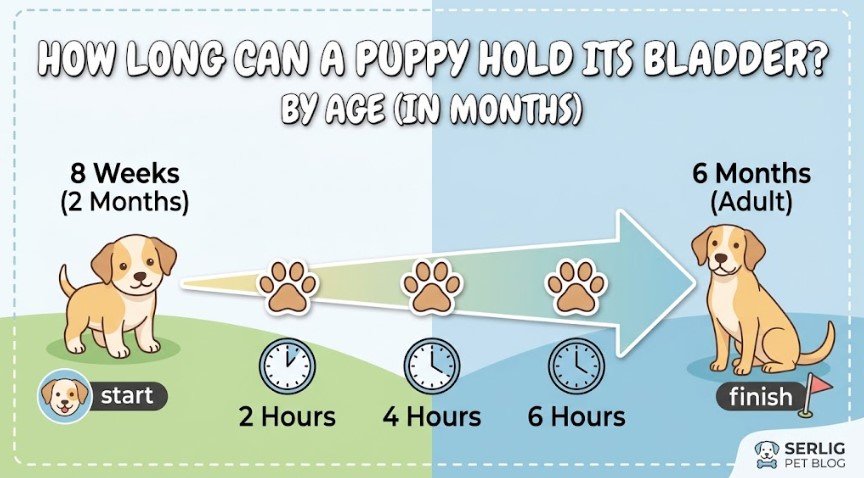
How long can a puppy hold its bladder is usually estimated at about one hour per month of age, so an eight week old manages roughly two hours and a four month old about four. That rule has limits at both ends: it overestimates for puppies under about twelve weeks, and it stops scaling at around eight hours. Puppies last noticeably longer at night than by day, most sleep through by four to six months, and small breeds reach their limit sooner. What a puppy can hold is a ceiling, not a schedule.
The Short Answer
The widely used guideline is one hour of bladder control per month of age.
- 8 weeks: about 2 hours
- 12 weeks: about 3 hours
- 16 weeks: about 4 hours
- 6 months: about 6 hours
Some sources add one to that figure, which gives a slightly more generous estimate. That difference matters more than it looks, and it is covered below.
Three qualifications apply to every number on this page. These are averages, individual puppies vary considerably, and the figure describes a physical limit rather than a sensible interval between trips outside.
This article is about the numbers themselves: what they are, why they change, and where they stop being reliable. For how to use them in a daily routine, our guide to potty training a puppy covers the method.
The Full Chart by Age
| Age | Daytime capacity | Overnight capacity | Practical daytime interval |
| 8 weeks | 1 to 2 hours | 2 to 3 hours | Every 1 to 2 hours |
| 10 weeks | 2 hours | 3 hours | Every 1.5 to 2 hours |
| 12 weeks | 2 to 3 hours | 3 to 4 hours | Every 2 hours |
| 14 weeks | 3 hours | 4 to 5 hours | Every 2 to 3 hours |
| 16 weeks | 3 to 4 hours | 5 to 6 hours | Every 3 hours |
| 5 months | 4 to 5 hours | 6 to 7 hours | Every 3 to 4 hours |
| 6 months | 5 to 6 hours | 7 to 8 hours | Every 4 hours |
| 8 months and over | 6 to 8 hours | 8 hours or more | Every 4 to 6 hours |
How to read this table. The capacity columns describe what a typical puppy can physically manage. The final column is what you should actually plan around, and it is always shorter, for reasons covered in the “can hold is not should hold” section.
Reduce every figure for small and toy breeds. See the size section.
Two Rules That Disagree
You will find two versions of the rule, and nobody reconciles them.
Version one: hours equal age in months. Version two: hours equal age in months, plus one.
For an older puppy the gap is small. For a young one it is not.
| Age | Months rule | Months plus one | Difference |
| 8 weeks | 2 hours | 3 hours | 50 percent longer |
| 12 weeks | 3 hours | 4 hours | 33 percent longer |
| 6 months | 6 hours | 7 hours | 17 percent longer |
At eight weeks, one rule allows fifty percent more time than the other. That is the difference between a dry floor and an accident.
How to use both. Treat the plain months figure as your planning number and the plus one figure as the absolute ceiling you should never deliberately reach. Planning to the generous version means your puppy is routinely at its limit, and a puppy at its limit will sometimes fail.
Where the Rule Stops Working
The rule is useful in a middle range and unreliable at both ends. This is rarely explained.
Under About Twelve Weeks
The rule overestimates for very young puppies. An eight week old has immature bladder muscles and limited nerve control over the sphincter. It is not simply a small bladder, it is an undeveloped system. Some guidance notes that the monthly rule only really begins to apply from around three months.
In practice that means an eight week old may need to go considerably more often than two hours, particularly when awake and active. Treat the chart figures for this age as optimistic.
Above About Eight Months
The rule does not scale indefinitely. A twelve month old dog does not have twelve hours of comfortable capacity, and a two year old does not have twenty four.
Capacity plateaus somewhere around eight hours for comfortable holding in most dogs, with healthy adults able to manage roughly eight to ten hours overnight. Beyond that, the rule becomes meaningless and the adult guidance below applies instead.
The practical takeaway. The rule is a reasonable guide for puppies of roughly three to eight months. Outside that window, use the specific guidance for that age rather than the formula.
Why Puppies Last Longer at Night
Owners often notice that a puppy who needs to go every two hours by day can manage five or six hours overnight. This seems contradictory until you know the reason.
Antidiuretic hormone. During sleep, the body releases more of this hormone, which signals the kidneys to reabsorb water and produce less urine. The bladder simply fills more slowly at night.
Three other factors add to it
- Lower activity. Movement and play stimulate the bladder. A sleeping puppy is not moving
- No drinking. Daytime intake is continuous. Overnight it stops
- No excitement. Arousal, whether from play, visitors or a new smell, triggers urgency. None of that happens in a dark, quiet room
The consequence. Daytime and night time capacity are genuinely different numbers, which is why the chart gives both. Planning daytime trips around the overnight figure is one of the most common sources of accidents.
Can Hold Is Not Should Hold
This is the most important principle on the page, and every source hints at it without stating the consequences.
The capacity figure is a maximum, not a target. A puppy routinely kept to its limit is under constant strain.
Why it matters
- Accidents. A puppy at its physical limit will sometimes miss it, and every indoor accident sets house training back
- Urinary tract infections. Urine held for long periods allows bacteria to multiply, and puppies, particularly females, are prone to infection
- Bladder stretching. Regularly overfilled bladders can stretch, which may affect control later
- Discomfort. Holding urine at the limit is genuinely unpleasant, and chronic discomfort affects behaviour
The working rule. Plan trips outside comfortably before the capacity figure, not at it. That is why the practical interval column in the chart is always shorter than the capacity column.
The same logic applies to crate time. For how long a puppy can reasonably stay crated, our guide to crate training a puppy sets out the approach, and the capacity figures here are the upper boundary for it.
Size and Breed
Every source says small breeds need more frequent breaks. Very few say by how much.
Why size matters. Small breeds have both smaller bladders and faster metabolisms, so they fill a smaller container more quickly. Veterinary contributors quoted by Rover make exactly this point.
A practical adjustment
| Size | Adjustment to the chart |
| Toy breeds (Chihuahua, Yorkshire terrier, Pomeranian) | Reduce intervals by 30 to 60 minutes |
| Small breeds (Jack Russell, Shih Tzu, Cavalier) | Reduce intervals by around 30 minutes |
| Medium breeds | Use the chart as given |
| Large and giant breeds | Use the chart, though capacity may be slightly greater |
Toy breeds also take longer to sleep through the night, and may need overnight trips for weeks after a larger breed puppy of the same age has stopped.
Large breeds are not an excuse to stretch it. Greater capacity in a Labrador puppy does not change the developmental timeline for sphincter control, which follows age rather than size.
Marking adds a complication. Small dogs have been observed to scent mark more frequently than large ones, and intact males mark more than neutered dogs. Frequent small urinations are not always a capacity problem.
What Shortens It Day to Day
A puppy’s capacity is not fixed. These factors reduce it, sometimes considerably.
- Activity and play, which physically stimulate the bladder
- Excitement. Visitors, new places and greetings all trigger urgency
- Water intake, particularly large drinks after exercise
- Wet food, which adds substantial water to the diet. A puppy on wet food urinates more than one on dry
- Heat. Warm weather increases drinking, and our guide to keeping dogs cool in summer covers why water must never be restricted then
- Stress and anxiety, including a new home, travel or a change in routine
- Medication. Steroids such as prednisolone commonly cause a marked increase in thirst and urination. Diuretics have the same effect by design. If your puppy is on any medication and suddenly needs to go far more often, ask your vet whether it is expected
- Illness, covered below
Meal timing matters too. Consistent feeding times produce more predictable toileting, and our puppy feeding chart covers scheduling.
Finding Your Own Puppy’s Number
The chart describes an average puppy. Yours may sit either side of it, and a few days of observation will tell you where.
Note the times your puppy urinates for three or four days, alongside when they last ate, drank and slept. A simple list on your phone is enough.
Look for the natural gap. Most puppies settle into a fairly consistent interval once you can see it written down, and it is often shorter than owners assume.
Then plan to the shorter end of what you observe rather than the longest gap you recorded.
Recheck every few weeks, since capacity grows steadily with age and yesterday’s number goes out of date quickly.
When Will My Puppy Sleep Through the Night?
Most puppies manage a full night without a trip outside at around four to six months of age.
What to expect along the way
- 8 to 10 weeks: usually one overnight trip, sometimes two. A trip roughly halfway through your sleep is typical
- 10 to 12 weeks: one trip is still normal, with the gap widening
- 3 to 4 months: many can manage the night with a very late last trip and an early first one
- 4 to 6 months: most sleep through
- Toy breeds: often later than this
Overnight trips should be dull. No play, no talking, low light, straight back. An exciting night trip turns into a nightly request regardless of bladder capacity.
After Puppyhood: Adults and Seniors
Since this question often extends to older dogs, here is the full picture.
| Life stage | Comfortable daytime | Overnight |
| Healthy adult | 6 to 8 hours | 8 to 10 hours |
| Senior, around 7 years and over | 4 to 6 hours | 4 to 7 hours |
Adults should still go out several times a day. Three to five opportunities is a reasonable minimum. Guidance consistently treats ten to twelve hours as an upper limit that should not be routine.
Seniors slide back toward puppy intervals. Bladder muscles weaken with age and conditions such as kidney disease become more common. This is biology rather than regression, and it warrants more frequent opportunities rather than frustration.
The Spayed Female Exception
This deserves its own section because it is frequently mistaken for a training failure.
Urethral sphincter mechanism incompetence is a condition in which the muscle closing the bladder outlet weakens, allowing urine to leak. It is linked to reduced oestrogen, and published figures suggest it affects roughly five to twenty percent of spayed female dogs.
What it looks like
- Wet patches where the dog has been lying or sleeping
- Dribbling while relaxed, with no awareness of it
- A dog that is otherwise fully house trained and still asks to go out normally
Why it matters here. This is not a capacity problem and it is not a training problem. The dog is not choosing to urinate. It is leaking without knowing, often in its sleep.
It is very treatable. Medication is commonly effective. If a spayed female who was reliably trained starts leaking, particularly while asleep, that is a vet appointment rather than a return to house training.
When It Is a Health Problem
Capacity follows a predictable developmental curve. When it suddenly moves the wrong way, that usually has a medical cause.
See your vet if you notice
- A sudden decrease in how long a previously reliable puppy can last
- Frequent small amounts, especially with straining
- Blood in the urine, or urine that is cloudy or strongly smelling
- Crying or discomfort while urinating
- Drinking far more than usual. Our guide to a dog drinking a lot of water covers the possible causes
- Leaking while asleep or relaxed
- Accidents in a dog who was previously dry for months
Common causes include urinary tract infection, bladder stones or crystals, diabetes, kidney disease, congenital abnormalities in young puppies, and intestinal parasites, which can cause urgency. Our guide to worms in dogs covers the parasite side.
The principle. A puppy that suddenly cannot manage what it managed last week has not forgotten its training. Something has changed, and it is usually worth finding out what.
Our new puppy checklist covers the first veterinary appointment, which is a good moment to ask about anything unusual.
Frequently Asked Questions
How long can an 8 week old puppy hold its bladder? About one to two hours during the day and two to three overnight. The monthly rule tends to overestimate at this age because bladder control is still immature, so err on the shorter side.
How long can a 12 week old puppy hold it? Roughly two to three hours by day and three to four overnight. Plan trips at around two hours rather than waiting for the limit.
Why can my puppy hold it longer at night? During sleep the body releases more antidiuretic hormone, which reduces urine production. Lower activity, no drinking and no excitement also help.
When do puppies stop needing to pee at night? Most sleep through at around four to six months. Toy breeds often take longer.
Do small breed puppies need to go out more often? Yes. Smaller bladders and faster metabolisms mean toy breeds typically need trips thirty to sixty minutes sooner than the standard chart suggests.
Is it harmful to make a puppy hold it? Occasionally reaching the limit is not dangerous. Routinely doing so increases the risk of accidents and urinary infections, so plan trips before the capacity figure rather than at it.
My puppy was doing well and now needs to go constantly. Why? A sudden change usually has a medical cause, most often a urinary tract infection. Medication, stress and a switch to wet food can also increase urination. Ask your vet.
The Bottom Line
How long can a puppy hold its bladder is roughly one hour per month of age, and that is where most articles stop. The more useful truth is that the rule only works in a middle range. It overestimates for puppies under about twelve weeks, whose bladder control is still developing, and it stops scaling at around eight hours in adulthood.
Three things are worth carrying away. Night and day are different numbers, because antidiuretic hormone slows urine production during sleep, so planning daytime trips around overnight capacity causes accidents. The capacity figure is a ceiling, not a schedule, and a puppy routinely held to its limit will sometimes miss it. And small breeds need a genuine adjustment, typically thirty to sixty minutes shorter for toy breeds.
When the numbers suddenly move the wrong way, that is almost never forgotten training. It is usually a urinary infection, occasionally medication, and in spayed females sometimes a treatable leak that has nothing to do with training at all.