
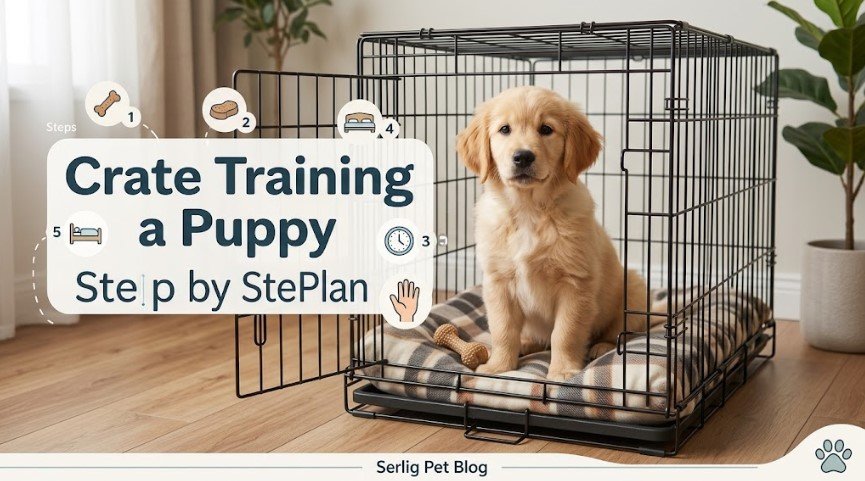
Crate training a puppy works by building a positive association slowly rather than shutting the door and waiting. Start with the door open and food inside, build to short closed sessions while you are present, then add brief absences. Keep the crate in your bedroom for the first few weeks. Most puppies settle within two to three weeks. The hardest part is night crying, and the skill that matters most is telling a genuine toilet need from a protest, because the two need opposite responses.
What a Crate Is For
A crate is a resting place, not a containment device, and the distinction decides whether this works.
What it is genuinely good for
- A safe place to sleep where your puppy cannot chew a cable or swallow something dangerous
- A calm space to retreat to when the house is busy
- Safe travel, since a crated dog is far safer in a car
- Making veterinary stays and future confinement far less frightening
- Supporting house training, since dogs avoid soiling where they sleep
What it is not for
- Long daytime confinement while you work full hours
- Punishment, ever
- Managing a problem that is really about exercise, enrichment or training
- Solving separation anxiety, which it usually makes worse
An honest note. Crating is standard in some countries and discouraged in others, and welfare organisations differ on it. Used as described here, a resting place with short durations and a positive association, it is widely accepted. Used to contain a dog for most of the day, it is not.
Crate training also makes house training considerably easier, and our guide to potty training a puppy covers the schedule side, which this article deliberately does not duplicate.
Choosing the Crate
Size
Large enough to stand up without ducking, turn around, and lie down fully stretched. No larger.
A crate that is too big lets a puppy sleep at one end and toilet at the other, which removes the main reason crates help with house training.
Buy for the adult size and use a divider panel, moving it out as the puppy grows.
Type
| Type | Best for | Watch out for |
| Wire | Most puppies. Good airflow and visibility, folds flat, usually comes with a divider | Can feel exposed. A cover over three sides usually fixes that |
| Plastic | Puppies who prefer a den, and air travel where it may be required | Less airflow, no divider, harder to clean |
| Soft fabric | Travel and calm adult dogs | Not suitable for puppies. Chewed through easily and offers no security |
| Furniture style | Established adult dogs in living spaces | Expensive, no divider, and often not sturdy enough for a chewer |
For most puppies, a wire crate with a divider and a cover over three sides is the practical choice.
Where to Put It
In your bedroom for the first two to four weeks. This matters more than most owners realise. A puppy placed in a kitchen, utility room or garage on its first night has gone from sleeping in a pile of littermates to complete isolation, and the crying that follows is entirely predictable.
Being close also lets you hear the difference between a toilet whine and a protest, which is covered below.
Once your puppy is settling reliably, move the crate gradually toward its permanent spot, a short distance every few nights.
What Goes Inside, and What Does Not
Inside
- Bedding, if your puppy does not shred it. A vet bed or a flat blanket is safer than a thick stuffed bed for a chewer
- One safe chew toy, solid and too large to swallow
- A food filled toy for settling sessions
- An item carrying your scent, such as a worn t shirt, which genuinely helps in the first nights
Not inside
- A collar with tags or any harness. Tags and buckles catch on crate bars and strangulation has happened. Remove the collar every time
- Rawhide, bones or hard chews given unsupervised
- Anything with squeakers or small parts that could come loose
- Food and water bowls for long periods, since spills make the crate wet. A clip on bowl is fine for longer sessions
The Introduction, Week by Week
The single biggest mistake is going too fast. This schedule assumes an eight to ten week old puppy, and you can move faster if your puppy is relaxed at every stage.
Days 1 to 3: Door Open Only
- Set the crate up with bedding and leave the door open or removed
- Feed every meal inside, starting with the bowl just inside the entrance and moving it further back each meal
- Drop treats inside at random moments through the day so your puppy finds them
- Never close the door. Never push or lift your puppy in
- Let them come and go freely
Days 4 to 7: Closing the Door
- Close the door for a few seconds while your puppy eats, then open it before they finish
- Build to a minute, then two, then five, staying in the room
- Reward calm behaviour, not exit. Open the door during a quiet moment rather than in response to a whine
- Add a cue word such as “crate” or “bed” as they go in voluntarily
Week 2: Adding Distance
- Close the door and step out of the room for one minute, then return calmly
- Build to five, then ten, then twenty minutes
- Use naps. A tired puppy settles far more easily than an energetic one
- Crate for short periods while you are home, so the crate does not only predict your absence
- Aim for around thirty minutes of calm settling before moving on
Week 3: Overnight and Longer
- Most puppies with a consistent introduction are ready for overnight crating by now
- Build daytime sessions toward an hour
- Begin short absences from the house
Do not skip stages to save time. A puppy rushed into a closed crate can develop a lasting aversion, and rebuilding takes far longer than doing it properly once.
The First Night
- Exercise well before bedtime, then allow a calm wind down. An overstimulated puppy cannot settle
- Final toilet trip as late as possible
- Crate beside your bed, close enough to touch
- Lights off, no talking
- Expect crying. Ten to forty five minutes on the first night is common
- You may reassure without releasing. A hand on the crate or a quiet word is fine. Opening the door in response to crying is not
- Set an alarm for the toilet trip rather than waiting to be woken
- Keep night trips silent and boring. Out, toilet, praise, straight back in
Night Crying: Toilet or Protest?
Every article tells you to learn the difference. Almost none describe it. This is the most useful section on this page.
| Protest crying | Genuine toilet need | |
| When | Starts immediately on being shut in | Starts after a period of sleeping |
| Sound | Rhythmic, repetitive, almost a chant | Sharper, more urgent, escalating |
| Pattern | Builds slowly, plateaus, gradually fades | Comes on suddenly and does not settle |
| Body | Lying down, often quiet between bursts | Standing, circling, scratching at the door or floor |
| If you appear | Often stops immediately | Continues, and intensifies toward the door |
| Duration | Fades within 10 to 45 minutes | Does not fade at all |
| Response | Wait. Do not open the door | Take them out, quietly and without fuss |
The rule that removes the dilemma: when in doubt, take them out.
A boring toilet trip costs you almost nothing. No talking, no play, no light, straight back to the crate. It reinforces very little.
The alternative is far worse. A puppy left crying with a genuine need will eventually soil the crate, and once that happens the instinct to keep the sleeping area clean weakens. That is much harder to repair than a slightly reinforced whine.
Check the obvious first. Too hot or cold, a light or noise disturbing them, a late meal, or wet bedding.
The Trajectory Test
Here is the diagnostic that tells you whether this is working, and it is absent from every competing article.
Normal adjustment crying decays. Problem crying does not.
- Night 1: ten to forty five minutes of crying is normal
- Night 3: noticeably less
- Night 5 to 7: a few minutes at most
- Week 2: usually settles within a minute or two
If night five sounds the same as night one, something is wrong. That is not a puppy that needs more time. It is a signal to slow down, go back a stage, or look at the next section.
Equally, crying that escalates over nights rather than decaying is a warning sign rather than stubbornness.
When Crying Is Not Normal
Some protest is expected. Genuine distress is different, and continuing to crate a truly panicked puppy makes the problem worse rather than better.
Signs of real distress rather than protest
- Frantic, continuous crying with no pauses, lasting well beyond forty five minutes
- Heavy panting and drooling while crated. Our guide to heavy panting in dogs covers the other causes
- Trembling or shaking, covered in our guide to why a dog shakes
- Desperate escape attempts, biting at the bars, digging at the floor
- Injury: bloodied gums or paws, broken nails, bent crate bars
- Soiling the crate despite an appropriate schedule
- Refusing to enter at all, or bolting out the instant the door opens
- Crying that gets worse over nights rather than better
What to do
- Stop and go back several stages. Door open, meals inside, no closed door at all for a week
- Try a playpen instead, which gives more space and is less confining
- Speak to your vet, since pain and medical problems can present as an inability to settle
- Ask about referral to a qualified behaviourist. Separation anxiety is a recognised condition with established treatment, and crating alone will not fix it
If a puppy is injuring itself trying to escape, stop crating and get professional help. That is not a training problem to push through.
The Water Question
Sources genuinely disagree here, so it is worth being clear rather than picking a side silently.
The common advice is to remove the water bowl one to two hours before bedtime to reduce overnight toilet needs.
The case against is that puppies dehydrate quickly, and restricting water can cause genuine problems, particularly in warm weather or for a puppy that is unwell.
A reasonable middle position
- Offer a final drink at the last toilet trip
- Lifting the bowl for the last hour or two before bed is generally considered acceptable for a healthy puppy in a comfortable environment
- Never restrict water in warm weather, for a puppy that is unwell, or for one with any diagnosed condition
- Never restrict water during the day
- Ask your vet if your puppy seems unusually thirsty, since increased drinking can itself indicate a problem
If overnight toilet trips are the issue, the answer is usually a later final trip and an alarm rather than less water. Our guide to keeping dogs cool in summer covers hot weather, when water restriction is genuinely unsafe.
Never Use the Crate as Punishment
This is stated everywhere and the reason is worth understanding.
You are spending weeks building an association: crate means food, rest, safety and good things. Sending a puppy to the crate after a telling off overwrites that in a single event, and associations built by fear form faster and last longer than associations built by reward.
A puppy crated in anger will hesitate at the door, need coaxing, and may refuse entirely. Rebuilding takes far longer than the original training did.
Also avoid
- Using the crate to interrupt unwanted behaviour such as biting. Our guide to when puppies stop biting covers better responses
- Dragging or lifting a reluctant puppy in
- Slamming the door or raising your voice near the crate
If you need to move your puppy away from a situation, lead them calmly with a treat and settle them with a chew, so the crate stays a good place rather than a consequence.
Building Duration
- Increase in small steps. If thirty minutes is comfortable, try forty, not ninety
- Vary the pattern so your puppy cannot predict a long stretch. Mix one minute sessions with longer ones
- Always crate sometimes while you are home, so the crate does not only mean you are leaving
- Give something to do. A food filled toy turns settling into an activity
- Come back before the crying starts. Returning during calm is what builds confidence
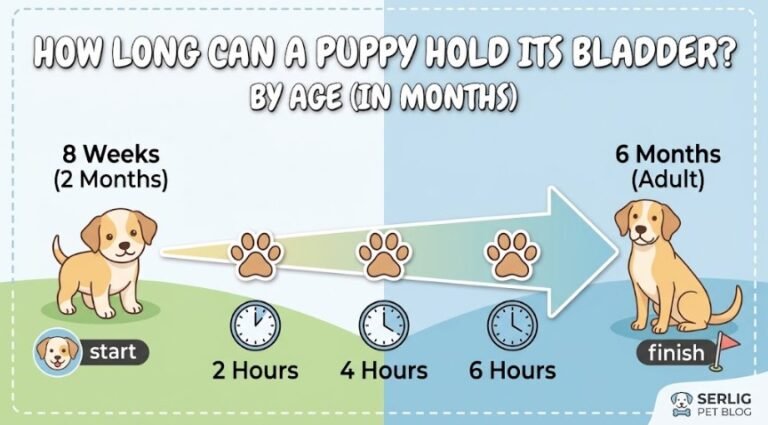
- Never crate longer than your puppy can comfortably last. For toilet limits by age, see our potty training guide
- A crate is not a solution to long working days. If nobody is home for extended periods, a playpen, a dog walker or daycare is the appropriate answer
Our new puppy checklist covers the wider setup, and our puppy feeding chart covers meal timing, which affects settling more than most people expect.
Adult and Rescue Dogs
The principles are the same and the pace is usually slower.
Assume a negative history. A rescue dog may have been crated for long periods, punished with a crate, or never seen one. Start with the door open.
Feed every meal inside for as long as it takes, sometimes weeks.
Do not close the door until the dog chooses to rest inside voluntarily.
Watch for panic signs more carefully, since an adult dog with a bad history can escalate quickly.
Some dogs never accept a crate, and that is fine. A bed in a quiet corner with a baby gate achieves most of the same things.
When a Crate Is Not the Answer
- True separation anxiety. Confinement usually intensifies panic. This needs a behaviourist
- Long working days. No puppy should be crated for a full shift
- Hot weather, where a crate reduces airflow and a dog cannot move somewhere cooler, especially for flat faced breeds
- Dogs with mobility problems or pain, who need to change position freely
- Dogs that panic despite a slow, correct introduction
Frequently Asked Questions
How long does crate training a puppy take? Most puppies accept the crate within two to three weeks with a gradual introduction. Rushing the stages usually adds weeks rather than saving them.
How long will my puppy cry in the crate? Ten to forty five minutes is common on the first night, reducing to a few minutes within a week. What matters is the trend: crying should decay night by night. If night five matches night one, slow down.
Should I ignore my puppy crying at night? Ignore protest crying, which is rhythmic and fades. Respond to a genuine toilet need, which starts after sleeping and does not settle. When in doubt, take them out quietly with no fuss.
Where should the crate go at night? Your bedroom for the first two to four weeks, then move it gradually. A puppy alone in a kitchen or garage on its first night will almost always cry more.
Can I put a collar on my puppy in the crate? No. Tags and buckles can catch on the bars and strangulation has happened. Remove the collar every time.
Should I take away water before bed? Lifting the bowl for the last hour or two is generally fine for a healthy puppy in comfortable conditions. Never restrict water in warm weather, for an unwell puppy, or during the day.
My puppy panics in the crate. What should I do? Stop, go back to door open sessions, and consider a playpen instead. If there is panting, drooling, injury or crying that worsens over nights, speak to your vet and ask about a behaviourist.
The Bottom Line
Crate training a puppy is a slow association built over weeks, not a door closed on night one. Feed meals inside, close the door for seconds before minutes, add distance gradually, and keep the crate beside your bed at first.
Two things matter more than the rest. Learn the difference between a protest cry and a toilet cry, because they need opposite responses, and when you cannot tell, take the puppy out quietly. A boring toilet trip reinforces almost nothing, while a soiled crate undoes the instinct the whole method depends on.
And watch the trajectory rather than the volume. Crying that fades a little each night is a puppy adjusting. Crying that stays the same on night five, or gets worse, is a puppy telling you to slow down or that something else is wrong.
The crate should end up as the place your dog chooses to go when it wants peace. If it is becoming a place they are sent, something has gone wrong with the method rather than the dog.

2 Comments