Quick Answer
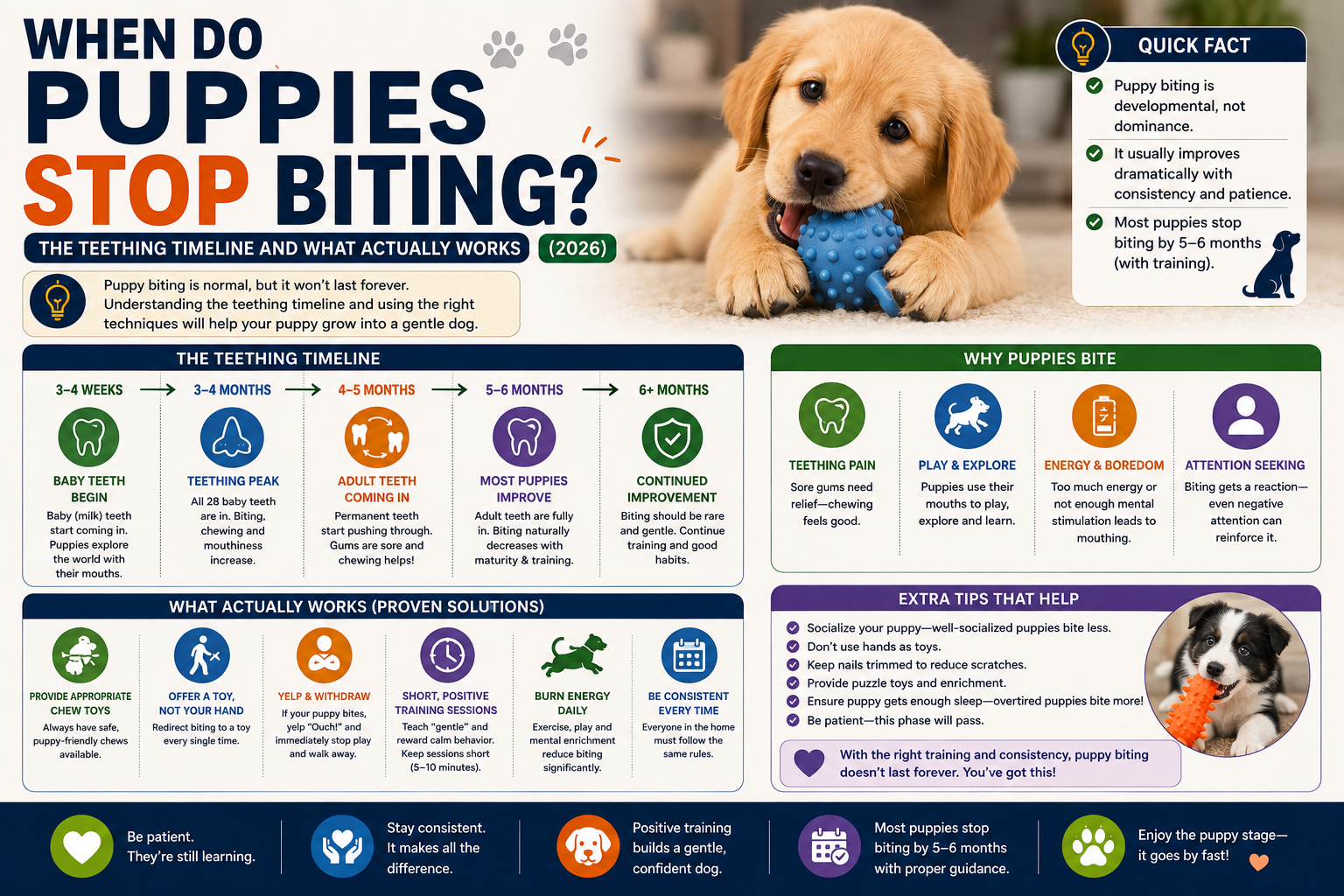
Most puppies stop mouthing and biting by around six to seven months, once adult teeth are fully through and training has taken hold. Biting peaks between 8 and 16 weeks, which is exactly when new owners are most alarmed by it. It is normal, developmentally necessary behaviour puppies explore with their mouths and learn bite inhibition through feedback. The most overlooked factor is sleep: an overtired puppy bites far more, and enforced naps resolve more biting than any training technique.
Key Takeaways
- Puppy biting is normal exploration and teething, not aggression.
- Peak biting: 8–16 weeks. Most puppies have largely stopped by 6–7 months.
- Adult teeth erupt from around 12–16 weeks, with teething discomfort driving chewing.
- Overtired puppies bite the most puppies need 18–20 hours of sleep a day.
- Redirection onto an appropriate item works better than punishment.
- Never hold a puppy’s mouth shut, scruff, or alpha-roll these increase fear-based aggression risk.
The Teething Timeline
| Age | What is happening |
| 2–4 weeks | Deciduous (“milk”) teeth begin erupting |
| 6–8 weeks | All 28 baby teeth present needle sharp, and deliberately so |
| 8–16 weeks | Peak mouthing. Exploration, play, and the start of teething |
| 12–16 weeks | Adult teeth begin pushing through; baby teeth fall out. Chewing increases sharply |
| 4–6 months | Heaviest teething period; sore gums drive constant chewing |
| 6–7 months | 42 adult teeth in place; biting should be reducing markedly |
| 7 months + | Occasional mouthing may persist in some dogs but should be gentle and infrequent |
Those needle-sharp puppy teeth are not an accident of development. Because they hurt, littermates yelp and stop playing when bitten too hard which is precisely how a puppy learns to control jaw pressure. That process is called bite inhibition, and it is one of the most valuable things a dog ever learns. It is also why puppies taken from the litter too early often have poorer bite control.
Why Puppies Bite
- Exploration. Puppies have no hands. The mouth is how they investigate texture, temperature, and edibility.
- Teething. Chewing relieves gum discomfort as adult teeth erupt.
- Play. Mouthing is normal dog play, and to a puppy your hands look exactly like another puppy’s face.
- Overtiredness. The most under-recognised cause by far.
- Overstimulation. Excitement escalates into frantic, uncontrolled behaviour.
- Attention-seeking. Biting reliably produces a reaction, and any reaction is rewarding.
- Boredom. An under-stimulated puppy makes its own entertainment.
- Frustration. Often seen when a puppy is confined without enough outlet.
The Sleep Connection
If you take one practical thing from this article, take this.
Puppies need 18–20 hours of sleep in every 24. Most puppies do not get anywhere near that, because there is always something interesting happening and puppies do not self-regulate well. An overtired puppy does not slow down it becomes wild, frantic, and bitey. This is often described as “witching hour,” typically striking in the early evening.
The instinctive owner response is to provide more exercise or more training, which compounds the problem.
What to do instead: enforce nap times. After every 1–2 hours awake, put your puppy in the crate or pen with something quiet to chew, cover it, and let them sleep. Most owners who try this report the biting drops noticeably within a few days. It is the single highest-return change available.
What Actually Works
1. Redirect, every time
The moment teeth touch skin, calmly swap in something appropriate. Keep chew toys in every room so you are never reaching. Make the toy interesting move it, wiggle it, play with it — so it wins on merit rather than by being handed over.
2. End the game
If teeth make contact, the fun stops. Stand up, fold your arms, and disengage for 10–20 seconds. Then resume calmly. The message is simple and consistent: teeth end play.
A note on the classic “yelp like a littermate” advice: it works well for some puppies and overstimulates others, escalating the biting. Try it, and if your puppy gets more excited, drop it and use silent disengagement instead.
3. Time-outs when needed
For a puppy that will not settle, a brief 30–60 second break in the pen resets things. This is not punishment it is a pause. If your puppy falls asleep immediately, that confirms overtiredness was the cause.
4. Give the teething relief they need
- Frozen wet flannel, twisted and frozen
- Frozen stuffable rubber toy the best all-round teething tool
- Frozen carrot as a chew for supervised sessions
- Puppy-safe teething toys in varied textures
Avoid antlers, hooves, bones, and hard nylon all are leading causes of fractured teeth. Also avoid ice cubes for hard chewers, for the same reason. Frozen homemade treats work well if you prefer to make your own.
5. Meet the needs first
- Physical exercise appropriate to age. The common guide is roughly five minutes per month of age, twice daily, though this is a rule of thumb rather than a strict limit.
- Mental enrichment snuffle mats, puzzle feeders, scatter feeding, and short training sessions. Ten minutes of sniffing tires a puppy more than a long walk.
- Chewing outlets, always available.
- Enough sleep, enforced.
6. Never use hands as toys
No wrestling, no play-slapping, no letting a puppy chase your fingers. It is charming at 4 kg and dangerous at 30 kg, and it directly teaches the behaviour you are trying to stop. Use toys as the interface always.
7. Teach an incompatible behaviour
A puppy sitting or holding a toy cannot bite your hands. Reward calm sitting during greetings, and hand your puppy a toy the moment visitors arrive.
What Not to Do
| Avoid | Why |
| Holding the mouth shut | Frightening, damages trust, does not teach an alternative |
| Scruffing or “alpha rolling” | Based on discredited dominance theory; increases fear and aggression risk |
| Smacking or tapping the nose | Teaches your puppy that hands are threatening |
| Shouting | Often reads as exciting participation, escalating play |
| Prong, choke, or shock collars | Evidence links aversive tools to increased fear and aggression |
| Pulling your hand away sharply | Triggers chase instinct and encourages harder biting |
| Ignoring it entirely | Biting is normal but still needs teaching; it does not resolve itself neatly |
Children and Puppies
Puppy biting is hardest with children, because high-pitched squealing and fast movement are exactly what triggers more of it.
- Always supervise, without exception.
- Teach children to stand still like a tree and fold their arms, rather than running.
- Give children the job of throwing toys, not of wrestling.
- Use a pen or gate so both puppy and child have a break available.
- Teach children to respect sleep a puppy in the crate is off-limits.
- Reward the puppy for calm behaviour around children rather than only reacting to the bad moments.
When Biting Is Not Normal Puppy Behaviour
Almost all puppy biting is developmentally normal. Seek help from a qualified, reward-based behaviourist if you see:
- Stiff, still body language with a hard stare before biting
- Growling that sounds low and serious, rather than play-growling
- Resource guarding snapping over food, toys, or a resting spot
- Biting that repeatedly breaks skin in an older puppy
- Biting that is escalating rather than reducing after six months
- Biting triggered by handling, grooming, or specific body areas — this can indicate pain, and a vet check should come first
- A puppy that seems fearful rather than playful when biting
Look for a behaviourist accredited by a recognised professional body who uses reward-based methods. Early intervention is far more effective than waiting.
Frequently Asked Questions
When do puppies stop biting? Most reduce markedly by six to seven months, once adult teeth are in and training has taken effect. Biting peaks between 8 and 16 weeks.
Is puppy biting aggression? Almost never. It is normal exploration, play, and teething. Aggression looks different stiff body, hard stare, low growling, and a fearful or guarding context.
Why is my puppy suddenly biting more? Usually teething (around 12–16 weeks) or overtiredness. Check whether your puppy is genuinely getting 18–20 hours of sleep a day.
Should I yelp when my puppy bites? It helps some puppies and overexcites others. If yelping makes it worse, switch to standing up and calmly ending the game.
How do I stop my puppy biting my children? Supervise constantly, teach children to stand still rather than run, give them the toy-throwing role rather than wrestling, and use gates so both can take breaks.
Is it normal for a 5-month-old puppy to still bite? Yes. Heavy teething runs through 4–6 months. It should be clearly reducing by six or seven months.
What should I give my puppy to chew? Frozen stuffable rubber toys, frozen flannels, and purpose-made puppy teething toys. Avoid antlers, hooves, bones, and hard nylon, which fracture teeth.
Will my puppy grow out of biting on their own? Partly teething ends regardless. But bite inhibition and impulse control are taught, so consistent redirection during these months genuinely shapes the adult dog.
Final Thoughts
The “land shark” phase is short, exhausting, and almost universal. Knowing it peaks at 8–16 weeks and fades by 6–7 months makes it considerably easier to live through, because it reframes the question from “is something wrong with my puppy” to “how do I get through the next few months well.”
Two things do most of the work. Redirect onto something appropriate every single time, so the rule never becomes negotiable. And guard your puppy’s sleep as fiercely as their feeding schedule a huge proportion of the biting that owners describe as impossible is simply a puppy who has been awake far too long.
Related Reading
- New Puppy Checklist: Everything You Need
- Puppy Feeding Chart by Age & Weight
- Best Super Premium Dog Food
- 5 Homemade Organic Dog Treat Recipes
A Note on Pet Health
Serlig publishes researched pet care information for everyday owners. It is general guidance, not veterinary advice, and it does not replace an examination by a licensed veterinarian who knows your pet. If your pet is unwell, or anything in this guide does not match what you are seeing at home, contact your vet.
About the Author
The Serlig Pet Care Team creates researched, plain-language pet care guides for everyday owners. Our content is written from hands-on pet-care experience and cross-checked against established veterinary sources so you can make confident decisions for your dog.