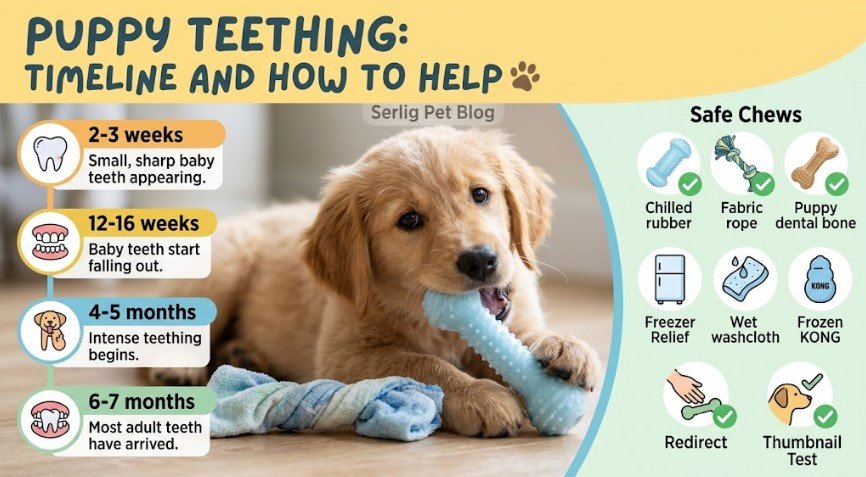
Puppy teething runs in two phases. Baby teeth erupt from around two to three weeks, and the phase owners actually see begins at about three to four months when those teeth fall out and adult teeth push through. Most puppies finish by six to seven months. The safest relief is cold and soft: frozen wet washcloths, chilled rubber toys and food filled toys frozen with kibble. Avoid anything you cannot dent with a thumbnail, since antlers, hooves and hard nylon chews fracture developing teeth. Never use human teething gel.
The Teething Timeline
Puppy teething follows a fairly predictable pattern, though individual variation is wide.
| Age | What is happening |
| 2 to 3 weeks | First baby teeth erupt. Puppy is still with the breeder |
| 6 to 8 weeks | Full set of 28 baby teeth present. Weaning is underway |
| 12 to 16 weeks | Baby incisors begin to fall out first. Adult incisors push through |
| 3 to 4 months | The phase owners notice. Chewing increases noticeably |
| 4 to 5 months | Premolars and canines start to go. Often the most uncomfortable stretch |
| 5 to 6 months | Canines and molars erupt. Peak discomfort for many puppies |
| 6 to 7 months | Most puppies have all 42 adult teeth |
| 7 to 9 months | Some large and giant breeds finish later |
Puppies have 28 baby teeth and 42 adult teeth. Our guide to how many teeth dogs have covers the full dental layout and what each type does.
Expect variation. Breed, size and individual development all shift these dates, and a puppy a few weeks either side of the chart is normal. The peak of discomfort usually falls between four and six months, when the canines and molars come through.
Puppies Teethe Twice
This is worth knowing because it explains why the process seems to start suddenly.
The first phase happens at two to three weeks, when baby teeth erupt into bare gums. Almost no owner sees this, because the puppy is still with its mother and breeder.
The second phase begins at around three to four months, when those baby teeth loosen and fall out while adult teeth push up beneath them. This is the phase you experience, and it is the more uncomfortable of the two.
Why the second is worse. Erupting adult teeth have to push through gum tissue while displacing a tooth that is still rooted. The gums are inflamed on two fronts at once. Veterinary sources consistently describe the period when baby teeth fall out and adult teeth erupt as the most uncomfortable part of the whole process.
Signs Your Puppy Is Teething
The signs of puppy teething range from unmistakable to almost invisible.
Common and normal
- Noticeably more chewing and mouthing
- Chewing on hands, furniture, shoes and skirting boards
- Drooling more than usual
- Small amounts of blood on toys or bedding
- Tiny teeth found on the floor, or none at all
- Red or slightly swollen gums
- Eating more slowly, or dropping food
- Being more irritable or restless than usual
- Whining while chewing
Many puppies show almost nothing. Some owners never see a single lost tooth and only notice when the adult set has arrived. That is equally normal.
What Actually Helps
There is no way to shorten puppy teething, only to make it more comfortable. The principle is simple: cold and soft, offered often, with plenty of choice.
- Frozen wet washcloth. Soak a clean flannel, wring it out, twist it and freeze it. Cheap, effective and most puppies love it. Supervise, since a determined puppy can shred fabric
- Food filled rubber toys, frozen. Pack a hollow rubber toy with your puppy’s own kibble softened with water, then freeze. This combines cold relief with mental work, which is why vets suggest it so often
- Chilled rubber toys from the fridge rather than the freezer, which are cold without being rock hard
- Frozen carrot sticks or vet approved frozen treats, supervised
- Soft rubber and textured puppy chews designed for the age group
- Rotate toys rather than leaving them all out. Novelty keeps a puppy interested in its own things rather than yours
- Soften kibble with warm water on particularly sore days, though most puppies eat dry food throughout without difficulty
- Redirect, do not punish. Move your puppy to an appropriate item every time, and reward them for taking it
Puppy proof the house properly. The urge to chew is at its strongest now, and cables, shoes and table legs are all at risk. Our new puppy checklist covers what to secure, and a crate or pen gives a safe space when you cannot supervise, as our guide to crate training a puppy explains.
The Thumbnail Rule
This is the most useful safety test on this page, and it is almost never stated.
If you cannot make a dent in it with your thumbnail, it is hard enough to fracture a tooth.
Teething puppies have newly erupted adult teeth that are still maturing, and they chew with real force. A slab fracture of an upper carnassial tooth is a common and expensive injury, and it usually requires extraction or a root canal.
Fails the thumbnail test, so avoid
- Antlers, which are widely sold as natural chews and are a frequent cause of fractures
- Cow and pig hooves
- Hard nylon bones
- Real bones, cooked or raw, which also splinter
- Hard plastic toys not designed for chewing
- Ice cubes, covered below
- Stones, sticks and hard rubber balls from the garden
Passes the thumbnail test, so reasonable
- Soft rubber puppy chews
- Rope toys, supervised, since threads can be swallowed
- Fabric and plush toys, supervised
- Softened frozen treats
- Dental chews appropriate for the puppy’s age and size, ideally carrying a recognised veterinary dental accreditation
Supervise everything. Any chew that breaks into pieces small enough to swallow becomes a choking or obstruction risk, and teething puppies swallow far more than they should.
Never Use Human Teething Gel
This deserves its own warning because it is the obvious thing for a parent to reach for.
Human teething gels are not safe for dogs. Many contain benzocaine, a local anaesthetic that can cause a serious blood disorder in dogs in which the blood loses its ability to carry oxygen properly.
Also avoid
- Any human painkiller, including paracetamol, ibuprofen and aspirin, all of which are dangerous to dogs
- Teething granules or powders intended for babies
- Alcohol based products, sometimes suggested as an old remedy, which are toxic
- Clove oil and similar home remedies
If your puppy seems genuinely distressed, speak to your vet. Pain relief formulated for dogs exists, and a vet will also check that the discomfort is actually teething rather than something else.
Our guide to foods and substances toxic to dogs covers the wider list worth keeping away.
The Ice Cube Question
Sources contradict each other on this, so it is worth resolving.
Ice is recommended by several articles as a cheap way to soothe sore gums. Ice is warned against by others because hard cubes can fracture teeth.
Both are right about different things. Cold genuinely helps inflamed gums. A solid ice cube is also hard enough to fail the thumbnail test.
The practical answer
- Crushed ice or ice shavings give the cold without the density
- A frozen wet washcloth gives the same relief and is softer
- Frozen kibble inside a rubber toy is colder than the toy alone and safer than ice
- Ice cubes made from low sodium broth are still ice, so the same fracture caution applies
- Avoid large solid cubes for enthusiastic chewers, and for any puppy whose adult teeth have recently erupted
Retained Baby Teeth
This is the one genuine clinical problem of teething and it is consistently underexplained.
What it is. A baby tooth fails to fall out as the adult tooth erupts, leaving two teeth in the same position. It is most often the canines, and it is described by vets as a regularly seen problem in practice.
How to spot it. Look at your puppy’s canine teeth from around five to six months. A retained baby canine sits just in front of the adult one, giving a distinctive double fang appearance. Baby teeth are noticeably thinner and more pointed than the adult versions.
Why it matters
- Crowding, which pushes adult teeth out of correct alignment
- A trap for food and plaque in the gap between the two teeth, leading to early gum disease
- Malocclusion, where the bite does not close correctly, occasionally severe enough to cause the lower canine to damage the upper palate
- Damage to the adult tooth root in some cases
Which puppies are most affected. Small and toy breeds considerably more often than large ones.
What to do. Mention it at your next appointment. The usual treatment is extraction of the retained baby tooth, and it is very commonly done under the same anaesthetic as neutering, which avoids a second procedure.
Do not wait and hope. If both teeth are still present at around six months, the baby tooth is unlikely to fall out on its own.
Bleeding, Loose Teeth and Swallowed Teeth
Small amounts of blood are normal. Pink tinged saliva, faint blood on a toy or a small spot on bedding are all expected as teeth come out.
Swallowed teeth are normal and harmless. Most puppies swallow their baby teeth while eating, which is why many owners never find one. It causes no problems.
Do not pull a loose tooth. Wobbly teeth come out on their own. Pulling risks snapping the crown and leaving the root behind, which then needs veterinary removal.
Contact your vet if you see
- Bleeding that continues rather than stopping quickly
- Heavy bleeding rather than light staining
- Obvious pain when eating, or refusing food entirely
- Very swollen, angry looking gums
- Bad breath that is strong rather than the usual puppy smell. Our guide to bad breath in dogs covers what else it can indicate
- A tooth that is broken rather than lost, with a jagged edge or exposed pink centre
- Pawing repeatedly at the mouth
Teething Is Not Aggression
This misreading is common and it happens at an unfortunate moment.
Teething increases mouthiness, and a puppy chewing hands harder than before can look like an escalation. Veterinary sources are clear that increased chewing during teething is not a sign of aggression. It is discomfort and a normal developmental urge.
The timing makes it worse. Teething overlaps with the start of adolescence, so owners often see the two together and conclude their puppy’s temperament is changing. It is not.
That said, teething is not a reason to skip bite inhibition training. A puppy needs to learn where the limits are regardless of why it is mouthing, and letting hard biting slide because “he is teething” builds a habit that outlasts the teeth.
Our guide to when puppies stop biting covers the training side in full, and the short version is to redirect to a toy every time and end play instantly if teeth meet skin.
Breed Differences
Large and giant breeds tend to erupt adult teeth slightly earlier than small breeds, but some finish later overall, occasionally continuing to around nine months.
Small and toy breeds are considerably more prone to retained baby teeth and crowding, because there is less room in a small jaw for 42 adult teeth. Check their canines carefully at six months.
Brachycephalic breeds with shortened muzzles frequently have crowding and misalignment regardless of teething, which makes early dental checks more important.
Start Mouth Handling Now
Teething is an inconvenient time to begin handling a puppy’s mouth and a very good time to start getting them used to it.
Go gently and keep it brief. Sore gums mean this should be seconds rather than minutes, and it should never be forced.
- Lift the lips and touch the gums for a moment, then reward
- Build to gently running a finger along the outside of the teeth
- Introduce a finger brush or a soft toothbrush with dog toothpaste only, since human toothpaste contains fluoride and sometimes xylitol, both harmful to dogs
- Stop at any sign of discomfort and try again another day
Why it matters. Dental disease affects the majority of dogs by middle age, and a dog that accepts having its mouth handled is far easier to care for and far easier for a vet to examine. Building that tolerance now costs very little.
When to See a Vet
- Adult and baby teeth both present at around six months, particularly the canines
- A broken tooth, with a jagged edge or a visible pink or dark centre
- Persistent or heavy bleeding
- Refusing food for more than a day, or obvious pain while eating
- A tooth that has not erupted where the matching one on the other side has
- A bite that looks misaligned, or a lower canine contacting the upper palate
- Swelling on the face or jaw
- Adult teeth still missing well past seven months
Ask for a dental check at the neutering appointment. It is a natural point to review the whole mouth, and it is when retained teeth are usually removed. Our guide to the puppy vaccination schedule covers the other appointments worth planning around, and our puppy feeding chart covers diet through this period.
Frequently Asked Questions
When do puppies lose their baby teeth? Usually from three to four months, starting with the incisors. Most puppies have a full adult set by six to seven months.
How long does puppy teething last? The phase owners notice runs from about three months to six or seven months. Some large breeds continue to around nine months.
Is it normal for my puppy to swallow their baby teeth? Yes. Most puppies swallow them while eating and it causes no problems, which is why many owners never find one.
Can I give my puppy ice cubes for teething? Crushed ice and frozen washcloths are better choices. Solid ice cubes are hard enough to fracture a developing tooth.
Can I use baby teething gel on my puppy? No. Many contain benzocaine, which can cause a serious blood disorder in dogs. Ask your vet if your puppy seems genuinely uncomfortable.
What if my puppy still has baby teeth at six months? That suggests retained deciduous teeth, which is common in small breeds. Mention it to your vet, since the usual treatment is extraction, often during neutering.
Does teething make puppies aggressive? No. It increases chewing and mouthing, which can look like escalation, particularly since it overlaps with adolescence. It is discomfort, not aggression.
The Bottom Line
Puppy teething is a two phase process, and the phase you live through begins at around three to four months when baby teeth fall out while adult teeth push up beneath them. Most puppies finish by six to seven months with a full set of 42 teeth.
Three things matter more than the rest. Use the thumbnail test on every chew, because antlers, hooves, hard nylon and real bones all fracture developing teeth, and a slab fracture is an expensive and painful way to learn that. Never reach for human teething gel, since benzocaine causes a serious blood disorder in dogs. And check the canines at around six months, because a retained baby tooth sitting beside its adult replacement will not resolve on its own and is best removed during neutering.
Beyond that, teething is mostly a matter of patience and cold, soft things to chew. The mouthiness is not aggression, the lost teeth are not a problem, and it genuinely does end.