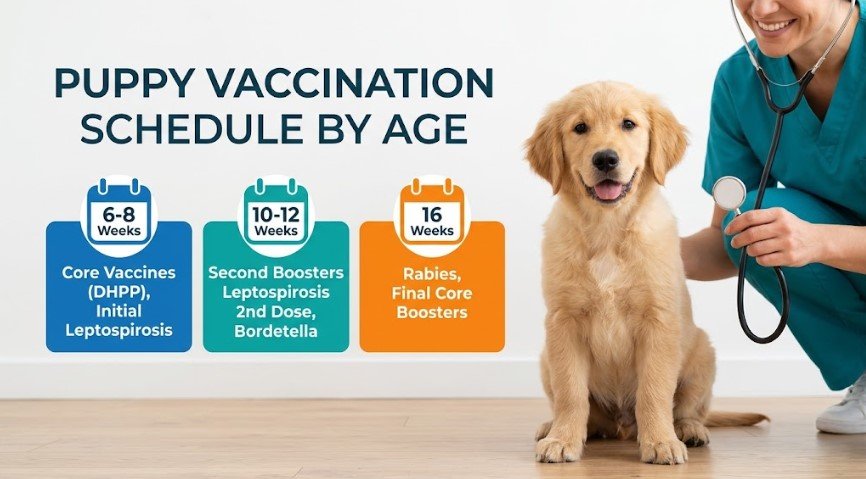
A puppy vaccination schedule usually starts at six to eight weeks and continues with boosters every two to four weeks until the final dose at sixteen weeks or later. Core vaccines cover distemper, adenovirus, parainfluenza and parvovirus, given together as DHPP or DAPP, plus rabies and, following the 2024 AAHA update, leptospirosis. Full protection arrives one to two weeks after the last dose, typically at eighteen to twenty two weeks. Schedules vary by country and by local risk, so your vet sets the final plan.
The Schedule at a Glance
This is the puppy vaccination schedule most practices work from. Yours may differ slightly.
| Age | Typical vaccines |
| 6 to 8 weeks | First DHPP or DAPP. Leptospirosis may begin here or slightly later |
| 10 to 12 weeks | Second DHPP or DAPP. Second leptospirosis. Non core vaccines may start |
| 12 to 16 weeks | Rabies, where required or recommended |
| 14 to 16 weeks | Third DHPP or DAPP |
| 16 weeks or later | Final DHPP or DAPP. This dose matters most. See below |
| 18 to 20 weeks | An additional dose for high risk breeds or areas, at your vet’s discretion |
| 12 to 16 months | First adult booster |
Two things this table cannot tell you. Schedules differ between countries, and your vet will adjust for your puppy’s breed, health, local disease prevalence and history. Use this as a map rather than a prescription.
Why So Many Shots?
This is the question every owner asks, and the answer is genuinely interesting once you know it.
Puppies are born with borrowed immunity. They receive antibodies from their mother, first across the placenta and then in her first milk. Those maternal antibodies protect a young puppy from disease during the weeks when its own immune system is still developing.
Those same antibodies block vaccines. While maternal antibodies are present at a high level, they neutralise vaccine virus before the puppy’s immune system can respond to it. The vaccine is given, and nothing happens.
Maternal antibodies fade unpredictably. They decline somewhere between about six and twelve weeks, and the exact timing differs from puppy to puppy depending on the mother’s own immunity and how much colostrum that particular puppy drank.
That creates a window of vulnerability. For a period, maternal antibodies are too low to protect and still high enough to block the vaccine. Nobody can tell from the outside when that window opens or closes for an individual puppy.
So the series exists to catch it. Repeating the vaccine every two to four weeks means that whenever maternal antibodies finally drop, a dose is never far away. It is not that one vaccine is too weak. It is that we cannot know in advance which dose will be the one that works.
Why the Final Dose Matters Most
This follows directly from the above and is widely misunderstood.
The dose given at sixteen weeks or later is the one that counts. By that age, maternal antibodies have almost always faded in almost all puppies, so that dose is the one you can reasonably rely on to produce lasting immunity.
The implication is important. A puppy that received three doses finishing at fourteen weeks is not in the same position as a puppy whose final dose was at sixteen weeks or later, even though both had three injections. Some of those earlier doses may have been blocked.
What to check. If you are unsure, look at the date of the last core vaccine rather than counting how many were given. If it was before sixteen weeks, ask your vet whether an additional dose is advisable.
Some veterinary guidance suggests a final dose at eighteen to twenty weeks for breeds known to respond less reliably, and in areas where parvovirus is common.
The Core Vaccines
Core vaccines are recommended for every dog regardless of lifestyle.
DHPP, DAPP or DA2PP is a single combination injection covering:
- Distemper. A viral disease affecting the respiratory, digestive and nervous systems. Often fatal, and survivors may have permanent neurological damage
- Adenovirus, or infectious canine hepatitis. Affects the liver, kidneys and eyes
- Parainfluenza. A respiratory virus contributing to kennel cough
- Parvovirus. Severe bloody diarrhoea and vomiting, frequently fatal in puppies, and the virus survives in soil for months. This is the reason behind most outdoor restrictions
Rabies. Legally required in many countries, including across the United States, and usually given between twelve and sixteen weeks. In the United Kingdom it is not part of the routine schedule and is given only for travel.
Leptospirosis. Now classified as core. See the next section.
Leptospirosis Is Now a Core Vaccine
This is recent enough that a great deal of published advice is out of date, and it is worth knowing.
In its 2024 update to the canine vaccination guidelines, AAHA reclassified leptospirosis as a core vaccine for all dogs, in line with consensus statements from the American College of Veterinary Internal Medicine and the World Small Animal Veterinary Association.
What changed. Leptospirosis is a bacterial disease spread through the urine of infected wildlife, most commonly rats. It was long treated as a rural problem affecting hunting and working dogs in wet areas. It is now diagnosed regularly in city and suburban dogs, because rats are everywhere and any dog that goes outside can be exposed.
Why it matters. It can cause kidney and liver failure, and it is zoonotic, meaning it can pass from dogs to people.
The practical point. If you read an older article listing leptospirosis as optional or lifestyle based, that reflects previous guidance. Ask your vet directly rather than assuming it is not needed, particularly if your puppy will have any outdoor access at all.
Non Core Vaccines
These depend on where you live and what your puppy will do.
- Bordetella, or kennel cough. Usually required for boarding kennels, daycare, grooming and training classes. Often given intranasally
- Canine influenza. Recommended in areas with outbreaks, and by some facilities
- Lyme disease. For areas with significant tick exposure
- Rattlesnake vaccine. Regional, in parts of the United States
Book ahead. If you plan to use daycare, a boarding kennel or a puppy class, ask what they require and how far in advance. Some vaccines need two doses and a waiting period, and discovering that a week before a holiday is a common frustration. Building these into the puppy vaccination schedule from the start avoids the scramble.
When Is My Puppy Actually Protected?
Not on the day of the last injection. The immune system needs time to respond.
Allow one to two weeks after the final core dose. With a final dose at sixteen weeks, that puts full protection at roughly eighteen to twenty two weeks of age.
This gap catches people out constantly. A puppy that had its last shot yesterday is not ready for the dog park today, and the assumption that it is has caused avoidable parvovirus cases.
The Socialisation Problem
This is the most important section on this page and it is the one most vaccination articles leave out entirely.
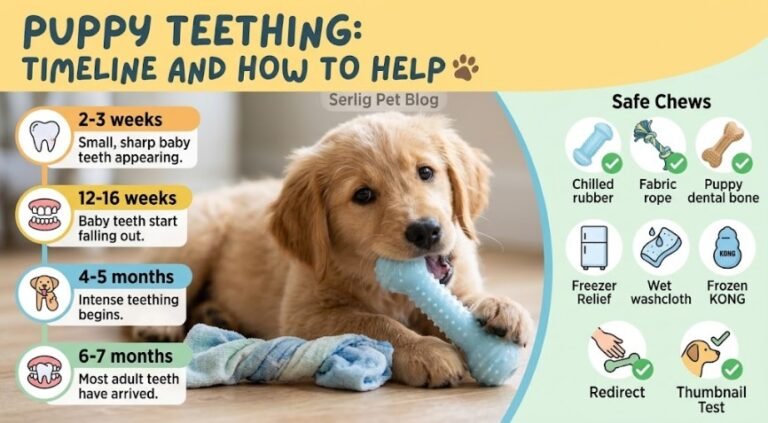
The critical socialisation window runs from roughly three to sixteen weeks. During that period a puppy forms its lasting impressions of what is normal and safe. Experiences after it closes carry far less weight, and gaps left in it are difficult to fill later.
Full vaccine protection arrives at eighteen to twenty two weeks.
Those two windows do not overlap. The socialisation window closes before the vaccination course finishes. That is not a scheduling error, it is a genuine biological conflict, and it puts owners in a real bind.
Why it matters more than it sounds. Behavioural problems, particularly fear and aggression rooted in poor early socialisation, are a leading reason dogs are given up or euthanised. Veterinary behaviour organisations have been explicit that the risk of an under socialised dog is substantial and should be weighed against infection risk rather than ignored.
The resolution is not “keep the puppy indoors until twenty weeks.” That trades one serious risk for another. It is to socialise carefully during the window, using controlled exposures that carry low infection risk. The next section covers how.
Veterinary behaviour guidance generally supports puppy classes from around seven to eight weeks, provided the class requires an up to date first vaccination, takes place on a cleanable surface, and excludes unwell puppies. Ask your vet what they recommend locally.
Safe Socialisation Before Full Cover
The aim is exposure without contaminated ground or unknown dogs.
Genuinely low risk
- Carrying your puppy in your arms, a sling or a stroller, so they see and hear the world without touching the ground
- Your own garden, if no unvaccinated or unknown dogs use it
- Car journeys, which also build travel tolerance early. A crate makes these safer, and our guide to crate training a puppy covers the introduction
- Visitors to your home, ideally many different people of different ages and appearances
- Healthy, fully vaccinated dogs you know, in your home or garden
- Clean surfaces. A friend’s house, a cleanable floor, a blanket in a quiet spot
- Household sounds. Vacuum, hairdryer, doorbell, traffic recordings
- Handling practice. Paws, ears, mouth, brushing, which pays off at every future vet visit
- A well run puppy class meeting the conditions above
Avoid until fully covered
- Public parks, pavements and verges where dogs toilet
- Dog parks and anywhere dogs congregate
- Unknown dogs of unknown vaccination status
- Pet shop floors and veterinary waiting room floors, where a puppy should be held or kept in a carrier
- Communal gardens with shared dog access
Ask visitors to remove shoes and wash their hands. Parvovirus travels on footwear and survives in the environment for a long time.
Our new puppy checklist covers the wider first weeks, and our guide to potty training a puppy covers how to manage toilet trips during this window.
Missed or Late Doses
This happens frequently and rarely gets covered.
A dose given late is not wasted. In most cases the series simply continues from where it stopped, and your vet will advise whether to restart.
A gap longer than about six weeks may mean your vet recommends beginning the series again, particularly early in the course.
A puppy behind schedule is less protected, so outdoor restrictions should continue until the course is genuinely complete plus the one to two week waiting period.
Keep the record. Ask for a written or digital vaccination card at every visit. Boarding kennels, groomers, training classes, insurers and any future vet will all want it, and reconstructing a lost history usually means starting again.
Side Effects: Normal Versus Not
Normal, and usually settling within twenty four to forty eight hours
- Mild tiredness or being quieter than usual
- Soreness at the injection site, or a small firm lump
- Reduced appetite for a day
- A mild temperature
Contact your vet promptly if you see
- Facial or muzzle swelling, or swelling around the eyes
- Hives or raised lumps across the body
- Repeated vomiting or diarrhoea
- Difficulty breathing
- Collapse or extreme weakness
- Persistent lethargy beyond forty eight hours
- A lump at the injection site that grows or is still present after several weeks
Severe reactions usually occur within minutes to a few hours, which is why many vets suggest staying nearby for a short period after the appointment, particularly for the first vaccination.
Trembling can be part of a normal mild reaction or a sign of something else, and our guide to why a dog shakes covers the other causes.
Regional Differences
Vaccination practice genuinely differs by country, and advice written for one audience can mislead another.
Rabies. Legally required for dogs across the United States, with the first dose usually by four months. In the United Kingdom, rabies is not part of the routine schedule and is given only for travel under pet passport rules.
Leptospirosis. Now core under AAHA guidance in the United States. In the United Kingdom it has long been part of the standard puppy course, usually as L2 or L4, referring to the number of strains covered.
Kennel cough. Rarely part of the core schedule anywhere, and commonly required by boarding facilities in both countries.
The practical rule. Follow your own vet’s schedule rather than an article, including this one. If you plan to travel with your dog, ask early, because entry requirements often involve waiting periods measured in weeks or months.
Titre Testing
Some owners ask about antibody titre testing as an alternative to routine boosters.
What it is. A blood test measuring antibody levels against specific diseases, used to judge whether protection is still present.
Where it is useful. It is most commonly used for adult booster decisions, particularly for distemper, adenovirus and parvovirus, and for dogs that have had a previous vaccine reaction.
Where it is less useful. It is not a substitute for the initial puppy series, since a puppy needs to develop immunity in the first place. It is also unreliable for some diseases, and it does not satisfy legal rabies requirements or most boarding facility rules.
Discuss it with your vet rather than treating it as a straightforward replacement for boosters. It has a genuine place and it is narrower than it is sometimes presented.
Do Not Forget Parasites
Vaccines cover viruses and bacteria. They do nothing about parasites, and puppies need protection from the start.
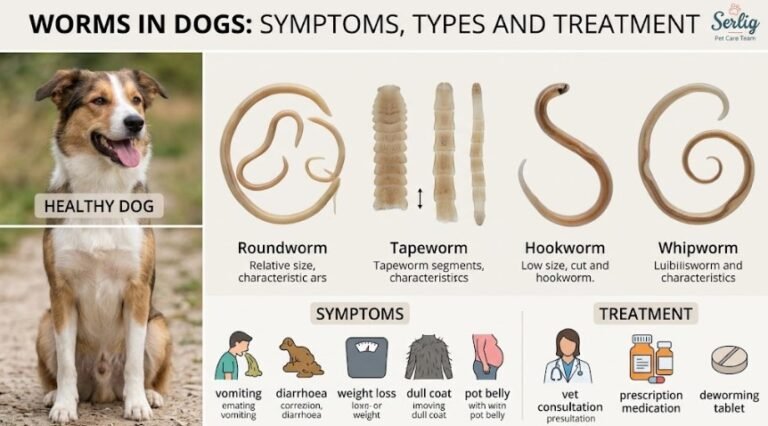
- Worming usually begins at two to three weeks and repeats frequently through the early months. Our guide to worms in dogs covers the types and the signs
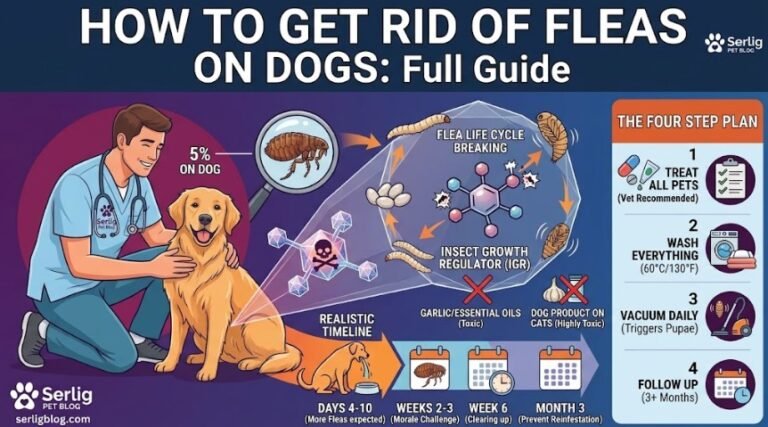
- Flea and tick prevention typically starts at around eight weeks, depending on the product and the puppy’s weight. Our guide to flea treatment covers what works
- Heartworm prevention, where relevant in your region, and it is prevention rather than treatment
Ask your vet to set the parasite plan at the same appointment as the puppy vaccination schedule, since the timings interlock. Our puppy feeding chart covers the other thing worth fixing early.
Frequently Asked Questions
When do puppies get their first vaccination? Usually at six to eight weeks. Many puppies receive their first dose from the breeder before going home, so ask for the record.
How many vaccinations does a puppy need? Typically three or four core doses given two to four weeks apart, with the final one at sixteen weeks or later, plus rabies where required. The timing of the last dose matters more than the total count.
When can my puppy go outside? Your own garden is usually acceptable early if no unknown dogs use it. Public areas should wait until one to two weeks after the final core dose, generally eighteen to twenty two weeks.
Why does my puppy need so many shots? Because maternal antibodies block vaccines while they are present and fade at an unpredictable age. Repeating the dose ensures one lands after they have gone.
Is leptospirosis really necessary? AAHA reclassified it as a core vaccine for all dogs in 2024. It is spread by wildlife urine, is diagnosed in urban dogs regularly, and can pass to people. Ask your vet.
Can I socialise my puppy before full vaccination? Yes, and you should. Carry them, use your own garden, invite visitors, and meet known vaccinated dogs. The socialisation window closes before vaccination finishes, so waiting entirely carries its own serious risk.
What if I miss a vaccination appointment? Book as soon as you can. A short delay usually means continuing the series. A long gap may mean restarting, and your vet will advise.
The Bottom Line
A puppy vaccination schedule runs from six to eight weeks to at least sixteen weeks, with doses every two to four weeks and full protection arriving one to two weeks after the last one.
Three things are worth carrying away. The series exists because maternal antibodies block vaccines and fade at an unpredictable age, which is why the dose at sixteen weeks or later is the one that really counts. Leptospirosis is now a core vaccine, so older articles calling it optional are out of date. And the socialisation window closes before vaccination finishes, which means keeping a puppy entirely indoors until twenty weeks trades one serious risk for another.
Carry your puppy, use your own garden, invite people over, and ask your vet about a well run puppy class. Then follow their schedule rather than any article, including this one, because local disease risk and legal requirements differ more than most guides admit.