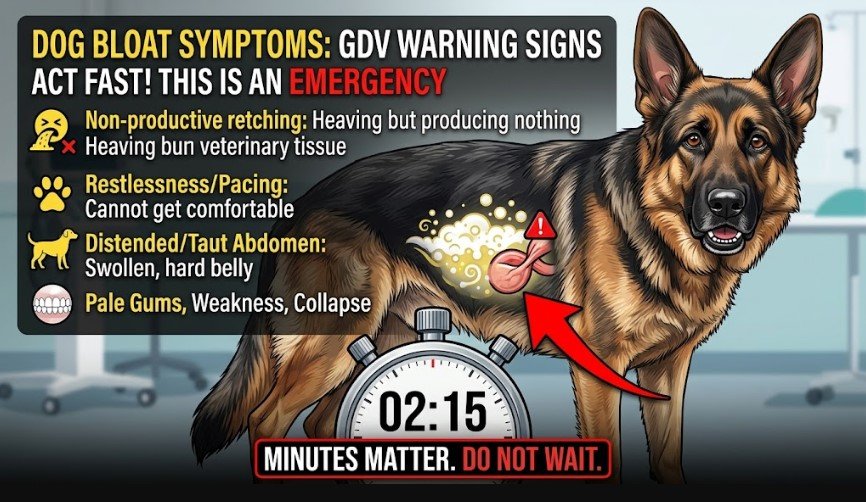
Dog bloat symptoms include a swollen or hard abdomen, repeated retching that produces nothing, restlessness and pacing, excessive drooling, an arched or hunched posture, and rapid shallow breathing. Later signs include pale gums, weakness and collapse. Bloat becomes gastric dilatation volvulus, or GDV, when the gas filled stomach twists and cuts off its own blood supply. GDV is fatal without emergency surgery and progresses within hours. You cannot tell simple bloat from GDV at home, so treat every case as an emergency.
The Signs That Matter Most
Dog bloat symptoms generally appear in this order, though not every dog shows every stage and progression can be rapid.
Early, and easy to mistake for a stomach upset
- Repeated retching or gagging that produces nothing, or only foam and saliva
- Restlessness and pacing, an inability to settle
- Excessive drooling, often thick and ropey
- Looking at, licking or nosing the abdomen
- Arched back, hunched posture, or the front down and rear up “praying” position
- Refusing food, or eating and then immediately becoming distressed
Progressing
- A visibly swollen or distended abdomen, most obvious on the left side behind the ribs
- A firm, tight belly that feels hard rather than soft
- Rapid, shallow or laboured breathing
- Panting out of proportion to the temperature or activity
- Rapid heart rate
- Obvious pain when the abdomen is touched
Late, and critical
- Pale, white or bluish gums
- Weakness and inability to stand
- Collapse
- Shock
One important caution. A swollen belly is the sign everyone knows and it is not always visible, particularly in deep chested dogs where the stomach sits high under the ribs, or in dogs carrying extra weight or a thick coat. Do not wait for a visible swelling before acting. The behavioural signs frequently come first.
Two of these dog bloat symptoms are also easy to explain away in other contexts. Heavy panting is often put down to heat or excitement, and trembling to cold or nerves. Our guides to heavy panting in dogs and why a dog shakes cover the other causes, but alongside retching and restlessness they point firmly in one direction.
Why Unproductive Retching Is the Signature Sign
Of everything on that list, this is the one most worth understanding, because it is the most specific to bloat and the least likely to be a coincidence.
When the stomach twists, both the entrance and the exit are sealed off. Gas and fluid continue to build with nowhere to go. The dog feels the need to vomit and its body tries repeatedly, but nothing can physically come up, because the way out is closed.
So the picture is a dog heaving over and over and producing nothing, or at most a small amount of white foam and saliva.
This is different from ordinary vomiting. A dog that vomits productively, bringing up food or liquid, is less likely to have a twisted stomach, though it may still be unwell for other reasons. Our guide to a dog throwing up white foam covers the other causes worth knowing about.
Repeated retching with nothing produced, in a dog that also seems restless and uncomfortable, is a go to the vet now situation. Do not wait to see whether it settles.
The Drum Test
There is one simple check an owner can do while arranging transport, described in veterinary guidance.
Gently tap the swollen area just behind the last rib on the left side. If the stomach is distended with gas, this often produces a hollow, drum like sound, a bit like tapping a taut balloon.
What this tells you: a tympanic, drum like sound supports gas distension.
What it does not tell you: whether the stomach has twisted. That requires X rays.
A dull sound does not rule anything out. If the signs above are present, go regardless of what the tap sounds like. This is a piece of information to give the vet on the phone, not a test to pass or fail at home.
Be gentle. The abdomen is painful in a bloating dog, and firm pressure on a distended stomach is both cruel and unhelpful.
Simple Bloat and GDV: Why You Cannot Tell at Home
This distinction matters, and it is where most articles either oversimplify or accidentally mislead.
Simple bloat, or dilatation, is the stomach filling with gas, fluid or food without twisting. Veterinary specialists note that this can sometimes resolve on its own, and that risk depends on severity and duration. Some cases persist for hours without becoming life threatening.
GDV, or volvulus, is when that distended stomach rotates on its axis. The entrance and exit are blocked, blood supply to the stomach wall is cut off, the spleen is often dragged round with it, and the pressure on major blood vessels sends the dog into shock. Tissue begins to die. The stomach can rupture.
Here is the part that matters:
The two look identical from outside. The same swollen belly, the same retching, the same restlessness. Distinguishing them requires an X ray, which is exactly why radiographs are the standard diagnostic step.
So the nuance about simple bloat is useful for understanding what a vet is looking for. It is not a reason to wait at home hoping it is the milder version. A simple dilatation can progress to a volvulus, and by the time the difference becomes obvious from the outside, the dog is in shock.
The only safe assumption at home is that it is GDV.
How Fast It Moves
Timescale is what makes this condition different from almost anything else you will read about.
GDV progresses over hours, not days. A dog can go from the first restless pacing to cardiovascular shock within that window. Survival depends heavily on how quickly the stomach is decompressed and untwisted, and outcomes worsen sharply with delay.
This has a practical consequence that owners consistently get wrong: there is no observation period. With most conditions, watching for an hour to see whether things settle is reasonable. With suspected bloat it is the single most costly decision available.
If it turns out to be a mild stomach upset, you have had an unnecessary trip and an examination fee. That is the worst case of going. The worst case of waiting is considerably different.
What Not to Do
No competitor page we reviewed covers this, and each item here causes real delay or harm.
Do not wait to see if it resolves. Covered above, and it is the mistake that kills.
Do not give anti gas medication and go back to bed. Simethicone and similar products do nothing for a twisted stomach and give false reassurance during the window that matters.
Do not attempt to relieve the gas yourself. Instructions exist online for passing a tube or using a needle to decompress a stomach. These are veterinary procedures. Attempting them causes serious injury.
Do not give food or water. Both add volume to a stomach that already cannot empty.
Do not walk the dog to “work it out.” Movement does not untwist a stomach and exercise raises the risk in the first place.
Do not induce vomiting. Nothing can come up, and trying makes a distressed dog worse.
Do not delay to find a cheaper option. Call the nearest emergency clinic and discuss cost with them on the way. Section below covers this honestly.
Which Dogs Are at Risk
Deep chested, large and giant breeds carry the highest risk. Commonly affected breeds include Great Danes, Saint Bernards, Weimaraners, Irish setters, Gordon setters, standard poodles, Dobermann pinschers, basset hounds, Old English sheepdogs and German shepherds.
The figure worth knowing: dogs weighing over 100 pounds have been reported to carry roughly a 20 percent lifetime risk of bloat. For a Great Dane owner that is not a rare event.
But any dog can bloat. Cases have been reported in dachshunds and chihuahuas. Simple gastric dilatation without twisting also occurs in elderly small dogs.
Other risk factors identified in studies
- Increasing age. Risk rises as dogs get older
- A first degree relative with a history of GDV
- Having previously had the spleen removed
- Temperament. Dogs described as calm and relaxed have been found at lower risk than dogs described as hyper or fearful
- Illness that slows gut motility
Risk Factors You Can Actually Change
Several of these are counterintuitive, and one contradicts advice many owners have been given.
Raised feeding bowls appear to increase risk, not reduce it. This surprises most people, since elevated bowls are widely sold and recommended for large breeds. Veterinary surgical guidance lists elevated feeding among the factors associated with increased incidence. Unless your vet has specifically recommended a raised bowl for another condition, feed at floor level.
Feed two or three smaller meals rather than one large one. A single large daily meal is associated with higher risk.
Check the ingredient list for oils and fats near the top. A 2006 study found that dry foods listing an oil or fat, such as sunflower oil or animal fat, among the first four ingredients were associated with increased risk in dogs already predisposed. Our guide to choosing a premium dog food covers how to read a label properly.
Avoid exercise for an hour before and after meals. Both vigorous activity and large drinks around mealtimes are associated with higher risk.
Slow down fast eaters. A slow feeder bowl or a puzzle feeder reduces swallowed air. Our puppy feeding chart covers portioning and meal frequency from the start.
Reduce mealtime stress. Feed anxious dogs separately and calmly, given the temperament association.
Do not let a dog gulp large volumes of water at once after exercise. Offer smaller amounts more frequently instead. Our guide to a dog drinking a lot of water covers when thirst itself is a warning sign.
What Happens at the Emergency Vet
Knowing this in advance removes hesitation, and hesitation is the thing that costs lives here.
Triage first. Vital signs are assessed and the abdomen palpated for distension, firmness and pain. This happens immediately on arrival, which is why calling ahead helps.
Stabilisation begins before diagnosis is complete. Large bore intravenous catheters deliver aggressive fluid therapy to treat shock, along with oxygen and pain relief.
Decompression. Pressure is released from the stomach, usually by passing a tube or by inserting a needle through the body wall. This is often done before surgery because the distension itself is what is crushing blood flow.
X rays confirm the diagnosis. A twisted stomach produces a characteristic appearance on an abdominal radiograph that distinguishes true volvulus from simple dilatation.
Further tests. An ECG is common, because cardiac arrhythmias are a frequent and dangerous complication. Bloodwork assesses electrolytes, organ function and lactate, which indicates how severe the shock is.
Surgery. If the stomach has twisted, surgery is the only treatment. The stomach is untwisted, its wall and the spleen are assessed for tissue death, and any dead tissue is removed. A gastropexy is then performed, tacking the stomach to the body wall so it cannot twist again.
Recovery. Dogs typically stay in hospital for several days with continued monitoring, particularly for arrhythmias.
Survival is good when surgery happens promptly and falls sharply with delay, which is the reason every part of this article keeps returning to the same point.
Gastropexy: The Preventive Option
This is worth knowing about before you ever need it, and it is barely mentioned in owner facing content.
A prophylactic gastropexy is a preventive surgery that tacks the stomach to the abdominal wall. It does not stop the stomach filling with gas, but it prevents the twisting, which is the part that kills.
It is commonly recommended for high risk dogs and is often performed at the same time as spaying or neutering, which avoids a second anaesthetic. It can also be done laparoscopically in many practices.
Who it is usually discussed for: giant and large deep chested breeds, and dogs with a close relative that has had GDV.
When to ask: before a planned spay or neuter, ideally. If you have a Great Dane, Weimaraner or similar breed, raise it at your next appointment rather than waiting for a reason to.
If you have a new puppy of a predisposed breed, our new puppy checklist covers the other early decisions worth planning for.
The Cost Question
This deserves an honest answer, because cost causes delay and delay is what kills in this condition.
GDV surgery is expensive. It involves emergency admission, imaging, stabilisation, anaesthesia, major abdominal surgery and several days of intensive monitoring. It is one of the higher cost emergencies in small animal practice.
What to do about it
- Call the clinic on the way and ask about payment options. Many offer payment plans or work with third party financing. This conversation can happen while your dog is being stabilised
- Check your insurance policy now, before you need it. Some insurers pre authorise emergency treatment by phone
- If you own a high risk breed, price a prophylactic gastropexy. Preventive surgery during a planned neuter costs a fraction of emergency GDV surgery
- Do not delay the journey to compare prices. Get the dog seen, then discuss options
Every hour of delay reduces the chance of survival and tends to increase the cost of treatment, because a sicker dog needs more intervention.
Frequently Asked Questions
What are the first signs of bloat in a dog? Restlessness and pacing, repeated retching that produces nothing, heavy drooling, and a hunched or arched posture. These behavioural signs often appear before any visible swelling.
How quickly does bloat kill a dog? It progresses over hours rather than days. A dog can move from the first signs to cardiovascular shock within that window, which is why there is no safe observation period.
Can a dog have bloat without a swollen stomach? Yes. Distension is not always visible, particularly in deep chested dogs, overweight dogs or dogs with thick coats. Act on the behavioural signs.
Can bloat resolve on its own? Simple bloat without twisting sometimes does. GDV never does, and the two are indistinguishable at home without an X ray. Always treat it as an emergency.
Do raised food bowls prevent bloat? No. Elevated feeding has been associated with increased risk rather than reduced risk. Unless your vet has advised otherwise for a different condition, feed at floor level.
Which dogs get bloat most often? Large and giant deep chested breeds, with Great Danes, Saint Bernards, Weimaraners and setters among the most affected. Dogs over 100 pounds have been reported to carry around a 20 percent lifetime risk. Any dog can be affected.
What is a gastropexy and should my dog have one? It is a surgery that tacks the stomach to the body wall so it cannot twist. It is often recommended preventively for high risk breeds and is commonly done during a planned spay or neuter. Ask your vet whether your dog is a candidate.
The Bottom Line
Dog bloat symptoms are worth memorising rather than looking up, because the time you would spend searching is time this condition does not give you. A restless dog, drooling heavily, retching repeatedly and bringing nothing up, is a dog that needs an emergency vet immediately.
The swollen belly everyone associates with bloat is a useful sign when it is there and a dangerous one to wait for when it is not. The behavioural signs usually come first.
You cannot tell simple bloat from a twisted stomach at home, and a simple bloat can become a twisted one while you watch. That is the whole reason there is no observation period here.
If you own a large deep chested breed, two conversations are worth having with your vet before anything happens: whether a preventive gastropexy makes sense, and what your nearest twenty four hour emergency clinic is. Save that number in your phone now.