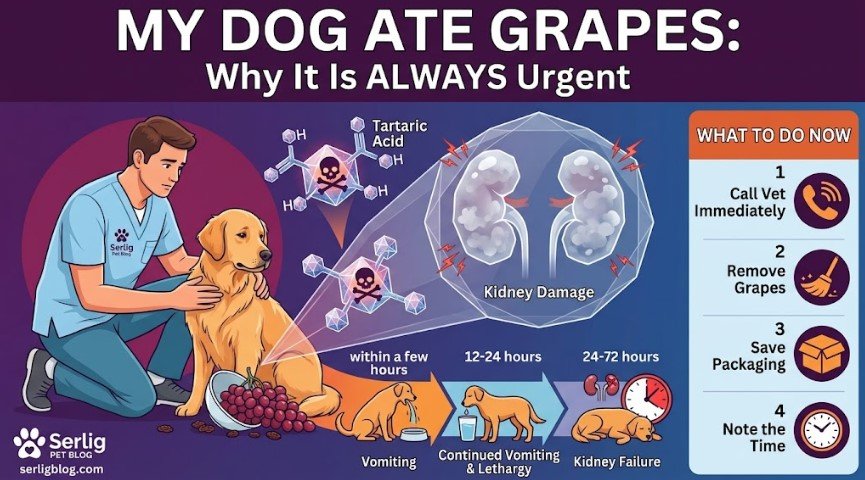
My dog ate grapes is one of the few situations where there is no safe amount to work with. Grapes, raisins, sultanas and Zante currants can cause acute kidney injury in dogs, and the toxic compound is now believed to be tartaric acid, which dogs cannot excrete properly. Its concentration varies widely between grapes, so the same handful can harm one dog and not another. Most affected dogs show vomiting within a few hours, but kidney damage can take up to 72 hours to appear. Call a vet immediately regardless of quantity.
Do This Now
- Remove any remaining fruit and shut your dog away from it.
- Keep the packaging: A box of raisins, a bag of grapes or a fruit cake wrapper all help your vet judge the amount.
- Count what is missing and assume your dog ate all of it. Guessing low is the most common mistake owners make here.
- Note the time, or the widest window it could have happened in.
- Call your vet or a poison service now: Use the numbers above.
- Do not induce vomiting at home unless a vet tells you to. Hydrogen peroxide can cause stomach ulceration, and a dog that inhales vomit can develop aspiration pneumonia.
- Go in if asked, even if your dog seems completely well. Early decontamination is the part of treatment that works best, and it is only available in the first few hours.
Speed matters more here than in most poisonings, because the aim of treatment is to stop the tartaric acid being absorbed before the kidneys ever see it.
What Your Vet Will Need to Know
- Your dog’s weight: The most important figure.
- What exactly was eaten: Fresh grapes, raisins, sultanas, currants, or a product containing them.
- How many, or how much of a package is gone.
- The time, or the earliest and latest it could have been.
- Whether anything else was in the product: Chocolate, nuts or xylitol each add a separate problem.
- Your dog’s age and any existing conditions, especially any history of kidney disease.
- Any symptoms so far, particularly vomiting, and when they started.
How Many Grapes Is Dangerous?
There is no confirmed safe dose, and that is the honest starting point.
The Merck Veterinary Manual gives a working rule of thumb: more than one grape or raisin per 4.5 kilograms, or 10 pounds, of body weight may contain enough tartaric acid to pose a risk of kidney effects.
For a sense of scale:
| Dog weight | Merck rule of thumb threshold |
| 4.5 kg (10 lb) | More than 1 grape or raisin |
| 9 kg (20 lb) | More than 2 |
| 18 kg (40 lb) | More than 4 |
| 27 kg (60 lb) | More than 6 |
| 36 kg (80 lb) | More than 8 |
Treat this as a threshold for concern, not a safe allowance: Cases of acute kidney injury have been reported in dogs that ate as few as four or five grapes. Raisins and sultanas are dried, so they are more concentrated by weight than fresh grapes, and a small handful represents far more fruit than it looks.
The reason no reliable dose exists is covered in the next section, and it is the most useful thing to understand about this poisoning.
Why Some Dogs Are Fine and Others Are Not
This is the question that confuses everyone, including vets for the past twenty years, and there is now a good answer.
Tartaric acid concentration in grapes varies enormously, from around 0.35 percent to 2 percent, depending on the grape variety, where it was grown, and how ripe it was.
That is roughly a sixfold range. The same number of grapes, from two different punnets, can represent very different doses of the actual toxin.
This explains three things that used to make no sense:
- Why one dog eats a bunch of grapes and is completely fine while another develops kidney failure from a few
- Why no reliable toxic dose could ever be established
- Why a dog that ate grapes last year without incident is not protected this time
Published data indicates that most dogs that eat grapes remain asymptomatic. One analysis put that figure around three quarters. That sounds reassuring and it is not, for one simple reason: there is no way to identify in advance which dogs will be in the other quarter.
You are not choosing between “probably fine” and “definitely serious.” You are choosing between finding out with a vet involved and finding out without one.
What We Now Know About the Cause
For two decades this was an unsolved problem. Heavy metals, pesticides and fungal toxins were all investigated and ruled out.
The answer came from an unexpected direction. In 2022, veterinarians at the ASPCA Animal Poison Control Center were reviewing a case in which a dog developed acute kidney injury after eating homemade playdough. The symptoms did not match the expected salt poisoning picture. The playdough contained cream of tartar, which is a form of tartaric acid.
That observation connected to something already known: grapes and tamarinds contain tartaric acid in unusually high concentrations, and dogs had been shown to be sensitive to it.
Why dogs specifically: Dogs lack the organic acid transporter, known as OAT4, that humans use to clear tartaric acid. Without it, tartaric acid accumulates in the cells of the proximal renal tubules and damages them. A 2023 laboratory study found that tartaric acid was toxic to canine kidney cells but not to human kidney cells, and that adding the human transporter to the canine cells prevented the damage.
This is why grapes are a normal food for you and a nephrotoxin for your dog. It is a difference in kidney biology rather than anything about the fruit.
An honest caveat:Tartaric acid is the leading and best supported explanation, and major veterinary references now describe it as the proposed toxic principle. It is not yet stated as settled fact in every source. That uncertainty does not change the advice.
Signs and the 72 Hour Timeline
Signs follow a rough sequence, and the timeline is the part owners most need to understand.
Within a few hours
- Vomiting, often the first sign and frequently containing pieces of grape or raisin
- Diarrhoea
- Loss of appetite
- Lethargy and weakness
12 to 24 hours
- Continued vomiting
- Abdominal pain
- Dehydration
- Increased thirst and urination as the kidneys come under strain
- Tremors in some dogs
24 to 72 hours
- Reduced urination, or none at all. This is the sign that matters most. A dog producing little or no urine is in established kidney failure
- Bad breath with an unusual chemical smell
- Collapse
- Seizures in severe cases
The critical point about timing: blood changes showing kidney damage typically appear between 12 and 24 hours, but can take up to 72 hours. A normal blood test at twelve hours is not an all clear, which is why vets repeat bloodwork over several days rather than testing once.
Vomiting, changes in drinking and tremors all have other explanations in isolation. Our guides to a dog throwing up white foam, a dog drinking a lot of water and why a dog shakes cover those. After known grape ingestion, none of them should be attributed to anything else.
What Is Not a Grape Risk
This section exists because owners panic over things that are not the problem, and clarity here is genuinely useful.
Not associated with kidney injury in dogs
- Grape juice
- Wine
- Jellies made from grape juice concentrate
- Grape seed extract
- Grape vine leaves
- True currants of the genus Ribes, meaning blackcurrants, redcurrants and whitecurrants
That last one causes real confusion. The dangerous “Zante currants” are not currants at all. They are small dried grapes. Blackcurrants from your garden are a different plant entirely and have not been associated with renal injury in dogs.
Two honest caveats: Wine is unsafe for a completely separate reason, since alcohol is toxic to dogs. And while grape juice and grape products have not been linked to poisoning, it is not certain that they carry no potential at all, so they are still not something to offer deliberately.
If you want to give your dog fruit, our guide to what fruits dogs can eat covers the safe options, and blueberries are a good direct substitute for grapes in size and appeal.
Other Sources of Tartaric Acid
This is the newest and least known practical consequence of the tartaric acid discovery, and it is missing from most articles on this topic.
If tartaric acid is the toxin, then grapes are not the only route to it.
Cream of tartar: A baking ingredient and a form of tartaric acid. Present in some baked goods and meringue recipes.
Homemade playdough: Most recipes include cream of tartar, and this is exactly the case that led to the discovery. Playdough is soft, salty, appealing and usually made in households with young children. If you have a dog and you make playdough at home, keep it out of reach and dispose of it properly.
Tamarind and tamarind paste: High in tartaric acid, and documented cases of kidney failure in dogs have followed tamarind ingestion. Common in South Asian, Middle Eastern, Caribbean and Latin American cooking, so it is in far more kitchens than most pet articles assume.
Grape pressings from wineries: Poisoning has been reported following ingestion of the pressed residue.
If your dog has eaten any of these, mention tartaric acid specifically when you call. It is recent enough that it is worth naming.
Hidden Sources of Grapes and Raisins
Most cases do not involve a bowl of grapes. They involve something with raisins in it.
- Raisin bread, fruit loaf and hot cross buns
- Fruit cake, Christmas pudding and mince pies
- Cereal and granola, including raisin paste in granola bars
- Trail mix
- Chocolate assortments, which combine two toxins. Our guide to what to do when a dog eats chocolate covers that side
- Some jams and chutneys
- Packed lunches and school bags
- Compost heaps and garden waste
- Fruit bowls left on a low table
Our guide to foods toxic to dogs covers the wider list worth keeping out of reach, and our new puppy checklist covers household hazard proofing.
What About Cats and Other Pets?
Grape toxicity is described almost entirely in dogs, and owners of other pets are often left guessing.
Cats: Cases of grape or raisin toxicity in cats are rare and poorly understood. Whether that reflects genuine resistance or simply the fact that cats rarely eat grapes voluntarily is not established, since cats cannot taste sweetness and have little interest in fruit. The sensible position is that the absence of case reports is not the same as proven safety, so grapes and raisins should be kept away from cats too. If your cat has eaten any, call your vet rather than assuming the dog literature does not apply.
Ferrets: Toxicity has been reported occasionally and, as with cats, is less well characterised than in dogs.
Other species: Tartaric acid sensitivity in dogs is linked to a specific gap in their kidney transporters. Whether other pets share that gap has not been studied in most cases, so the same caution applies.
The practical rule for a multi pet household: treat grapes, raisins and sultanas as a whole household hazard rather than a dog specific one. Store them as you would any other poison, and do not assume the cat is safe simply because the research is about dogs.
Decontamination first, if ingestion was recent: Vomiting may be induced with an injectable medication, which is far safer than anything attempted at home. Activated charcoal is often given afterwards to bind what remains in the gut.
Intravenous fluid therapy: This is the core of treatment, typically run for around 48 hours. The aim is aggressive fluid diuresis to protect the kidneys and support them through the period when damage would otherwise develop.
Serial bloodwork: Kidney values, electrolytes and hydration are checked repeatedly over several days rather than once, because of the delayed timeline described above. Urine output is monitored closely.
There is no antidote and no specific test: Diagnosis rests on the history of ingestion, the clinical signs and the bloodwork. This is another reason an honest account of what was eaten matters so much.
Prognosis: Dogs treated early, before kidney damage is established, generally do well. Dogs that have already stopped producing urine have a considerably poorer outlook, and treatment at that stage is much harder. The gap between those two outcomes is measured in hours.
Frequently Asked Questions
How many grapes are toxic to a dog? There is no confirmed safe dose. The Merck Veterinary Manual uses more than one grape or raisin per 4.5 kilograms of body weight as a threshold for concern, but kidney injury has been reported after as few as four or five grapes.
My dog ate one grape. Should I worry? Call your vet for advice rather than deciding alone. A single grape is below the usual threshold for a medium or large dog, but there is no established safe dose and small dogs have very little margin.
Are raisins worse than grapes? By weight, yes. Drying concentrates the fruit, so a small handful of raisins represents far more grape than it appears to.
Is grape juice or wine dangerous? Grape juice has not been associated with kidney injury in dogs, and neither have jellies made from juice concentrate or grape seed extract. Wine is dangerous for a different reason, because alcohol is toxic to dogs.
Are blackcurrants toxic to dogs? True currants of the genus Ribes, including blackcurrants and redcurrants, have not been associated with kidney injury. The dangerous “Zante currants” are small dried grapes, not true currants.
My dog ate grapes last year and was fine. Does that mean he is not sensitive? No. Tartaric acid content varies from around 0.35 to 2 percent between grapes, so last year’s grapes may simply have been a lower dose. Previous exposure offers no protection.
How long until symptoms appear? Vomiting often begins within a few hours. Kidney damage shows in bloodwork between 12 and 24 hours in most cases, but can take up to 72 hours, which is why testing is repeated.
The Bottom Line
My dog ate grapes is a call to make immediately, at any quantity, without waiting for a symptom. There is no confirmed safe dose, and the reason is now understood: the toxin is tartaric acid, dogs lack the transporter needed to clear it, and its concentration varies roughly sixfold between grapes.
Most dogs that eat grapes are fine. That is true and it is not a reason to wait, because nobody can tell in advance which dogs those are, and the treatment that prevents kidney damage only works before the damage happens.
Two things are worth carrying away beyond the emergency itself. Grape juice, grape seed extract and true blackcurrants are not the same risk, so there is no need to panic over those. And since tartaric acid is the culprit, cream of tartar, homemade playdough and tamarind belong on the same shelf as the raisins, well out of reach.