
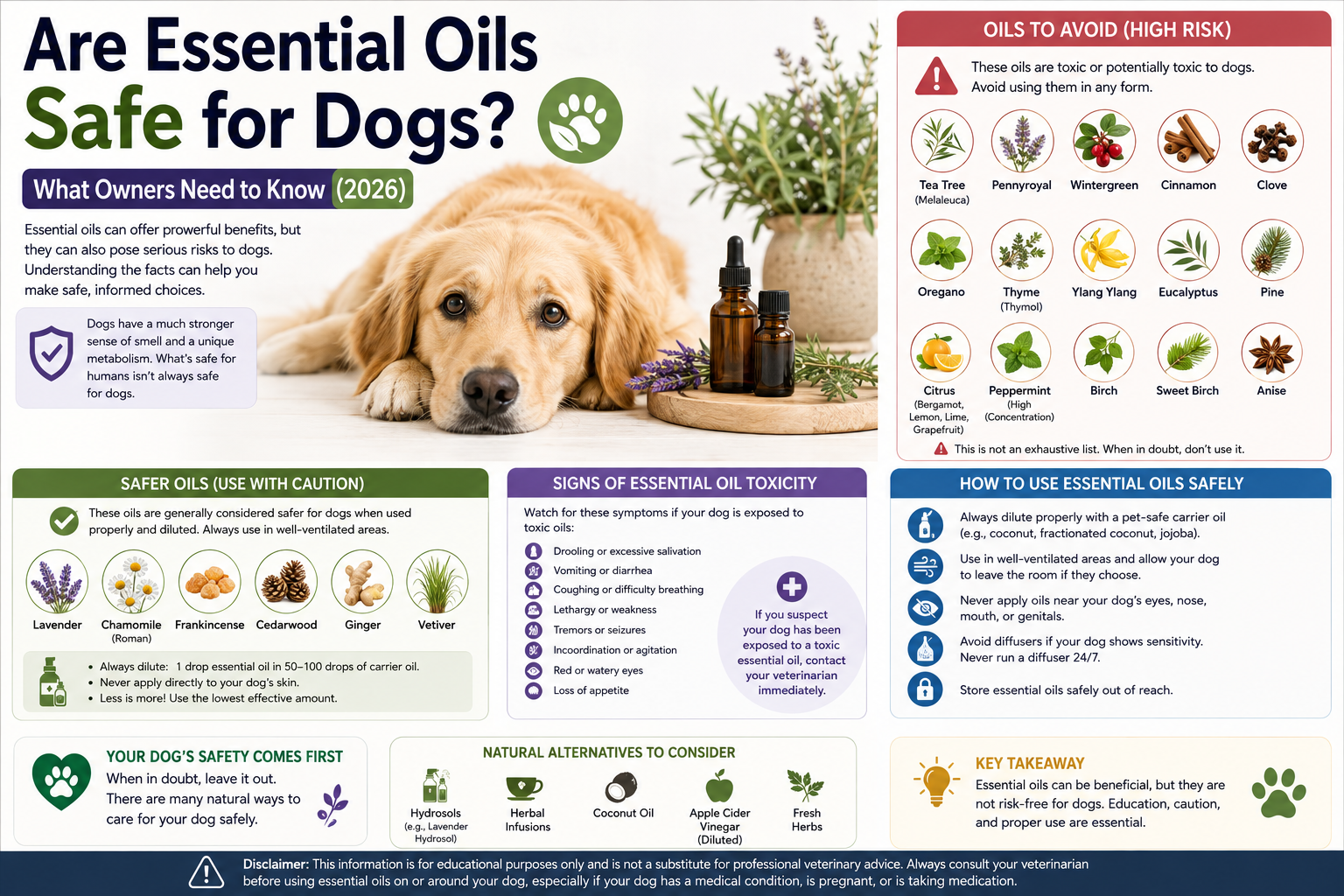
Quick Answer
Most essential oils are not safe for dogs, and several are seriously toxic. Oils are highly concentrated plant extracts, and dogs are more sensitive to them than people cats more so again. The three exposure routes all matter: ingestion (licking a spill or a treated coat), skin absorption (applied oils, even diluted), and inhalation (diffusers, which release droplets that settle on fur and are then groomed off and swallowed). Tea tree oil is the most common cause of essential oil poisoning in pets, and it appears in many “natural” flea products.
Key Takeaways
- Never apply undiluted essential oil to a dog’s skin or coat.
- Tea tree (melaleuca) is the most frequent culprit in reported poisonings.
- Diffusers are a genuine risk in small rooms or where a dog cannot leave.
- Cats are far more sensitive than dogs in a shared home, assume cat-level caution.
- Never use essential oils as a flea treatment. They are ineffective and dangerous.
- If exposure occurs, do not induce vomiting call a vet or poison line.
Why Dogs React Differently to Us
An essential oil is a plant extract concentrated many times over. A few drops can represent an enormous quantity of raw plant material.
Three factors make dogs more vulnerable:
- Body size. A dose trivial for a 70 kg adult is significant for a 7 kg dog.
- Liver metabolism. Dogs process certain compounds particularly phenols and terpenes less efficiently than humans. Cats are dramatically worse, lacking sufficient glucuronyl transferase, an enzyme essential for clearing many of these compounds.
- Behaviour. Dogs groom, lick, and roll. Anything on the coat ends up ingested.
On “natural” as a safety signal: it is not one. Many of the most dangerous substances in veterinary toxicology are entirely natural including several on our toxic foods list.
Oils Known to Be Toxic to Dogs
| Oil | Notes |
| Tea tree (melaleuca) | The most commonly reported. Causes weakness, tremors, wobbliness, low temperature. Common in “natural” flea products |
| Pennyroyal | Highly toxic; associated with liver failure |
| Wintergreen | Contains methyl salicylate related to aspirin toxicity |
| Sweet birch | Same salicylate risk |
| Pine and pine-derived cleaners | Irritant; can cause liver and kidney damage |
| Citrus oils (d-limonene) | Skin irritation, drooling, weakness |
| Peppermint | Gastrointestinal upset, central nervous system effects |
| Cinnamon | Irritating to skin and mouth; can lower blood sugar |
| Clove | Contains eugenol; liver toxicity risk |
| Eucalyptus | Drooling, vomiting, weakness, depression |
| Thyme and oregano | High phenol content |
| Ylang ylang | Weakness, vomiting |
| Anise | Gastrointestinal and neurological effects |
| Garlic oil | Damages red blood cells |
On lavender and chamomile: these are often described as the safest options, and heavily diluted lavender is used in some veterinary calming products. But “safer than tea tree” is not “safe.” Concentrated lavender oil can still cause vomiting and central nervous system depression, and it should never be applied directly or given orally without veterinary direction.
The Three Routes of Exposure
Ingestion the most severe
Licking a spill, chewing a bottle, licking an oil-treated coat, or grooming after a diffuser has coated the fur. This produces the most serious poisonings.
Skin absorption
Essential oils absorb readily through skin. Applying them even diluted delivers a systemic dose, and dogs then lick the area, adding ingestion on top. Never apply essential oils to a dog without explicit veterinary instruction.
Skin contact also causes direct irritation: redness, itching, and burns. If your dog is already licking or chewing at itchy skin, adding oils will make it considerably worse see why is my dog licking his paws for what actually helps.
Inhalation and diffusers the underestimated one
This is where most owners go wrong, because a diffuser feels passive and indirect.
Passive diffusers (reeds, plug-ins) release vapour. Risk is lower, but a dog can knock one over and be exposed to concentrated liquid.
Active diffusers (ultrasonic, nebulising) release microdroplets of actual oil into the air. These settle on surfaces including your dog’s coat and are then groomed off and swallowed. This is the mechanism most people do not anticipate.
If you use a diffuser at all:
- Use it in a large, well-ventilated room only
- Ensure your dog can freely leave the room at any time
- Never in a bedroom where the dog sleeps, a crate area, or a small enclosed space
- Never around dogs with asthma, collapsing trachea, or brachycephalic airways
- Never in a home with cats. Cats cannot metabolise these compounds, and their constant grooming maximises ingestion see our feline toxicity guide
Signs of Essential Oil Poisoning
Immediate or within hours:
- Drooling, pawing at the mouth
- Vomiting
- Difficulty breathing, coughing, or wheezing
- Redness or burns on skin, gums, or tongue
- A strong smell of the oil on breath or coat
Progressing:
- Wobbliness, weakness, difficulty walking
- Tremors a hallmark sign; see why is my dog shaking
- Lethargy or collapse
- Low body temperature
- Muscle weakness
Serious:
- Seizures
- Liver damage (yellowing gums or eyes, appetite loss, vomiting)
- Respiratory distress
What to Do If Your Dog Is Exposed
- Move your dog to fresh air and remove the source.
- Do not induce vomiting. Essential oils are caustic and can cause further damage coming back up, and aspiration into the lungs is a serious risk.
- If it is on the skin or coat, wash with liquid dish soap and warm water soap cuts oil far better than pet shampoo. Wear gloves. Rinse thoroughly and repeat if needed.
- Do not give milk, oil, or home remedies.
- Call your vet or a poison line immediately, with the product to hand:
- ASPCA Animal Poison Control Center: 888-426-4435
- Pet Poison Helpline: 855-764-7661
- UK: Animal PoisonLine 01202 509000
- Take the bottle with you to the clinic the specific oil and concentration change treatment.
Safer Alternatives
For calming: veterinary pheromone diffusers, which are species-specific and well tolerated. Also predictable routine, a safe den space, background sound, and for genuine anxiety a veterinary behaviour plan. Noise phobia and separation distress have effective treatments; scent is not one of them.
For fleas and ticks: use a veterinary-licensed product. Essential oil flea remedies are both ineffective and a common cause of poisoning. Tea tree oil in particular appears in “natural” flea products and is responsible for a meaningful share of reported cases.
For odour: ventilation, washing bedding at 60°C, an enzymatic cleaner for accidents, regular vacuuming, and an unscented HEPA air purifier. Odour is information a persistent smell usually means something needs cleaning or a dog needs checking.
For skin conditions: a veterinary diagnosis. Itchy skin has many causes and each needs different treatment; oils will irritate every one of them.
For a hot, stuffy room: ventilation and cooling rather than fragrance see how to keep dogs cool in summer.
Frequently Asked Questions
Are essential oil diffusers safe around dogs? Only with real caution a large ventilated room, free exit for the dog, and never around cats, puppies, or dogs with airway conditions. Active diffusers release oil droplets that settle on fur and are then licked off.
Is lavender oil safe for dogs? Safer than many oils, and heavily diluted lavender is used in some veterinary products. It is still not safe applied directly or given orally without veterinary direction.
Is tea tree oil toxic to dogs? Yes it is the most commonly reported cause of essential oil poisoning in pets. Never apply it, and avoid “natural” flea products containing it.
Can I use essential oils for fleas on my dog? No. They are ineffective and a common cause of poisoning. Use a veterinary-licensed parasite product.
What should I do if my dog licks essential oil? Do not induce vomiting. Move to fresh air, wash any skin contact with dish soap and water, and call your vet or a poison line immediately with the bottle to hand.
Are essential oils worse for cats than dogs? Considerably. Cats lack a liver enzyme needed to process many of these compounds, and their grooming increases ingestion. Avoid them entirely in homes with cats.
How long do symptoms take to appear? Often within minutes to a few hours for ingestion or skin contact. Liver effects can develop over 24–72 hours.
Can I diffuse oils if my dog is in another room? It reduces exposure but does not remove it, since droplets travel and settle. If you have a cat, or a dog with any airway condition, do not use active diffusers at all.
Final Thoughts
Essential oils occupy an awkward space in pet care: they are marketed as gentle and natural, and they are among the substances poison lines hear about most often.
The safest position is the simplest one. Do not apply them to your dog, do not add them to water or food, and think carefully before running an active diffuser in a home with pets — especially cats. If you want a calmer dog or a fresher house, the effective tools are different ones: veterinary pheromone products, a proper behaviour plan, ventilation, and clean bedding. None of them smell as nice, and all of them work better.
Related Reading
- Foods Toxic to Dogs: The Complete List
- How to Keep Dogs Cool in Summer
- Why Is My Dog Licking His Paws?
- Why Is My Dog Shaking? 8 Common Causes
- Emergency Alert: 10 Human Foods That Are Toxic to Cats
A Note on Pet Health
Serlig publishes researched pet care information for everyday owners. It is general guidance, not veterinary advice, and it does not replace an examination by a licensed veterinarian who knows your pet. If your pet is unwell, or anything in this guide does not match what you are seeing at home, contact your vet.
About the Author
The Serlig Pet Care Team creates researched, plain-language pet care guides for everyday owners. Our content is written from hands-on pet-care experience and cross-checked against established veterinary sources so you can make confident decisions for your dog.




One Comment