
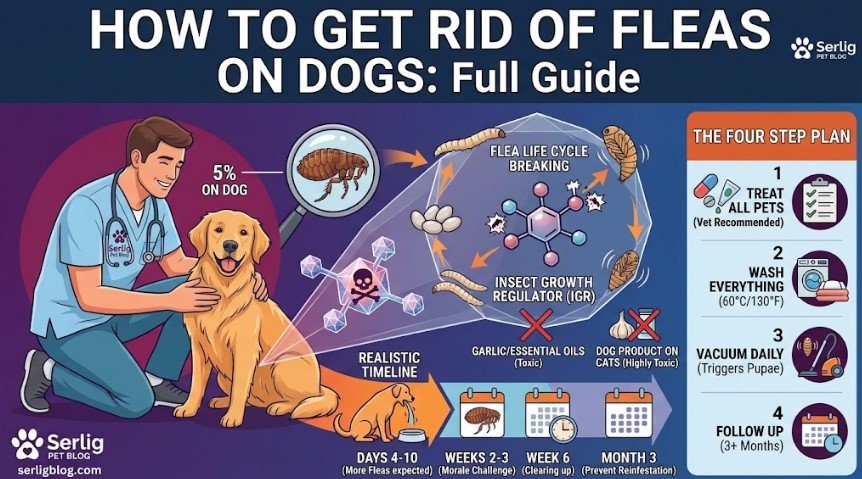
How to get rid of fleas on dogs comes down to treating the dog and the home at the same time, and then keeping going for longer than feels necessary. Start a vet recommended flea product on every pet in the household on the same day, wash all bedding at 60 degrees Celsius or above, vacuum thoroughly and daily at first, and treat the home with a product containing an insect growth regulator. Expect to keep seeing fleas for three to six weeks even when everything is working, because most of the population is not on your dog.
Why Most Flea Treatments Appear to Fail
Before any of the steps, one fact explains almost every failed flea treatment.
The fleas on your dog are roughly five percent of the problem: The other ninety five percent are eggs, larvae and pupae sitting in your carpets, skirting boards, sofa and bedding. Veterinary estimates suggest that for every six fleas you can see on a dog, there may be around three hundred more in the home.
Female fleas lay eggs in your dog’s coat, and those eggs fall off wherever your dog goes. They hatch into larvae in two to three days, the larvae feed on debris and then spin cocoons, and inside those cocoons the pupae wait.
Pupae are the reason this drags on: The cocoon is a physical barrier that insecticides do not readily penetrate, and a pupa can stay dormant inside it for weeks waiting for the right conditions. No product kills them reliably.
So here is what happens to most owners. You treat the dog on Monday. The visible fleas die within hours and you feel relieved. Ten days later you are finding fleas again, so you conclude the product has failed, buy a different one and start over.
Nothing failed. The new fleas are pupae that have hatched since. They will die on contact with a treated dog, but only once they emerge, and emergence happens over weeks. Switching products restarts your own clock without changing theirs.
Understanding this is the difference between a treatment that works and a cycle of frustration. Pick a good product, treat everything at once, and hold the line for at least three months.
The Four Step Plan
Public health guidance sets out four steps, and the critical detail is that they happen together, not one after another.
- Sanitation: Wash and vacuum everything.
- Pet treatment: Every animal in the household, on the same day.
- Home treatment: Started at the same time as pet treatment.
- Follow up: Repeat treatments and continued cleaning, because of the pupae.
Doing these in sequence rather than in parallel is the second most common reason flea control fails. A treated dog walking on an untreated carpet will simply pick up fleas again.
Step One: Treat Every Pet on the Same Day
Use a vet recommended product: Modern prescription oral and topical treatments kill fleas far more reliably than shampoos, powders or collars alone, and many also contain an ingredient that stops eggs developing. If your dog is miserable right now, a fast acting oral product can begin killing adult fleas within hours.
Which product suits your dog depends on weight, age, health and lifestyle, which is exactly why this is a conversation with your vet rather than a shelf decision.
Every pet in the house, on the same day: This is not optional. Fleas move between animals, so an untreated cat or a second dog becomes a reservoir that reinfests the treated one. Staggering treatment by even a few days undermines the whole plan.
A bath and a flea comb help with the immediate misery but are not treatment. Comb from head to tail, paying attention to the neck, the base of the tail and the groin, and dip the comb in soapy water after each pass to kill what you remove.
Do not stop after one dose: Flea products work for a defined period. Missing the next dose in month two is how an infestation comes back after you thought you had won.
Step Two: Treat the Home
Wash everything washable at 60 degrees Celsius or above, which is around 130 degrees Fahrenheit. That includes dog bedding, blankets, soft toys, throws, cushion covers, your own bedding if your dog sleeps on it, and collars and harnesses. Hot water kills every life stage.
Use a household flea product containing an insect growth regulator: An IGR stops eggs and larvae maturing, which is what actually breaks the cycle rather than just killing the adults you can see. Follow the label exactly and keep pets and people off treated surfaces until dry.
Focus on where larvae hide: They avoid light and burrow down into carpet fibres, so the places that matter are under furniture, along skirting boards, in cracks between floorboards, and anywhere your dog sleeps.
Do not forget the car if your dog travels in it, and any room you have been keeping closed.
For heavy infestations, a professional pest control treatment is a reasonable call rather than an admission of defeat.
Step Three: Vacuum, and Why It Does More Than You Think
Vacuuming is usually described as a way of removing eggs and larvae. It does that, and it does something considerably more useful.
The vibration of a vacuum cleaner triggers pupae to emerge from their cocoons.
That matters enormously. A pupa inside its cocoon is protected from insecticide. A newly emerged adult flea is not. So vacuuming does not just remove fleas, it pulls the resistant stage out of hiding and into contact with your treatment.
Reframed this way, vacuuming becomes an active weapon rather than housekeeping.
How to do it properly
- Daily for the first two weeks, then every other day for a month
- Cover carpets, rugs, hard floors, skirting boards, under furniture, upholstery and stairs
- Use the crevice tool along edges and in cracks, since that is where larvae go
- Empty the canister outside immediately, or seal and remove the bag. Eggs can hatch inside a vacuum
- Do not forget the car seats
Our guide to removing pet hair from carpet covers technique that applies here too.
Step Four: Follow Up
This is the step people skip, and it is where infestations are won or lost.
Repeat home treatment. Public health guidance recommends two or more follow up treatments within five to ten days of the first, because stages that were protected the first time will have emerged by then.
Keep vacuuming and washing throughout. Ongoing sanitation is what catches each new wave.
Keep every pet on their preventive, without gaps, for at least three months after you last see a flea.
Do not judge success by week two. See the timeline below.
A Realistic Timeline
Nobody tells owners what normal progress looks like, so normal progress gets mistaken for failure. Here is what to expect when everything is being done correctly.
| When | What you should expect |
| Day 1 | Treat all pets and the home. Adult fleas on the dog begin dying within hours |
| Days 2 to 3 | Far fewer fleas on the dog. Itching starts to settle |
| Days 4 to 10 | You will see fleas again. New adults are emerging from pupae. This is expected, not failure |
| Weeks 2 to 3 | Usually the worst period for morale. Emergence continues. Keep vacuuming daily and do not switch products |
| Weeks 4 to 6 | Numbers fall noticeably. Most homes are close to clear by the end of this window |
| Weeks 6 to 12 | Occasional stragglers from late hatching pupae. Stay on preventives |
| Month 3 onward | Should be clear. Continue year round prevention |
Moderate to severe infestations can take months rather than weeks. If you have a heavily infested home, judge progress by the trend rather than by any single day.
If you are still finding significant numbers after eight weeks of doing all four steps consistently, that is the point to go back to your vet or call a pest control professional, not week two.
How to Confirm Your Dog Has Fleas
Signs to look for
- Persistent scratching, licking, chewing or biting, especially around the tail base, groin and hindquarters
- Hair loss or thinning, often over the lower back
- Red skin, scabs or small bumps
- Restlessness and disturbed sleep
- Bites on your own ankles
The flea dirt test. Flea dirt is digested blood and looks like black specks in the coat. Comb some onto a damp white tissue or piece of kitchen roll. If the specks smear reddish brown, it is flea dirt and your dog has fleas. Ordinary dirt stays black.
This test is worth knowing because you can have a flea problem without ever seeing a live flea, particularly on a dark or thick coated dog.
Persistent itching has other causes too, and our guides to dog dandruff and why a dog licks his paws cover what else to consider if the flea test comes back negative.
Dangerous Mistakes
These cause genuine harm rather than just wasted effort.
Never use a dog flea product on a cat: Many dog spot on treatments contain permethrin, which is highly toxic to cats and can cause tremors, seizures and death. This includes a treated dog and a cat that grooms it or sleeps against it in the hours after application. Separate them until the product is fully dry, and read every label.
Be extremely careful with essential oils: Pennyroyal, eucalyptus, tea tree and geranium oils are commonly promoted as natural flea remedies and can cause severe reactions in pets. Our guide to essential oils and dogs covers which are genuinely dangerous.
Never use garlic as a flea remedy: Garlic damages red blood cells in dogs and cats. It does not repel fleas.
Do not double up products without veterinary advice. Combining a collar, a spot on and an oral product can overdose your dog.
Check the weight band on the packet: Dosing by eye is how small dogs get overdosed and large dogs get undertreated.
Puppies need age appropriate products: Many flea treatments have a minimum age or weight. Our new puppy checklist covers what is suitable early on.
Do Home Remedies Work?
An honest assessment, since these are heavily promoted.
| Remedy | Verdict |
| Dish soap bath | Kills live fleas on contact. Useful for immediate relief, useless as treatment. Does nothing to eggs or pupae |
| Flea comb | Genuinely useful for removal and for monitoring. Not a treatment |
| Hot washing | Genuinely effective on every life stage. A core part of the plan |
| Vacuuming | Genuinely effective, and triggers pupal emergence. A core part of the plan |
| Diatomaceous earth | Weak evidence. Only works when completely dry, and the dust is a respiratory irritant for pets and people |
| Salt on carpets | Weak evidence. Can damage carpet fibres and attract moisture |
| Apple cider vinegar | No good evidence that it kills or repels fleas |
| Coconut oil | No good evidence as a flea treatment |
| Essential oils | Ineffective at best, dangerous at worst. See above |
| Garlic | Dangerous. Never use |
| Nematodes in the garden | Some evidence for reducing outdoor larvae. Reasonable as a supporting measure |
The pattern: the home remedies that work are the mechanical ones, washing, combing and vacuuming. The ones sold as natural alternatives to veterinary products mostly do not work, and several are harmful.
When Fleas Become a Medical Problem
Fleas are not only an irritation.
Flea allergy dermatitis: Some dogs are allergic to flea saliva, and a single bite can trigger intense itching, hair loss and secondary skin infection. These dogs need veterinary treatment alongside flea control.
Flea anaemia: A heavy infestation removes enough blood to cause anaemia, and puppies, small dogs and elderly dogs are at real risk. Pale or white gums, lethargy and weakness are an emergency. Take a puppy with pale gums to a vet the same day.
Tapeworm: Fleas carry tapeworm larvae, and a dog that swallows a flea while grooming becomes infected. If your dog has had fleas, assume it may need worming too and ask your vet. Scooting and rice like segments around the tail are the usual signs, covered in our guide to why a dog scoots.
Skin infection: Constant scratching breaks the skin and lets bacteria in.
Household bites: Cat fleas, which are the species most often found on dogs, will bite people too, usually around the ankles.
Preventing Reinfestation
- Year round prevention, without gaps: Fleas survive indoors through winter, and the most common cause of a repeat infestation is a skipped dose
- Every pet, permanently: Including indoor only cats, since fleas arrive on people, on other pets and through open doors. Our guide to hair loss in patches in cats covers what flea allergy looks like in cats
- Keep grass short and clear leaf litter from shady, damp areas near paths and resting spots
- Wash bedding regularly as routine rather than only during an outbreak
- Check after contact with other animals, kennels, grooming and the park
- Accept that wildlife and stray cats are a permanent source: Prevention is ongoing rather than a one off fix
Frequently Asked Questions
How long does it take to get rid of fleas on dogs? Three to six weeks with consistent treatment in a typical case, and months in a heavy infestation. The delay is caused by pupae hatching over an extended period, not by treatment failure.
Why do I still see fleas after treating my dog? Because around ninety five percent of the population is in your home rather than on your dog, and pupae keep hatching for weeks. Newly emerged fleas will die on a treated dog, but you will see them first.
Do I need to treat my house as well as my dog? Yes. Treating the dog alone leaves the eggs, larvae and pupae in your carpets and bedding, and your dog will be reinfested from them.
Can I use a dog flea treatment on my cat? No. Many dog products contain permethrin, which is highly toxic to cats and can be fatal. Use species specific products only, and keep treated dogs away from cats until dry.
Do flea collars work? Some modern veterinary collars are effective, and many shop bought ones are not. Ask your vet rather than choosing from a shelf, and never combine a collar with another product without advice.
Are natural flea remedies effective? The mechanical ones, washing, combing and vacuuming, genuinely help. Apple cider vinegar, coconut oil, salt and diatomaceous earth have weak or no evidence, and essential oils and garlic can be dangerous.
My dog has fleas. Does he need worming too? Very likely. Fleas transmit tapeworm when swallowed during grooming, so ask your vet about treating for tapeworm alongside the fleas.
The Bottom Line
How to get rid of fleas on dogs is less about finding the right product and more about understanding what you are actually fighting. The fleas you can see are a small fraction of the infestation, and the stage that matters most is sitting in a cocoon in your carpet where nothing can reach it.
That single fact drives everything else. Treat every pet on the same day, treat the home at the same time, vacuum daily because the vibration forces the protected stage out into the open, and keep going through the second and third weeks when it looks like nothing is working.
If you take one thing from this page, take this: seeing fleas again ten days after treating is expected. It is the point at which most people give up and switch products, and it is the point at which the plan is actually working.

One Comment