Quick Answer
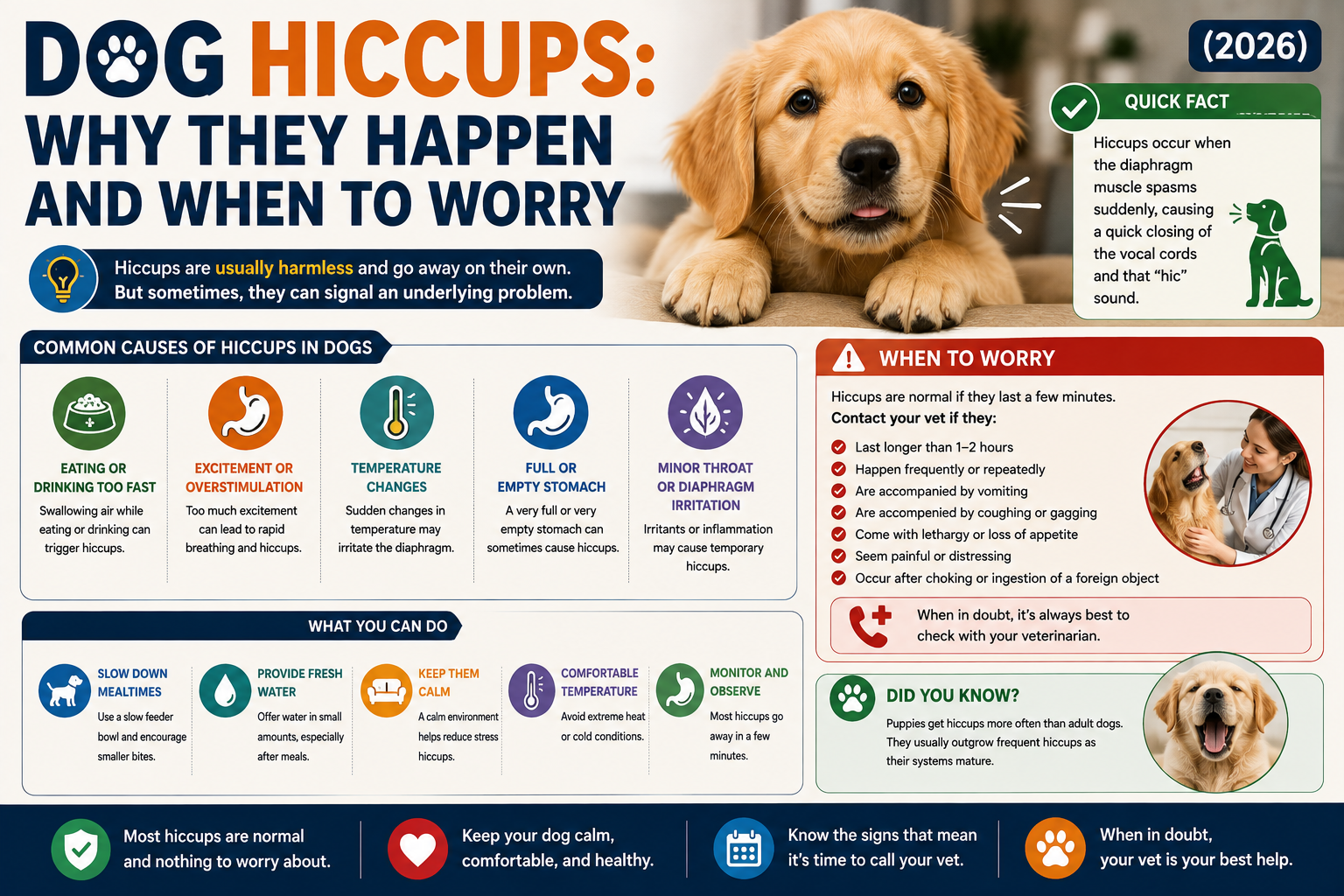
Hiccups in dogs are common, normal, and almost always harmless especially in puppies. A hiccup is an involuntary spasm of the diaphragm, followed by the vocal folds snapping shut, which makes the sound. Eating or drinking too fast, excitement, stress, and swallowing air are the usual triggers. Most episodes stop within a few minutes on their own. The only real concern is hiccups that last more than an hour, recur constantly, or come with coughing, retching, or breathing difficulty.
Key Takeaways
- Hiccups are a diaphragm spasm the same mechanism as in people.
- Puppies hiccup far more than adults and typically grow out of it.
- Eating too fast is the single most common trigger.
- Most episodes resolve within a few minutes to half an hour.
- No home “cure” is proven slowing things down and calming your dog is the practical approach.
- Never startle a dog to stop hiccups, or hold their mouth shut.
What Is Actually Happening
The diaphragm is the sheet of muscle separating chest from abdomen, and it drives normal breathing. Occasionally it contracts involuntarily, pulling air in sharply. The glottis the opening between the vocal folds snaps shut in response, producing the characteristic “hic.”
Why this reflex exists at all is not fully settled. One well-supported idea is that it is an evolutionary remnant from amphibian gill ventilation. Another is that it helps young mammals clear air from the stomach while nursing, which would neatly explain why puppies hiccup so much more than adult dogs.
Either way, the mechanism is a muscle reflex, not a disease.
Why Puppies Hiccup So Much
If you have a new puppy hiccupping several times a day, that is entirely expected.
- Immature nervous system. The reflex pathways controlling the diaphragm are still developing.
- Enthusiastic eating. Puppies gulp food and water with more speed than technique, swallowing air with it.
- Big emotions. Puppies swing rapidly between overexcitement and exhaustion, and both provoke hiccups.
- Sleep hiccups. Common in very young puppies and no cause for concern.
Most puppies hiccup noticeably less by around six months and rarely as adults. Frequency alone is not a warning sign, provided your puppy is eating, playing, and growing normally.
The Common Triggers
| Trigger | Why it causes hiccups |
| Eating too fast | Air swallowed with food distends the stomach and irritates the diaphragm |
| Drinking too fast | Same mechanism |
| Excitement | Rapid, irregular breathing disrupts the diaphragm’s rhythm |
| Stress or anxiety | Breathing pattern changes under adrenaline |
| Cold air or a sudden temperature change | Can trigger diaphragm spasm |
| Vigorous play | Fast, shallow breathing |
| Gas or a full stomach | Pressure against the diaphragm |
| Certain medications | Occasionally listed as a side effect |
How to Help
There is no evidence-based cure, and you do not need one hiccups stop on their own. What you can do is remove the trigger and settle your dog.
Reasonable things to try:
- Offer a small amount of water, slowly. Gentle swallowing can interrupt the rhythm.
- Encourage gentle activity a slow walk around the room changes breathing pattern.
- Massage the chest and belly in slow circles to help the diaphragm relax.
- Calm the environment. If excitement triggered it, quiet usually ends it.
- Wait. The most effective option most of the time.
Never do these:
- Do not startle your dog. The human folk remedy has no evidence behind it and, in dogs, teaches fear of you.
- Do not hold the mouth or nose shut. Distressing and unnecessary.
- Do not give human hiccup remedies, sugar, vinegar, or lemon.
- Do not give any human medication.
Preventing Frequent Hiccups
Because eating speed is the most common trigger, that is where the fix lives.
- Use a slow-feeder bowl or puzzle feeder. These reliably reduce gulping and are the single most effective change for most dogs.
- Scatter feed. Spreading kibble across a snuffle mat or a clean floor slows things down and provides enrichment.
- Feed smaller, more frequent meals, particularly for puppies.
- Separate competing pets at meal times competition drives fast eating.
- Raise the bowl for large or deep-chested breeds if your vet recommends it.
- Allow a calm gap of 15–20 minutes between food and vigorous play.
- Keep water available all day, so your dog does not arrive at the bowl desperate.
- Feed an appropriate portion of a complete, well-formulated diet a hungry dog eats fast.
Hiccups or Something Else?
Owners often mistake other events for hiccups. The distinction matters.
| What you may be seeing | How to recognise it |
| Hiccups | Rhythmic, regular, brief “hic” with a small body jerk; dog otherwise normal |
| Reverse sneezing | Loud snorting on the in-breath, neck extended, elbows braced see why is my dog sneezing |
| Coughing | Forceful, from the chest, often ending in a retch or gag |
| Choking | Distress, pawing at the mouth, difficulty breathing emergency |
| Retching or nausea | Drooling, lip licking, repeated swallowing, abdominal effort |
| Tremors or muscle twitching | Irregular, not synchronised with breathing see why is my dog shaking |
| Focal seizure | Repetitive twitching with altered awareness needs veterinary assessment |
If you are unsure, film it. Twenty seconds of video answers this question far better than any description.
When to Contact a Vet
Genuine problems are rare, but they exist.
Book an appointment if hiccups:
- Last more than one hour, or recur throughout the day for several days
- Appear suddenly in an adult dog that has never had them
- Come with coughing, wheezing, or noisy breathing
- Come with vomiting, drooling, or refusing food see dog not eating but drinking water
- Seem to distress your dog, or occur alongside lethargy or weight loss
Go immediately if there is:
- Difficulty breathing, or gums that look pale, grey, or blue
- Choking, gagging, or pawing frantically at the mouth
- Collapse
- A swollen, hard abdomen with unproductive retching this can indicate bloat (GDV), a life-threatening emergency in deep-chested breeds
What persistent hiccups could indicate: in uncommon cases, respiratory disease, gastrointestinal irritation, heat or airway problems, parasites, or in young unvaccinated puppies a heavier worm burden. Your vet will listen to the chest, palpate the abdomen, and take a history.
Frequently Asked Questions
Are dog hiccups normal? Yes. They are a common, harmless diaphragm spasm, particularly frequent in puppies.
How long do dog hiccups last? Usually a few minutes, occasionally up to half an hour. Anything beyond an hour deserves a vet call.
Why does my puppy hiccup so much? Immature reflexes, fast eating, and big emotional swings. Most puppies hiccup far less by six months.
How do I stop my dog’s hiccups? Offer a little water, encourage gentle movement, massage the chest, and keep things calm. Mostly, waiting works.
Can I scare the hiccups out of my dog? Please do not. There is no evidence it works, and it damages your dog’s trust in you.
Do hiccups mean my dog ate too fast? Very often, yes. A slow-feeder bowl is the most effective single change you can make.
Is my dog hiccupping or reverse sneezing? Hiccups are rhythmic and brief with a small body jerk. Reverse sneezing is loud snorting on the in-breath with the neck extended.
Should I worry about hiccups in an old dog? Hiccups appearing for the first time in a senior dog are worth mentioning to your vet, particularly with coughing, appetite changes, or weight loss.
Final Thoughts
Dog hiccups are one of the few pet symptoms where the honest answer really is “this is fine.” They are common, self-limiting, and in puppies almost a rite of passage.
The useful work is prevention rather than treatment: slow the eating down, feed smaller meals, and let the excitement settle before dinner. And if you find yourself unsure whether you are watching hiccups, a reverse sneeze, or a cough, reach for your phone and record it that single habit turns a worrying unknown into a five-second answer.
Related Reading
- Why Is My Dog Sneezing?
- Why Is My Dog Shaking? 8 Common Causes
- Dog Not Eating but Drinking Water: What It Means
- Best Super Premium Dog Food
A Note on Pet Health
Serlig publishes researched pet care information for everyday owners. It is general guidance, not veterinary advice, and it does not replace an examination by a licensed veterinarian who knows your pet. If your pet is unwell, or anything in this guide does not match what you are seeing at home, contact your vet.
About the Author
The Serlig Pet Care Team creates researched, plain-language pet care guides for everyday owners. Our content is written from hands-on pet-care experience and cross-checked against established veterinary sources so you can make confident decisions for your dog.