
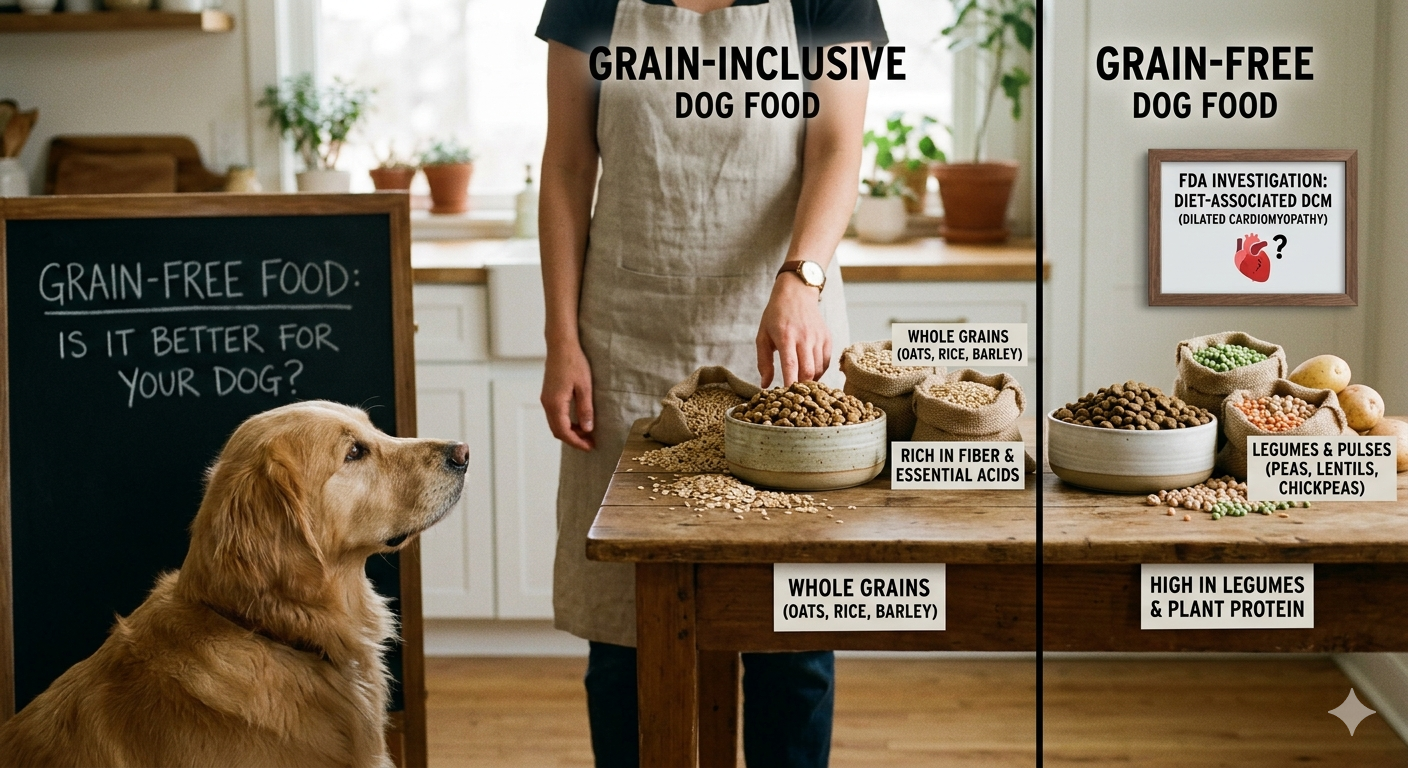
Walking down the pet food aisle can feel like navigating a nutritional minefield. With colorful packaging boasting premium ingredients, many pet owners find themselves wondering which diet will help their canine companion thrive. One of the most prominent trends in recent years is the shift toward grain-free diets, heavily marketed as the ultimate choice for canine health and vitality.
However, marketing claims and veterinary science do not always align. The choice between grain-free dog food vs grain inclusive options carries significant health implications that go far beyond basic ingredient preferences. Deciding what goes into your dog’s bowl requires looking past the advertisements and examining the biological facts.
This comprehensive guide examines the science behind canine nutrition evolution, analyzing clinical studies and veterinary consensus. By exploring the biological mechanisms of digestion, the reality of food allergies, and recent cardiac health investigations, you will gain the knowledge necessary to make an informed, safe, and healthy dietary choice for your pet.
The 60-Second Answer: Grains or No Grains?
Grain-free is not inherently better for most dogs. Unless your dog has a diagnosed grain allergy (which is rare), whole grains provide essential fiber and nutrients. Current research also investigates links between certain grain-free diets and heart issues, specifically Dilated Cardiomyopathy (DCM). For the vast majority of healthy dogs, a balanced, grain-inclusive diet formulated to meet veterinary standards is the safest and most nutritious choice.
The Science of Canine Nutrition Evolution
To understand how dogs process food, we must look at their genetic history. A common misconception drives the grain-free movement: the idea that domestic dogs should eat exactly like their wild wolf ancestors. While dogs and wolves share a common lineage, thousands of years of genetic selection and domestication have fundamentally altered canine biology.
During the agricultural revolution, dogs began living alongside humans and scavenging scraps from human settlements. This environmental shift triggered a crucial evolutionary change. Researchers have discovered that modern dogs possess multiple copies of the gene responsible for producing amylase, a pancreatic enzyme specifically designed to break down starches. Wolves, by contrast, typically have only two copies of this gene.
Because of this amylase adaptation, dogs are highly efficient at digesting complex carbohydrates. Grains are not biologically inappropriate for them. In fact, properly cooked grains are highly digestible and serve as an excellent source of sustained energy, essential fatty acids, and dietary fiber that promotes a healthy gut microbiome.
The Controversy: Grain-Free Diets and Heart Disease
The conversation around canine nutrition shifted dramatically when veterinary cardiologists noticed a troubling trend: an increase in cases of Dilated Cardiomyopathy (DCM) in dog breeds not genetically predisposed to the condition. This observation prompted a massive, ongoing investigation by the U.S. Food and Drug Administration (FDA) regarding FDA grain-free dog food heart disease links.
Dilated Cardiomyopathy (DCM) is a severe disease that causes the heart muscle to weaken and enlarge, eventually leading to congestive heart failure. The FDA investigation, supported by institutions like the American Veterinary Medical Association (AVMA) and researchers at UC Davis, revealed a strong correlation between these atypical DCM cases and boutique, exotic, or grain-free diets (often referred to as BEG diets).
The issue does not appear to be the mere absence of grains. Instead, the problem stems from what replaces the grains. To bind the kibble and provide carbohydrates, grain-free formulas rely heavily on legumes and pulses, specifically peas, lentils, and chickpeas, as well as potatoes.
High concentrations of these legumes may interfere with a dog’s ability to synthesize or absorb taurine, a crucial amino acid for cardiac muscle function. Taurine deficiency directly compromises heart health. While the exact physiological mechanism is still being studied, the veterinary consensus strongly advises against feeding diets heavily reliant on legumes unless medically necessary.
Allergic Reactions: Fact vs. Fiction
Many owners switch to grain-free food at the first sign of itching, assuming their pet is reacting to wheat or corn. You need to know dog grain allergy symptoms to identify true issues, but it is equally important to understand the statistical reality of canine allergies.
True food allergies in dogs are quite rare, accounting for only about 10% of all allergy cases (with environmental allergies like pollen and flea bites making up the vast majority). Furthermore, when a dog does have a food allergy, the culprit is almost always an animal protein. Beef, dairy, chicken, and lamb are the most common dietary allergens for dogs.
Allergies to grains are exceptionally uncommon. Removing complex carbohydrates from a dog’s diet to cure an itch often completely misses the actual allergen. If you suspect your dog has a food allergy, a veterinary-supervised elimination diet using a novel protein or hydrolyzed protein is the medically appropriate diagnostic tool, rather than arbitrarily removing grains.
Do grains cause inflammation in dogs?
A scientific no. There is no biological evidence supporting the claim that whole grains cause systemic inflammation in healthy dogs. In reality, the benefits of whole grains for dogs are well-documented. Whole grains like oats, brown rice, and barley offer high bioavailability of vital nutrients. They provide linoleic acid (an essential omega-6 fatty acid for coat health), antioxidants, and soluble fiber. The fiber found in grains acts as a prebiotic, feeding beneficial gut bacteria and actually helping to reduce gastrointestinal inflammation.
Grain-Free vs. Grain-Inclusive: A Balanced View
To help clarify the differences, here is a breakdown of how these two diet types compare across key nutritional and medical metrics.
| Feature | Grain-Inclusive Dog Food | Grain-Free Dog Food |
| Carbohydrate Source | Whole grains (oats, rice, barley, sorghum, corn) | Legumes and pulses (peas, lentils, chickpeas), potatoes, sweet potatoes |
| Heart Health Risk | Standard baseline risk; no established link to diet-associated DCM | Elevated risk under FDA investigation due to high legume/pulse content |
| Digestibility | Highly digestible due to canine amylase adaptation | Highly digestible, but high legume content can cause excess flatulence/GI upset |
| Nutritional Profile | Rich in fiber, essential fatty acids, and bioavailable vitamins | High in complex carbohydrates and plant-based proteins |
| Medical Suitability | Ideal for the vast majority of healthy domestic dogs | Only recommended for dogs with a diagnosed grain allergy or specific intolerance |
Frequently Asked Questions
Is corn a filler in dog food?
No, corn is not a filler. When properly cooked and processed, corn is a highly digestible, nutrient-dense ingredient. It provides a highly bioavailable source of complex carbohydrates for energy, essential amino acids for muscle maintenance, and linoleic acid for healthy skin and a shiny coat.
Which breeds are most affected by DCM?
Historically, DCM is a genetic condition affecting large and giant breeds like Doberman Pinschers, Great Danes, Boxers, and Irish Wolfhounds. However, the diet-associated DCM currently under investigation has appeared in atypical breeds, including Golden Retrievers, mixed breeds, Shih Tzus, and Bulldogs, indicating that the diet rather than genetics alone is a primary factor.
How do I know if my dog actually has a grain allergy?
Signs of a food allergy include chronic ear infections, obsessive paw licking, gastrointestinal distress, and generalized itching. However, because grain allergies are incredibly rare, the only definitive way to diagnose one is through a strict prescription elimination diet trial managed by your veterinarian, lasting 8 to 12 weeks. Blood tests and saliva tests for food allergies are historically inaccurate.
Is grain-free better for weight loss?
Grain-free does not mean carbohydrate-free or low-calorie. In many cases, grain-free foods actually contain more calories and fat than their grain-inclusive counterparts. Replacing grains with potatoes and legumes often results in a higher carbohydrate load. For canine weight loss, portion control and a diet formulated for weight management (regardless of grain inclusion) are the most effective strategies.
Making the Best Nutritional Choice for Your Pet
Navigating canine nutrition requires leaning on science rather than trends. The genetic evolution of dogs has equipped them to utilize the nutrients found in whole grains effectively. Furthermore, the ongoing investigations into Dilated Cardiomyopathy highlight the potential unintended consequences of replacing standard grains with high concentrations of legumes and pulses.
Before making any drastic changes to your dog’s diet, schedule a consultation with your veterinarian. They can help you assess your dog’s specific health needs, body condition score, and medical history to recommend a scientifically backed, balanced diet. By prioritizing
A Note on Pet Health
Serlig publishes researched pet care information for everyday owners. It is general guidance, not veterinary advice, and it does not replace an examination by a licensed veterinarian who knows your pet. If your pet is unwell, or anything in this guide does not match what you are seeing at home, contact your vet.