A German Shepherd puppy grows from roughly a kilo at birth to an adult dog of 25 to 40 kg in about eighteen months. Almost everything that matters about raising one well happens inside that window: how fast the skeleton grows, how much of the world the puppy meets before fourteen weeks, and whether the habits you allow at nine kilos are still tolerable at thirty-five.
This guide covers growth, feeding, socialisation, exercise, grooming, health testing and cost for German Shepherd puppies, with a short section at the end on the common crosses. It is written for first-time owners of the breed.
The short version
- Feed a large-breed puppy formula, not standard puppy food. Controlled calcium and a slower growth rate protect developing joints.
- The socialisation window closes around 14 weeks. What your puppy meets before then shapes the adult dog more than any later training.
- Keep forced exercise short until the growth plates close, usually between 12 and 18 months.
- Ask the breeder for hip and elbow scores on both parents, plus a DNA result for degenerative myelopathy. A breeder who cannot produce these is the wrong breeder.
- Expect to brush year-round. The double coat sheds constantly and heavily twice a year.
How fast a German Shepherd puppy grows
German Shepherds are a large breed that matures slowly. Most of the height arrives in the first eight months; the chest, muscle and final weight keep filling out until two or three years old. A lanky, slightly awkward-looking eight-month-old is normal and not a sign of poor feeding.
These are approximate ranges. Individual puppies vary, working lines are often lighter than show lines, and your vet weighing your own dog matters more than any chart.
| Age | Males (approx.) | Females (approx.) |
|---|---|---|
| 8 weeks | 6–9 kg / 13–20 lb | 5–8 kg / 11–17 lb |
| 4 months | 16–20 kg / 35–44 lb | 14–18 kg / 31–40 lb |
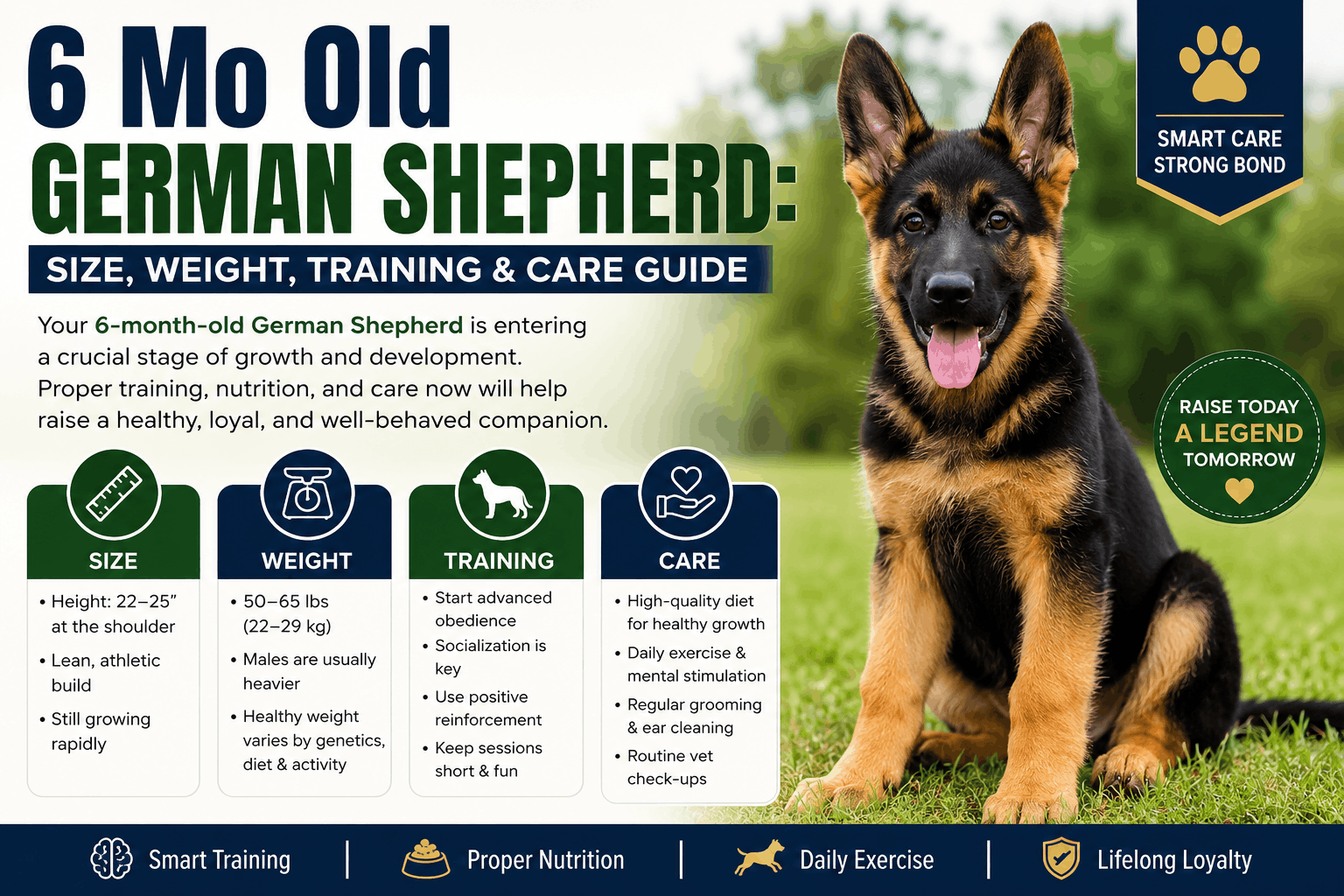
| 6 months | 23–28 kg / 49–62 lb | 20–24 kg / 44–53 lb |
| 12 months | 30–38 kg / 66–84 lb | 25–32 kg / 55–70 lb |
| Adult | 30–40 kg / 65–90 lb, 60–65 cm tall | 22–32 kg / 50–70 lb, 55–60 cm tall |
The American Kennel Club breed standard puts adult males at 24 to 26 inches at the shoulder and females at 22 to 24 inches.
Faster is not better. Pushing a large-breed puppy to grow quickly with rich food or free feeding raises the risk of developmental joint disease. A lean puppy that grows steadily ends up the same adult size, with better joints.
Feeding
Why large-breed puppy food specifically
Standard puppy foods are formulated for dogs that will finish growing at ten or fifteen kilos. Fed to a dog heading for thirty-five, the calcium load and energy density can push the skeleton to grow faster than the joints can cope with.
Look for a bag whose AAFCO statement says it is complete and balanced for growth including the growth of large size dogs (70 lb or more as an adult). That exact wording is the thing to check — not the picture on the front. Our guide to a complete and balanced dog food covers how to read the rest of the label.
Do not add calcium supplements to a complete puppy food. In a growing large-breed dog, extra calcium causes harm rather than stronger bones.
How often to feed
- 8–12 weeks: four meals a day
- 3–6 months: three meals a day
- 6 months onward: two meals a day, kept at two for life
Measure portions rather than filling the bowl, and adjust by body condition: you should be able to feel the ribs easily under a thin layer, and see a waist from above. Keep treats to about a tenth of daily calories, and check anything new against our list of foods toxic to dogs before sharing it.
German Shepherds are a deep-chested breed and carry a raised risk of bloat and gastric torsion. Splitting the daily ration across two meals rather than one, and avoiding hard exercise immediately around eating, are sensible precautions.
Socialisation: the part with a deadline
Puppies pass through a sensitive period for social learning that runs from roughly three to fourteen weeks. Experiences during that window are absorbed as normal. Afterwards, unfamiliar things are assessed with far more suspicion — and German Shepherds are a naturally watchful, discriminating breed to begin with.
Since your puppy usually comes home around eight weeks, you have about six weeks of that window left. Use them deliberately.
- People who look different from your household: hats, beards, uniforms, walking sticks, wheelchairs, children of different ages.
- Surfaces and sounds: metal grates, slippery floors, stairs, traffic, vacuum cleaners, doorbells.
- Handling: paws, ears, mouth, nails. A thirty-five kilo adult who objects to nail trims is a genuine problem.
- Being alone: short, calm absences from the first week, before separation distress can take root.
Quality matters more than quantity. One calm, positive meeting teaches more than ten overwhelming ones. A puppy that is frozen, tucked or trying to retreat is not being socialised — it is being frightened, and the lesson lands the wrong way round.
Vaccination timing creates a real tension here, because the window closes before the course finishes. The usual compromise is to carry the puppy in public, use clean private gardens, and choose well-run puppy classes that require proof of vaccination. Ask your vet what is reasonable in your area.
Training
German Shepherds learn quickly, which cuts both ways: they pick up unwanted habits just as efficiently as wanted ones. They are also a working breed that becomes destructive when under-occupied. Ten minutes of scent work or a food puzzle often settles a puppy more effectively than another walk.
Priorities in the first few months, in order: name response, toilet training, a reliable recall, settling on a mat, and accepting handling. Everything else can wait. Our guide to German Shepherd training commands goes into the specific cues.
Two breed-typical issues are worth naming early. Nipping and mouthing is normal puppy behaviour but hurts more from a herding breed with strong jaws — redirect onto an appropriate toy rather than punishing. Barking at movement and sound is the guarding instinct switching on, usually between six and twelve months; teach an alternative behaviour before it becomes a rehearsed habit.
Exercise before the growth plates close
Growth plates are soft zones of cartilage at the ends of the long bones. They harden into bone somewhere between twelve and eighteen months in this breed. Until they do, repetitive high-impact loading can damage them.
A widely used rule of thumb is roughly five minutes of formal walking per month of age, once or twice a day — so about twenty minutes twice daily at four months. Treat it as a starting point rather than a law; free play on grass at the puppy’s own pace is different from a forced-pace road walk.
Worth avoiding until the skeleton has finished: long runs on hard surfaces, repeated jumping in and out of cars, agility jumps at full height, forced stair work, and long fetch sessions with hard stops and turns.
Coat, grooming and colour
German Shepherds carry a dense double coat: a coarse outer layer and a soft insulating undercoat. They shed steadily all year and drop the undercoat heavily twice a year. Brushing two or three times a week, rising to daily during a coat blow, removes most of it before it reaches your floor.
Bathe only when genuinely dirty — frequent washing strips the coat. Never shave a double-coated dog for summer: the undercoat insulates against heat as well as cold, and it often grows back patchy.
Black German Shepherds and other colours
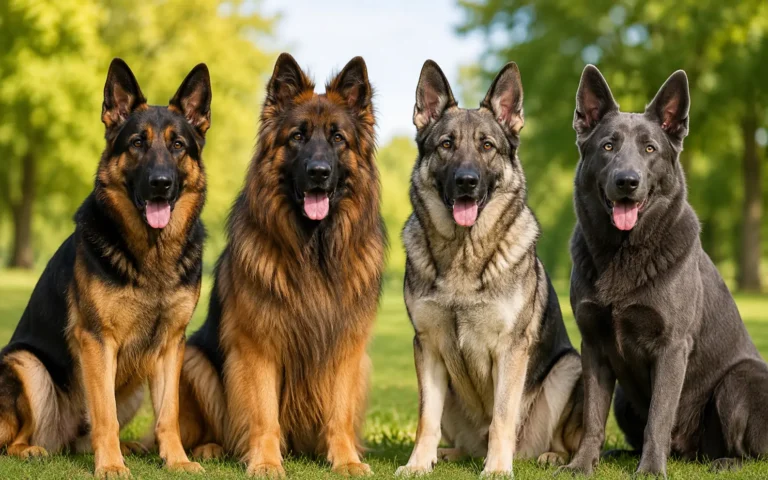
Solid black is a recognised colour in the breed standard, produced by a recessive gene — both parents must carry it. Black and red, black and tan, sable and bi-colour are all likewise standard variations.
Colour carries no health or temperament meaning. Treat a breeder advertising a rare colour at a premium price as a warning sign: money spent on coat colour is money not spent on health testing. Coat colour in puppies also changes considerably — most black-and-tan puppies are born much darker and lighten over the first year.
Health, and what to ask a breeder
The breed has several well-documented predispositions. None of them is a reason to avoid a German Shepherd; all of them are reasons to choose a breeder carefully.
| Condition | What it is | What to ask for |
|---|---|---|
| Hip dysplasia | Malformed hip joint leading to arthritis | Hip scores or an OFA/PennHIP evaluation on both parents |
| Elbow dysplasia | Developmental elbow disease, often bilateral | Elbow grading on both parents |
| Degenerative myelopathy | Progressive spinal cord disease of older dogs | SOD1 DNA test result for both parents |
| Exocrine pancreatic insufficiency | Pancreas stops producing digestive enzymes; the breed is over-represented | Ask whether it has occurred in the line |
| Bloat / gastric torsion | Emergency stomach distension and twisting | Learn the signs; know your nearest out-of-hours vet |
A responsible breeder will offer these results before you ask, let you meet the mother with the litter, and take the dog back at any point in its life. Anyone who will meet you in a car park, has puppies always available, or declines to show the dam is not a breeder you want.
Bloat is the one to memorise now: a swollen or hard abdomen, unproductive retching, drooling, restlessness and collapse. It kills within hours and needs emergency surgery, not a wait-and-see.
German Shepherd mixes
Crosses are common, and the honest summary is that a mix is less predictable than a purebred, not automatically healthier. A first-generation cross inherits from two gene pools; which traits surface varies between littermates. Ask for health testing on both parents exactly as you would for a purebred.
Broadly, crossing with another high-drive working breed such as a Malinois raises the exercise and training demand rather than lowering it. Crossing with a Husky or Australian Shepherd tends to add coat, energy and vocal habits. None of them makes a German Shepherd easier to live with.
If you are still choosing, our guide to 15 dog breeds that look like German Shepherds compares the purebred alternatives and the common crosses side by side.
What it costs
Purchase price varies enormously by country, line and breeder, so any single figure would be misleading. What is consistent is the shape of the spending: the purchase price is a minority of the first year’s cost.
Budget for vaccinations and parasite control, neutering if you choose it, insurance, a crate and bedding sized for an adult, food at large-breed volumes, puppy classes, and a contingency for the emergency vet. A well-bred puppy from health-tested parents costs more up front and usually less over fifteen years.
Frequently asked questions
When is a German Shepherd fully grown? Height is largely set by about 12 months, but chest, muscle and final weight continue developing until two to three years old.
How much should a 6-month-old German Shepherd weigh? Roughly 23–28 kg for males and 20–24 kg for females, though lines vary. Body condition matters more than the number — ask your vet to assess it at a routine visit.
Are black German Shepherds rarer or different? Solid black is recessive, so it appears less often, but it is a standard colour with no bearing on health or temperament. It does not justify a higher price.
When do German Shepherd puppies stop biting? Mouthing usually eases as the adult teeth settle, around five to six months, provided it is consistently redirected onto toys rather than punished.
Can a German Shepherd live in a flat? Yes, if the exercise and mental work actually happen. Space matters far less than routine, and a bored German Shepherd is destructive regardless of floor area.
Should I let my puppy use stairs? Occasional careful stairs are fine. Repeated up-and-down sessions on hard stairs are worth avoiding until the growth plates close.
Final thoughts
German Shepherds have a reputation for being demanding, and it is deserved — but the demand is front-loaded. The work you put into socialisation before fourteen weeks, joint-safe growth in the first year, and an occupied mind throughout is what produces the steady, capable adult the breed is known for.
Get the breeder right, feed for slow growth, and give the brain as much work as the body. The rest follows.
A Note on Pet Health
Serlig publishes researched pet care information for everyday owners. It is general guidance, not veterinary advice, and it does not replace an examination by a licensed veterinarian who knows your pet. If your pet is unwell, or anything in this guide does not match what you are seeing at home, contact your vet.