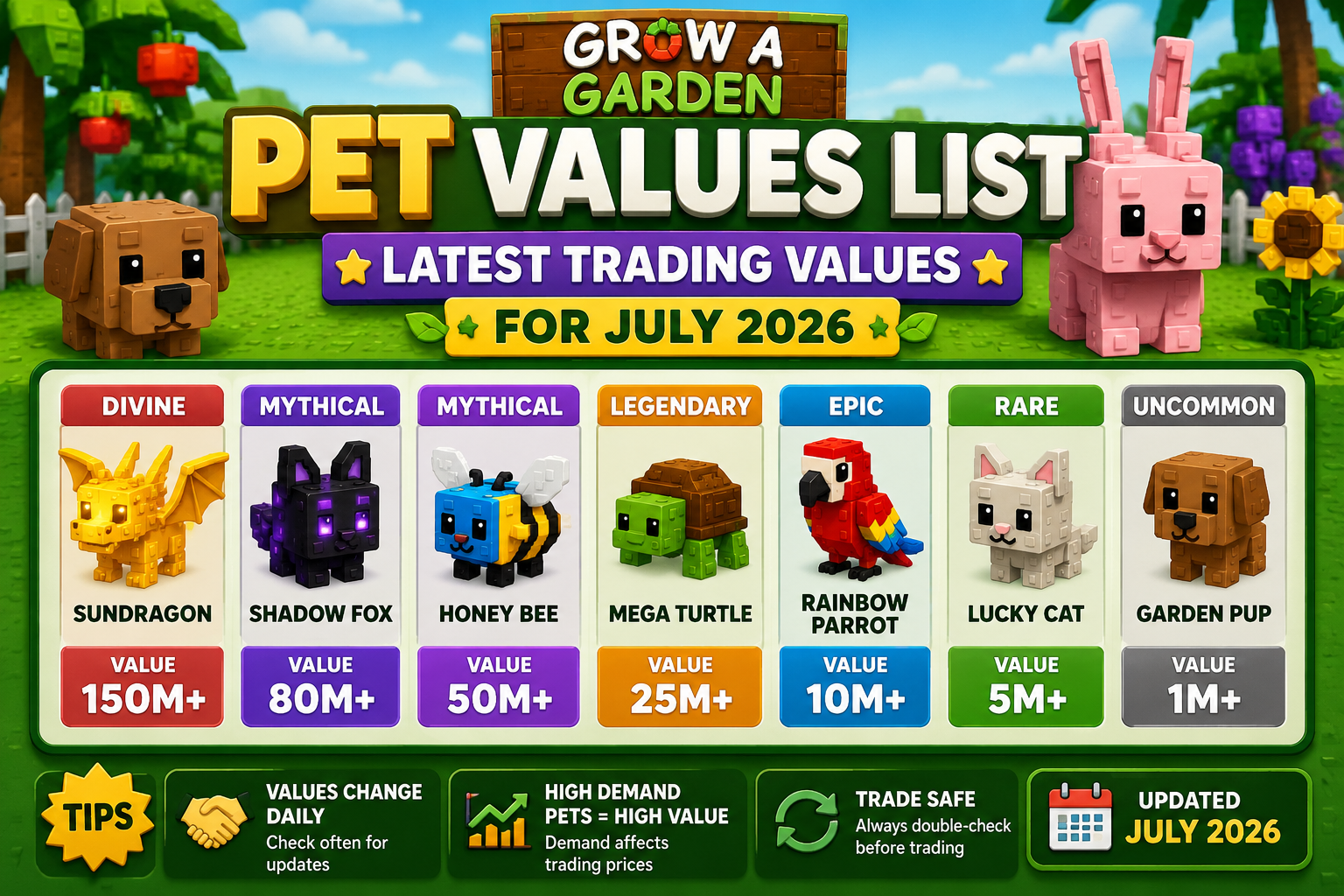
Knowing the latest Grow a Garden pet values can help you avoid unfair trades and understand what your collection is actually worth.
The trading market in Grow a Garden changes regularly. A pet that is highly valuable today may lose value after a new event, egg release, mutation, or game update. Demand can also increase when players discover a useful ability or when a limited pet becomes harder to obtain.
This guide covers the latest pet trading values, the most valuable pets, important value factors, and practical steps for checking whether a trade is fair.
Last updated: July 20, 2026
Important: These are community market estimates, not fixed values published by Roblox or the game developers. Always compare recent trades before accepting an offer.
Quick Grow a Garden Pet Value List
The following table shows some of the most valuable pets in the current Grow a Garden trading market.
| Rank | Pet | Estimated Token Value |
|---|---|---|
| 1 | Water Buffalo | 6,195,000 |
| 2 | Blue Lobster Thermidor | 377,000 |
| 3 | Black Swan | 318,000 |
| 4 | Rainbow Elephant | 243,000 |
| 5 | Calico | 189,000 |
| 6 | Albino Peacock | 87,750 |
| 7 | Rainbow Griffin | 63,750 |
| 8 | Rainbow Chinchilla | 58,750 |
| 9 | Ghostly Mummy | 51,250 |
| 10 | Rainbow Phoenix | 47,500 |
| 11 | Rainbow Krampus | 47,250 |
| 12 | Rainbow New Years Dragon | 42,000 |
| 13 | Rainbow Spinosaurus | 42,000 |
| 14 | Giant Scorpion | 38,250 |
| 15 | Rainbow Bearded Dragon | 36,750 |
| 16 | Wind Wyvern | 36,500 |
| 17 | Festive Ice Golem | 36,250 |
| 18 | Galah Cockatoo | 35,000 |
| 19 | Ghostly Black Cat | 30,500 |
| 20 | GIANT Swan | 27,750 |
At the time of this update, Water Buffalo sits far above most other pets in estimated token value. Blue Lobster Thermidor, Black Swan, Rainbow Elephant, and Calico also occupy the highest part of the market.
Popular Grow a Garden Pet Values
Not every player owns an ultra-rare or giant pet. The table below includes several more commonly discussed pets and their approximate base values.
| Pet | Estimated Token Value |
|---|---|
| Disco Bee | 370 |
| Rainbow Hydra | 320 |
| Krampus | 220 |
| Goblin Miner | 200 |
| Fennec Fox | 170 |
| Luminous Sprite | 160 |
| French Fry Ferret | 160 |
| Frost Dragon | 160 |
| Chimera | 100 |
| Shroomie | 100 |
| Spinosaurus | 95 |
| Queen Bee | 85 |
| Phoenix | 75 |
| Ruby Squid | 70 |
| Brontosaurus | 65 |
| Hydra | 65 |
| Griffin | 50 |
| Lion | 50 |
| T-Rex | 40 |
| Mimic Octopus | 35 |
| Golden Goose | 35 |
| Headless Horseman | 25 |
| Silver Dragonfly | 20 |
| Arctic Fox | 16 |
| Dragonfly | 10 |
| Corrupted Kitsune | 10 |
These figures should be treated as starting points rather than guaranteed prices. The exact version, weight, mutation, availability, and buyer demand can produce a very different final offer.
What Are Grow a Garden Pet Values?
A pet value is an estimate of what other players may be willing to offer for a pet.
Pet value is different from the amount shown in the game’s interface. The displayed Sheckle value may help players understand an item’s basic worth, but trading communities also consider rarity, demand, mutations, weight, abilities, and recent trading activity.
Because there is no permanent official market price for every pet, most value lists are based on:
- Recent player trades
- Community demand
- Pet rarity
- Limited availability
- Egg hatch difficulty
- Pet abilities
- Pet weight and age
- Mutations and variants
- Recent game updates
Community trading platforms commonly combine listed values with demand signals and recent market activity. This means demand may change faster than a pet’s published base value.
What Determines a Pet’s Value?
1. Rarity
Rarity is one of the first factors traders examine. A pet that is difficult to hatch, craft, or obtain from an event will usually receive stronger offers.
However, rarity alone does not guarantee a high value. A lower-rarity pet with strong demand, unusual weight, or a useful ability may trade better than an unpopular high-rarity pet.
2. Demand
Demand measures how strongly players currently want a particular pet.
High demand makes a pet easier to trade. It may also allow the owner to request an overpay. Low-demand pets can be difficult to exchange even when their estimated numerical value appears high.
Current high-demand pets include variants such as Rainbow Elephant, Ghostly Mummy, and Rainbow New Years Dragon.
3. Pet Weight
Weight is one of the most important details to check before trading.
Pet weight increases as a pet ages, and heavier versions may be worth significantly more than freshly hatched versions of the same pet. The Grow a Garden community also uses weight classes and checkpoints when comparing pets.
Never compare a heavy, aged, giant, or unusually large pet directly with a basic 1 kg version.
4. Mutations and Variants
Mutations can increase a pet’s desirability and trading value.
Rainbow, Ghostly, Giant, Diamond, Gilded, Festive, and other special variants often trade separately from their standard versions. A Rainbow Phoenix, for example, should not be valued as if it were an ordinary Phoenix.
Always check the full pet name before accepting a trade. A small difference in the variant name can represent a large difference in value.
5. Limited Availability
Pets from expired eggs, seasonal events, or discontinued rewards may become more valuable because new copies are no longer entering the market.
Limited status does not always result in immediate value growth. The pet must also have enough collector demand. A discontinued but unpopular pet may remain difficult to trade.
6. Pet Ability
Some players trade for performance rather than appearance or rarity.
Pets with abilities that improve crop growth, mutations, egg hatching, cooldowns, or garden profits may attract more buyers. Changes to an ability can quickly affect demand.
7. New Updates
New eggs and event pets often begin with unstable values.
Early owners may receive large offers because supply is low. The value may decline once more players hatch the pet. In other cases, a pet’s value can rise after players recognize that its ability is stronger than expected.
How to Check Whether a Trade Is Fair
Use the following process before confirming a trade.
Check the Exact Pet Version
Confirm the complete name of the pet, including:
- Standard or Rainbow
- Normal or Giant
- Mutation
- Weight
- Age
- Event version
- Special prefix
Do not judge the offer from the pet’s base name alone.
Compare Both Sides Using One Value System
Different lists may use tokens, Sheckles, demand scores, or comparable pets.
Choose one current value source and calculate both sides with the same method. Mixing Sheckle values from one list with token values from another can produce an inaccurate result.
Consider Demand, Not Just Total Value
Suppose both sides are worth 1,000 tokens. One side contains a single high-demand pet, while the other contains several low-demand pets.
Although the numerical totals are similar, the high-demand pet will probably be easier to trade. The owner of the stronger-demand pet may reasonably expect a small overpay.
Review Recent Trades
Value lists can fall behind fast market changes. Check what players have actually accepted in recent trades, especially when dealing with:
- Newly released pets
- Event pets
- Mutated pets
- Giant pets
- Very heavy pets
- Pets with recently changed abilities
Avoid Pressure Trades
Do not accept an offer merely because the other player says it will disappear immediately.
Take time to verify the items. A legitimate trader should allow you to inspect the offer before confirming it.
Understanding Win, Fair, and Lose Trades
Grow a Garden players often describe trades as W, F, or L.
Win Trade
A win means the items you receive are worth noticeably more than the items you give.
A small numerical win may not be a true win when the received pets have very low demand.
Fair Trade
A fair trade means both sides have similar value and comparable demand.
Some calculators treat an offer within approximately five percent of the other side as fair, although community preferences may vary.
Lose Trade
A lose means you give more value than you receive.
An apparent loss may still make sense when you are upgrading several difficult-to-trade pets into one highly desirable pet. This is sometimes called paying an upgrade fee.
How Trading Works in Grow a Garden
Grow a Garden uses an in-game trading system designed to help players exchange pets and harvested crops.
Players use a Trading Ticket obtained from the Gear Shop. Up to 13 items can be included in one trading cycle. The interface displays information about the added items and starts a confirmation countdown.
When an item is removed, the countdown resets. This helps prevent a player from changing the offer at the last moment without giving the other person time to notice.
Only pets and harvested crops can be traded through this system. Accounts younger than 10 days are not permitted to trade.
Safe Trading Tips
Protect your account and pets by following a few basic rules:
- Use the official in-game trading interface.
- Inspect every item before confirming.
- Recheck the offer after the countdown resets.
- Do not share passwords or login codes.
- Avoid trust trades.
- Avoid deals requiring payment outside the game.
- Confirm weight, age, mutation, and variant.
- Take screenshots of valuable trades.
- Compare demand as well as numerical value.
- Decline offers that feel rushed or unclear.
A value list is useful, but it cannot protect you from every scam. Careful inspection remains the most important step.
Best Pets to Trade in Grow a Garden
The best pet for trading is not always the pet with the highest listed number.
A strong trading pet usually combines:
- High demand
- Limited supply
- Recognizable rarity
- Useful ability
- Stable market value
- Easy resale
Water Buffalo currently has the highest estimated token value in the referenced market list. Rainbow Elephant, Ghostly Mummy, and Rainbow New Years Dragon are also identified as high-demand pets.
For most players, a slightly lower-value pet with strong demand can be more useful than a higher-value pet nobody wants to trade for.
Why Grow a Garden Pet Values Change
Pet values can rise or fall because of:
- New eggs entering the game
- Limited events ending
- Ability buffs or nerfs
- Increased hatch supply
- New mutations
- Community trends
- Duplication concerns
- Changes in trading demand
- New pets replacing older strategies
For example, a new pet may receive very high offers during its first few hours because only a small number exist. Its value can fall sharply after thousands of players begin hatching the same egg.
This is why every Grow a Garden value list should display a visible update date.
Frequently Asked Questions
What is the most valuable pet in Grow a Garden?
Water Buffalo is currently listed as the most valuable pet, with an estimated value of approximately 6.195 million tokens in the July 2026 market snapshot. Values can change after new trades and updates.
Are Grow a Garden pet values official?
No. Most trading values are community estimates. Roblox and the game developers do not publish a permanent official trading price for every pet.
Does pet weight affect trading value?
Yes. Heavier and older pets may be worth considerably more than basic versions of the same species. Check the exact weight before comparing two pets.
Are Rainbow pets worth more?
Rainbow pets often trade for more because they are special variants. Their exact value still depends on the pet, weight, supply, and current demand.
What does demand mean in a pet value list?
Demand represents how strongly players want a pet. High-demand pets are usually easier to trade and may receive overpay offers.
Why do different value lists show different prices?
Each value list may use different trade samples, currencies, calculation methods, and update schedules. Compare several recent trades instead of relying on one number alone.
Can new Roblox accounts trade in Grow a Garden?
According to the Grow a Garden community wiki, accounts less than 10 days old cannot use trading, although they may still be able to gift or receive gifts.
How many items can be traded at once?
The trading system allows players to include up to 13 items in one trade cycle.
What is a fair trade in Grow a Garden?
A fair trade has similar value and demand on both sides. Weight, mutations, abilities, and ease of resale should also be considered.
How often should a pet value list be updated?
A value list should be checked after major game updates, egg releases, events, and market changes. Fast-moving or newly released pets may require much more frequent updates.
Final Thoughts
The latest Grow a Garden pet values provide a useful starting point, but no list can guarantee the exact offer another player will accept.
Before trading, confirm the pet’s complete name, weight, mutation, variant, demand, and recent market activity. Use the in-game trading interface, review both sides carefully, and avoid rushed offers.
The strongest trades are not based on numbers alone. A fair deal should also consider demand, availability, usefulness, and how easily each pet can be traded again.