German Shepherds are highly intelligent working dogs that require structured training to thrive. Without proper GSD obedience training, their sharp minds easily succumb to boredom, which often leads to destructive behavior, anxiety, or aggression. Training provides the mental stimulation they crave while establishing you as the clear leader.
If you live in a busy environment, early and consistent training is absolutely crucial. German Shepherds need clear guidance to stay calm in crowded streets or around stray animals. By establishing a foundation of obedience, you ensure your dog remains focused on you regardless of environmental distractions. Puppy socialization paired with positive reinforcement sets the stage for a well-adjusted adult dog.
The Quick Answer: 5 Essential Commands
- Sit: Establishes baseline focus and stops unwanted jumping.
- Stay: Prevents impulsive reactions to sudden distractions or prey.
- Come (Recall): Ensures absolute safety when your dog is off-leash.
- Down: Puts the dog in a relaxed posture, ideal for long durations.
- Heel: Keeps the dog by your side during walks and manages leash pressure.
The GSD Mindset: A History of Hard Work
German Shepherds think differently than companion breeds because they were originally bred for complex, demanding pastoral work. This working breed intelligence means they need a job to do. When you do not provide a task, they will invent one, which usually involves guarding the front window or chewing your furniture.
Their strong prey drive and natural protective instincts require a handler who understands how to channel that energy. You must establish leadership calmly and consistently. This does not mean using harsh punishments. Instead, it requires firm boundaries and clear communication.
By utilizing positive reinforcement, you teach your dog that following your commands is the most rewarding choice they can make. Focus exercises, like teaching your dog to make eye contact before receiving meals, help bridge the gap between their natural instincts and your expectations.
The 5 Essential Commands
Teaching German Shepherd training commands requires patience, timing, and consistency. Below is a breakdown of the foundational commands, complete with hand signals for dogs to improve communication.
Command vs. Hand Signal Summary
| Command | Hand Signal | Purpose |
|---|---|---|
| Sit | Palm facing up, lifting slightly. | Pauses the dog’s movement. |
| Stay | Open palm facing the dog, like a “stop” sign. | Holds the dog in a specific position. |
| Come | Hand sweeping toward your chest. | Recalls the dog to your side. |
| Down | Index finger pointing directly to the ground. | Relaxes the dog in a prone position. |
| Heel | Tapping your left hip or thigh. | Keeps the dog walking by your side. |
1. Sit
The “Sit” command is your baseline for all obedience work. It requires the dog to pause, look at you, and wait for the next instruction.
Step-by-step method:
- Hold a treat close to your dog’s nose. Use a small, soft, high-value treat for maximum engagement.
- Move your hand up and slightly backward over their head.
- As their head tilts up to follow the treat, their bottom will naturally lower to the ground.
- The moment their hindquarters touch the floor, say “Sit” and immediately give them the treat.
- Repeat this process until the dog sits without the treat lure.
Common mistake: Repeating the word “Sit” multiple times. If you say “Sit, sit, sit,” the dog learns that the command is a suggestion rather than an absolute directive. Say it once, wait for compliance, and assist if necessary.
Hand signal: Hold your hand out with your palm facing up, then lift your hand upward in a smooth motion.
2. Stay
The “Stay” command teaches impulse control. It requires your dog to remain completely stationary until you give a release word, such as “Free” or “Okay.”
Step-by-step method:
- Ask your dog to get into a “Sit” or “Down” position.
- Open your palm toward the dog and firmly say “Stay.”
- Take one single step backward. If the dog holds the position, immediately step forward, praise them, and offer a treat.
- Gradually increase the number of steps you take away from the dog over several training sessions.
- Introduce a release word so the dog knows when the exercise is over.
Common mistake: Pushing the dog too fast. Owners often try to walk 10 feet away on the first day, causing the dog to break the position. Build distance and duration slowly.
Hand signal: An open palm facing the dog, resembling a universal “stop” gesture.
3. Come (Recall)
The recall is the single most important safety command you will ever teach. It ensures your dog returns to you immediately, bypassing stray animals, traffic, or other dogs.
Step-by-step method:
- Put your dog on a long training leash inside a quiet, enclosed area.
- Let the dog wander slightly away from you.
- Call their name followed by an enthusiastic.
- Gently guide them toward you using light leash pressure if they hesitate.
- When they reach you, reward them heavily with verbal praise and high-value treats.
Common mistake: Punishing the dog after they come to you. Even if it took them five minutes to return, you must always make a positive experience. If you yell at them upon arrival, they will avoid coming to you next time.
Hand signal: Extend your arm outward and sweep your hand inward toward your chest.
4. Down
The “Down” command puts your German Shepherd in a relaxed, settled posture. This is highly effective for settling the dog down when guests arrive or when you are eating dinner.
Step-by-step method:
- Ask your dog to “Sit.”
- Hold a treat in your closed hand and place it right in front of the dog’s nose.
- Move your hand straight down to the floor, then slowly drag it along the ground toward yourself.
- The dog will slide their front legs forward to follow the treat.
- Once their elbows and belly touch the ground, say “Down” and release the treat.
Common mistake: Pushing down on the dog’s back to force them into position. This triggers resistance and can damage trust. Always lure the dog into the position voluntarily.
Hand signal: Point your index finger directly toward the ground with a firm downward motion.
5. Heel
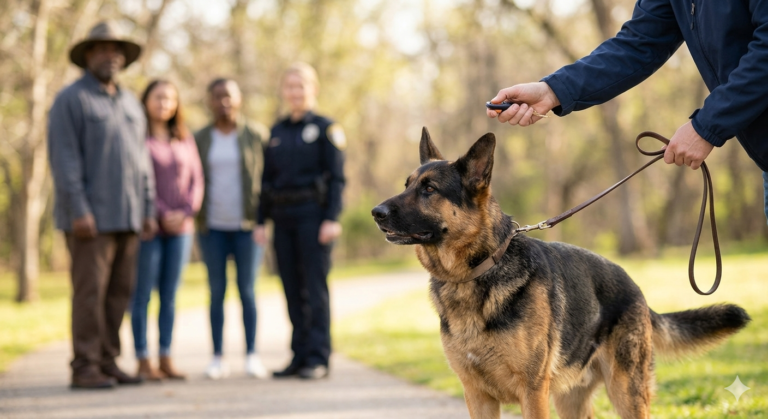
The “Heel” command teaches your dog to walk politely by your side, transforming stressful walks into enjoyable outings. A strong heel is vital for safely navigating crowded streets.
Step-by-step method:
- Start with your dog sitting at your left side, using a sturdy, well-fitted leash that gives you control over a strong working breed.
- Hold a treat in your left hand near your hip.
- Say “Heel” and step forward with your left foot first.
- Keep the treat visible to keep the dog’s attention on your hip.
- Stop walking after a few paces. Ask the dog to “Sit” again, then reward them.
Common mistake: Allowing tension on the leash. If the dog pulls, stop walking immediately. Never drag the dog back to your side; wait for them to release the leash pressure and return to you before continuing.
Hand signal: Tap your left hip or thigh to indicate where the dog should position their head.
Training Schedule: Consistency Over Duration
You should train your German Shepherd for 15 to 20 minutes a day, broken into several short sessions. Short, highly focused training intervals are far more effective than hour-long drills.
Puppies have incredibly short attention spans. Three five-minute sessions spread throughout the day keep the dog engaged without causing frustration. For adult dogs, keeping sessions under 15 minutes ensures they end the workout wanting more, rather than feeling exhausted. Always end the training session on a positive note with a command you know the dog can execute perfectly.
Advanced Tips for Mental Stimulation
You can provide profound mental stimulation for your GSD by introducing scent games, agility drills, and advanced obedience circuits. German Shepherds thrive when forced to use their noses and solve problems.
Hide their favorite toy or a treat in another room and command them to “Find it.” This taps directly into their working instincts. You can also practice commands in highly distracting environments. Once your dog masters “Sit” in the living room, ask them to do it at a busy park. This proofs the behavior and solidifies their obedience regardless of external chaos. The same consistency helps with problem behaviors, including unwanted barking at strangers.
Frequently Asked Questions
At what age should I start training?
You should start training your German Shepherd the moment you bring them home, usually around 8 weeks of age. Early puppy socialization and basic command training set the foundation for a well-behaved adult dog.
Are German Shepherds hard to train?
German Shepherds are generally easy to train because of their high intelligence and eagerness to please. However, their intelligence means they learn bad habits just as quickly as good ones, requiring owners to be highly consistent and firm in their methods.
What if my GSD doesn’t listen?
If your German Shepherd ignores commands, evaluate your training environment and your reward system. Move to a quieter area with fewer distractions, and ensure you are offering high-value rewards that motivate the dog to pay attention to you rather than their surroundings.
Building a Lifelong Bond Through Obedience
Training a German Shepherd requires commitment, but the payoff is immense. By mastering these five basic commands, you establish a communication system that keeps your dog safe, well-mannered, and mentally fulfilled. Grab a handful of high-value treats, attach a sturdy leash, and start your first five-minute session today. A well-trained German Shepherd is not just a pet; they are a loyal, dependable partner for life.