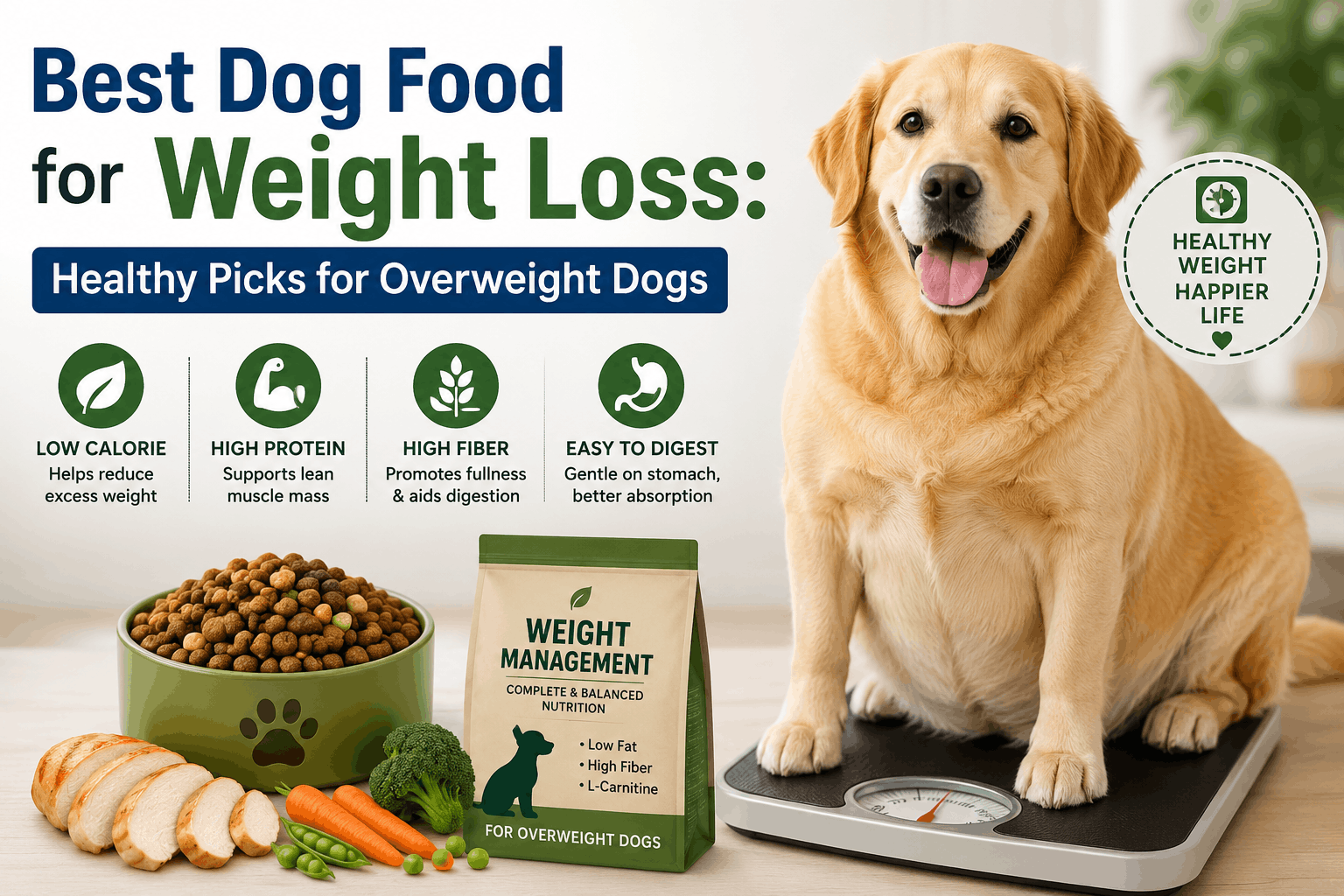
If your dog has been gaining weight, you are not alone, and you are not a bad owner. Most extra pounds creep on slowly through a few too many treats, smaller daily walks, a slowing metabolism, or a food that is simply higher in calories than your dog needs. The good news is that the best dog food for weight loss can make a real difference: the right reduced-calorie formula helps your dog feel full, holds onto lean muscle, and supports healthy digestion while the fat comes off gradually.
This guide explains how to choose a healthy weight dog food, what ingredients matter, how much to feed, and how to switch foods safely. A quick note before we start: weight loss should always be slow and steady. If your dog is severely overweight or has diabetes, joint disease, heart disease, or any other medical condition, talk to your veterinarian before changing the diet. Excess weight is more common than most owners realize. The Association for Pet Obesity Prevention has reported that roughly 59% of U.S. dogs are overweight or have obesity, and a large veterinary study of nearly five million dogs found more than half of adult dogs carry excess body condition.
Quick Answer: What Is the Best Dog Food for Weight Loss?
The best dog food for weight loss is a complete and balanced, reduced-calorie formula with high-quality protein, moderate fiber, and controlled fat, plus clear feeding guidelines. It should help your dog feel full while protecting lean muscle and supporting healthy digestion, and it should suit your dog’s age, size, and health.
Below, we cover why dogs gain weight, how to read a label, the best weight management dog food by category, dry vs wet food, ingredients to look for and avoid, portion sizes, a safe transition plan, and answers to the questions owners ask most.
Why Do Dogs Gain Weight?
Weight gain is usually the result of more calories going in than the body burns. Several everyday factors stack up:
- Overfeeding: guessing portions or topping up the bowl
- Too many treats: even small biscuits add up fast over a day
- Lack of exercise: fewer walks or less active play
- Age-related slow metabolism: older dogs burn fewer calories
- Neutering or spaying: which can lower energy needs
- Calorie-dense, low-quality food: a lot of calories in a small scoop
- Medical issues: such as hypothyroidism (worth a vet check)
- Table scraps: human food is often far richer than dog food
None of this means you have failed your dog. It simply means the calorie math has drifted, and that is something you can adjust.
How to Choose the Best Dog Food for Weight Loss
This is the part that matters most. A good weight loss dog food does more than cut calories.
Look for Controlled Calories
Weight loss happens when calorie intake is managed against what your dog burns. Check the calorie content (kcal per cup or per can) and the feeding guidelines on the bag, then adjust based on your dog’s size, age, activity level, and your vet’s advice. The label is a starting point, not a fixed rule.
Choose High-Quality Protein
Protein is the priority in any high protein dog food for weight loss because it helps maintain lean muscle while your dog sheds fat. Look for a named animal protein near the top of the ingredient list, such as chicken, turkey, salmon, lamb, egg, or a clearly named fish meal.
Prioritize Fiber for Fullness
Fiber adds bulk and helps dogs feel satisfied between meals, which makes a calorie-controlled diet easier to live with. Helpful sources include pumpkin, brown rice, peas, oats, barley, beet pulp, and sweet potato.
Avoid Empty Calories
Steer clear of formulas loaded with cheap fillers, added sugar, artificial flavors, and excessive fat. These add calories without doing much for nutrition or fullness.
Check for Complete and Balanced Nutrition
A low calorie dog food still needs to deliver every essential nutrient. Look for an AAFCO statement on the label confirming the food is “complete and balanced” for your dog’s life stage. Fewer calories should never mean fewer nutrients.
Best Dog Food for Weight Loss by Category
The right pick depends on your dog. Below are honest category guides built around real, widely available product lines. Always confirm current calorie content and feeding guidelines on the package, and ask your vet before starting a therapeutic (prescription) diet.
Best Overall Dog Food for Weight Loss
Best for: Most overweight adult dogs in otherwise good health.
A balanced over-the-counter weight management formula such as Hill’s Science Diet Perfect Weight or Royal Canin Weight Care fits the majority of adult dogs. These come from established brands that employ veterinary nutritionists and run feeding trials.
- Pros: Reduced calories, complete and balanced, widely available, research-backed brands.
- Cons: Still requires accurate portioning; some dogs prefer different flavors or textures.
- Key features: Controlled calories, quality protein, added fiber for satiety.
Best Dry Dog Food for Weight Loss
Best for: Owners who want easy portion control and convenient storage.
The best dry dog food for weight loss makes measuring simple. Options like Purina Pro Plan Weight Management or the budget-friendly Purina ONE Healthy Weight offer calorie-controlled kibble you can portion precisely with a cup or scale.
- Pros: Easy to measure, affordable, long shelf life, good for scheduled feeding.
- Cons: Lower moisture; some dogs eat dry food quickly (a slow feeder helps).
- Key features: Defined kcal per cup, balanced macros, satiety-focused fiber.
Best Wet Dog Food for Weight Loss
Best for: Picky eaters, senior dogs, and dogs who seem hungry on kibble alone.
The best wet dog food for weight loss uses high moisture to add volume without many calories, which can help a dog feel fuller. Look for a reduced-calorie canned formula from a reputable brand.
- Pros: High moisture, can feel more filling, palatable, soft texture.
- Cons: Costs more per serving, shorter fridge life once opened, harder to free-feed.
- Key features: Lower calorie density, named protein, clear per-can calorie count.
Best Dog Food for Small Dogs to Lose Weight
Best for: Toy and small breeds carrying extra weight.
The best dog food for small dogs to lose weight uses smaller kibble that is easier to chew and accounts for a faster small-breed metabolism. Small-breed weight management formulas are ideal because tiny dogs need precise, modest portions.
- Pros: Right-sized kibble, calorie control suited to small frames.
- Cons: Very small portions can look “not enough” trust the math, not the eye.
- Key features: Small-breed sizing, controlled calories, quality protein.
Best Dog Food for Large Breed Weight Loss
Best for: Big dogs where extra weight stresses the joints.
The best dog food for large breed weight loss pairs calorie control with joint support. Look for a large-breed weight formula that includes glucosamine and chondroitin alongside lean protein.
- Pros: Joint-friendly nutrients, muscle-supporting protein, controlled calories.
- Cons: Larger bags must be stored well to stay fresh.
- Key features: Joint support, omega fatty acids, calorie management.
Best Dog Food for Senior Dogs to Lose Weight
Best for: Older, less active dogs that have slowed down.
The best dog food for senior dogs to lose weight accounts for lower activity, supports joints and digestion, and protects muscle mass, which naturally declines with age. A senior weight management formula balances all of this.
- Pros: Senior dog nutrition, joint and digestive support, muscle maintenance.
- Cons: Some seniors are fussy, wet food or warming can boost appeal.
- Key features: Moderate calories, easy digestibility, joint and omega support.
Best Grain-Free Dog Food for Weight Loss
Best for: Dogs with a vet-confirmed grain sensitivity.
The best grain free dog food for weight loss is only worth choosing if your dog actually needs it. Grain-free is not automatically healthier or lower in calories, many grain-free foods are calorie-dense, and most dogs digest grains well. Choose based on calories and balance, not the label trend.
- Pros: Useful for genuine grain sensitivities.
- Cons: Not lower-calorie by default; discuss with your vet.
- Key features: Alternative carbs (peas, sweet potato), named protein, controlled calories.
Best Dog Food for Sensitive Stomach and Weight Loss
Best for: Dogs that need to lose weight but get upset stomachs easily.
A weight management dog food for sensitive stomach leans on limited, gentle, highly digestible ingredients plus fiber and often probiotics. Some therapeutic diets, like Royal Canin Satiety Support or Hill’s Prescription Diet Metabolic, target both weight and digestive needs but require veterinary authorization.
- Pros: Gentle on digestion, supports gut health while cutting calories.
- Cons: Prescription options need a vet; limited-ingredient diets can cost more.
- Key features: Digestible protein, prebiotics/probiotics, balanced fiber.
Dry vs Wet Dog Food for Weight Loss: Which Is Better?
Neither is automatically better, the right choice depends on your dog and your routine.
Dry food benefits:
- Easy, precise portion control
- Usually more affordable
- Convenient storage and shelf life
- Great for scheduled feeding
Wet food benefits:
- Higher moisture content
- Can feel more filling for hungry dogs
- Often more appealing to picky eaters
- Softer texture for seniors or dental issues
Many owners get the best of both by feeding measured kibble and mixing in a spoonful of wet food for flavor and moisture. Whatever you choose, the deciding factors are total calories, complete nutrition, your dog’s preference, and your vet’s guidance.
Ingredients to Look for in Weight Loss Dog Food
- Lean animal protein: chicken, turkey, fish, lamb, egg
- Moderate fiber: for fullness and digestive health
- Controlled fat: enough for health, not excess calories
- Complex carbohydrates: brown rice, oats, barley, sweet potato
- Omega-3 and omega-6 fatty acids: for skin, coat, and joints
- Probiotics or prebiotics: to support digestive health
- L-carnitine: an amino acid that helps the body use fat for energy and supports muscle maintenance, included in many weight management formulas
- Vitamins and minerals: for complete and balanced nutrition
- Joint-support ingredients: glucosamine and chondroitin for large or senior dogs
Ingredients to Avoid in Dog Food for Weight Loss
- Excessive fat that drives up calories
- Added sugars and sweeteners
- Heavy use of artificial colors or flavors
- Vague “meat by-products” with no transparency about the source
- High-calorie fillers offering little nutrition
- Too many treats fed outside the main diet
- Human leftovers and table scraps
There is no need to fear every unfamiliar ingredient, focus on transparency, calorie density, and overall balance rather than chasing a “perfect” label.
How Much Food Should You Feed an Overweight Dog?
Portion size is where most weight loss plans succeed or stall. The right amount depends on:
- Current weight and ideal (target) weight
- Breed and breed size
- Age
- Activity level
- The food’s calorie density (kcal per cup or can)
- Any health conditions
Use a proper measuring cup or, better still, a kitchen scale, eyeballing portions is the most common reason a diet fails. Start from the feeding guideline for your dog’s target weight, not its current weight, and adjust based on results and vet advice. Crucially, count treats as part of the daily calories: as a rule of thumb, treats should make up no more than about 10% of daily intake.
How to Transition Your Dog to Weight Loss Food
Switching foods too fast can upset your dog’s stomach. Spread the change over about a week:
Day 1–2
75% old food + 25% new food
Day 3–4
50% old food + 50% new food
Day 5–6
25% old food + 75% new food
Day 7
100% new food
Dogs with sensitive stomachs may need a slower transition over 10 to 14 days. If you notice ongoing digestive upset, slow down and check with your vet.
Common Mistakes Dog Owners Make During Weight Loss
- Cutting food too aggressively, which can cause hunger, stress, and muscle loss
- Giving too many treats, including “just one” too often
- Not measuring food and relying on guesswork
- Ignoring exercise and relying on diet alone
- Switching foods too quickly
- Expecting instant results instead of gradual change
- Skipping the vet when there is a medical issue behind the weight
- Feeding multiple dogs together so portions can’t be monitored
How to Support Dog Weight Loss Beyond Food
Food is only half of the picture. Pair the right diet with:
- Daily walks: build up duration and pace gradually
- Playtime: fetch, tug, and active games
- Puzzle feeders and slow bowls: to slow eating and add enrichment
- Controlled treats: swap biscuits for green beans, carrots, or kibble counted from the daily ration
- Regular weigh-ins: track progress every two to four weeks
- Vet checkups: to confirm the plan is working safely
- A consistent routine: same meals, same times, every day
Expert Tips for Choosing Safe Weight Management Dog Food
To choose a vet recommended dog food for weight loss with confidence:
- Choose by calories, not marketing. “Lite,” “healthy,” and “natural” are not regulated promises, check the kcal and the AAFCO statement.
- Insist on complete and balanced nutrition for your dog’s life stage.
- Prefer transparent labels with named protein sources.
- Match the food to your dog’s age and breed size, since a small senior and a young large breed have very different needs.
- Ask your vet first if your dog has any health condition.
- Track progress every two to four weeks and adjust portions as needed.
- Avoid crash dieting. Safe loss is gradual, many vets aim for roughly 1–2% of body weight per week, guided by a body condition score.
FAQs About the Best Dog Food for Weight Loss
What is the best dog food for weight loss?
The best dog food for weight loss is a complete and balanced, reduced-calorie formula with high-quality protein, moderate fiber, and controlled fat. It should keep your dog feeling full, protect lean muscle, and suit your dog’s age, size, and health. Confirm calories on the label and check with your vet.
Is wet or dry dog food better for weight loss?
Neither is automatically better. Dry food makes portion control easy and is more affordable, while wet food adds moisture that can feel more filling. The best choice depends on your dog’s preference, total calories, and your feeding routine. Many owners successfully combine both in measured amounts.
How fast should my dog lose weight?
Weight loss should be slow and steady. Many veterinarians aim for around 1–2% of body weight per week. Rapid loss can be unsafe and cause muscle loss. Weigh your dog every two to four weeks, adjust portions as needed, and let your vet guide the target.
Can I give treats while my dog is losing weight?
Yes, in moderation. Treats should stay within about 10% of daily calories and be counted toward the daily total, not added on top. Low-calorie options like carrots, green beans, or a few pieces of the dog’s own kibble work well during a diet.
Should I consult a vet before using weight loss dog food?
Yes, especially if your dog is significantly overweight or has any health condition such as diabetes, joint disease, or heart disease. Your vet can confirm a healthy target weight, rule out medical causes, and recommend a therapeutic diet if one is needed. A quick checkup makes the plan safer and more effective.
Is grain-free dog food good for weight loss?
Grain-free is not automatically better for weight loss. Many grain-free foods are just as calorie-dense as those with grains, and most dogs digest grains well. Grain-free is mainly useful for dogs with a confirmed grain sensitivity. Choose any food based on calories and balance rather than the grain-free label alone.
Final Verdict: What Is the Best Dog Food for Weight Loss?
The best dog food for weight loss is a complete and balanced, lower-calorie formula that is rich in quality protein, includes moderate fiber for fullness, and matches your dog’s age, size, and health. Dry food makes portioning easy, wet food adds satisfying moisture, and senior, small-breed, large-breed, and sensitive-stomach dogs each benefit from a formula tuned to their needs. Whatever you choose, success comes down to accurate portions, counted treats, regular movement, and patience.
Choose a healthy weight management formula, follow proper portions, weigh your dog regularly, and speak with your veterinarian if your dog needs a personalized weight loss plan. With a steady, safe approach, a leaner, healthier, and happier dog is well within reach.